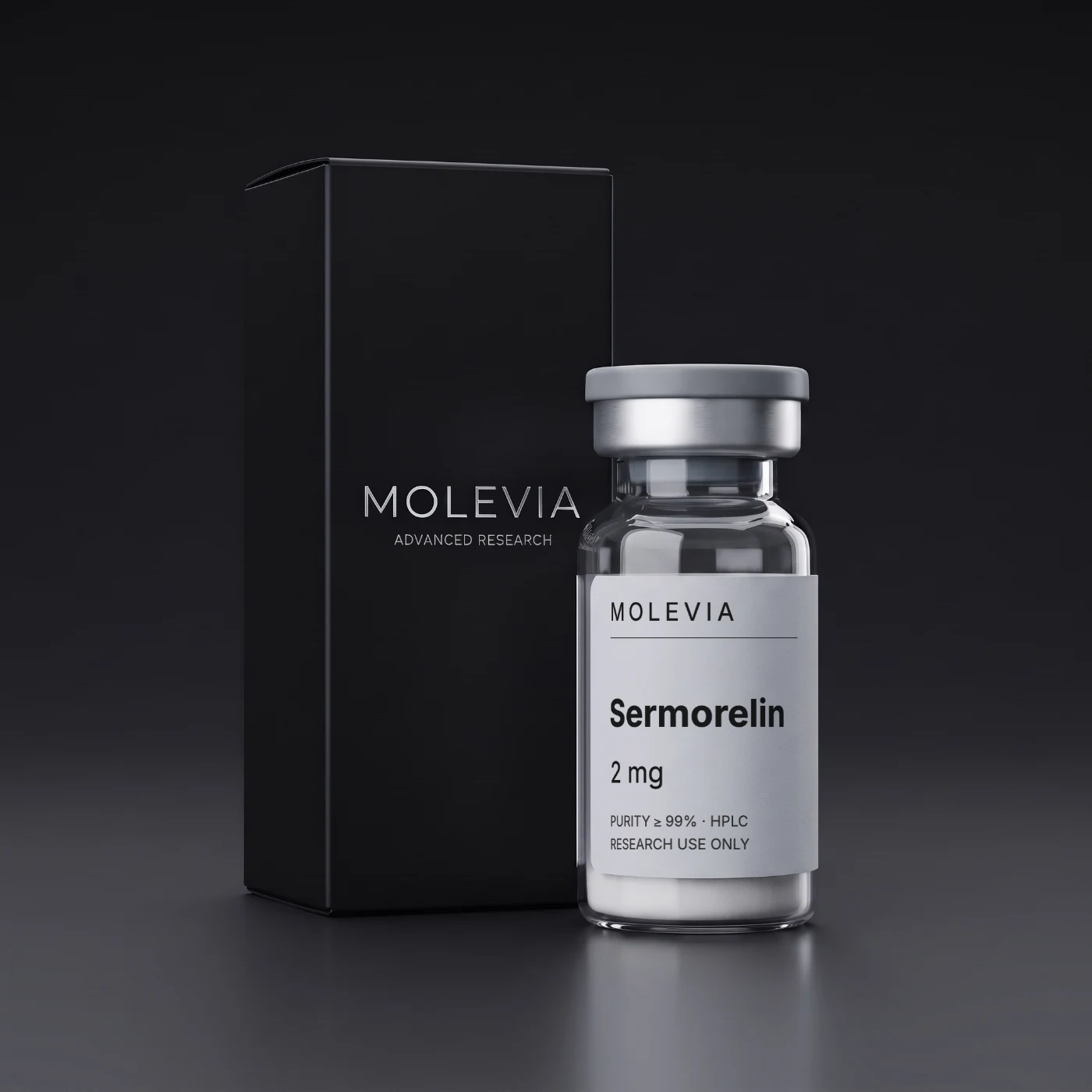
Sermorelin: research overview
What is sermorelin
Sermorelin is a synthetic peptide built from 29 amino acid residues. It corresponds to the first 29 residues of growth hormone releasing hormone (GHRH), the hypothalamic peptide that controls growth hormone (GH) release from the pituitary gland. This fragment retains the biological activity of the full GHRH molecule, which is why sermorelin has long been a well-documented compound in the literature on the GH axis.
The C-terminal end of the molecule is amidated, and the complete sequence is described in detail in published work on endocrinology and peptide biochemistry.
How the mechanism is described in research
Sermorelin binds the GHRH receptor on somatotroph cells of the anterior pituitary. In research models, this binding activates a cAMP-dependent signalling pathway and triggers GH release in a pattern that resembles physiological, pulsatile secretion.
In vitro studies on pituitary cell cultures have reported increased cAMP signalling after exposure to the peptide. Animal model studies have described changes in GH and IGF-1 levels, which makes it possible to examine the whole axis: hypothalamus, pituitary and liver. Sermorelin was also studied clinically in the context of the growth hormone axis, as documented in the historical literature.
Research areas
- GH axis and IGF-1 physiology in in vitro and animal models
- Neuroendocrinology and regulation of pituitary hormone release
- Ageing of the somatotropic system in research models
- Comparative studies of GHRH analogues and GH secretagogues in receptor assays
- Analytical methods: HPLC, mass spectrometry and peptide purity assessment
Specifications
| Parameter | Value |
|---|---|
| Name | Sermorelin (GHRH 1-29) |
| CAS number | 86168-78-7 |
| Molecular formula | C149H246N44O42S |
| Molecular weight | 3357.9 g/mol |
| Sequence | Y-A-D-A-I-F-T-N-S-Y-R-K-V-L-G-Q-L-S-A-R-K-L-L-Q-D-I-M-S-R-NH2 |
| Form | Lyophilized powder |
| Purity | 99% or higher (HPLC) |
| Variants | 2 mg, 5 mg, 10 mg |
Laboratory handling
Reconstitution
Dissolve the lyophilized powder in water or bacteriostatic water, the standard solvent in laboratory work. Choose the volume and concentration to match your research protocol, and the concentration calculator will convert the mass into solution strength. Add the solvent slowly down the wall of the vial, without vigorous shaking, to preserve the structure of the peptide.
Storage
| State | Temperature | Guidelines |
|---|---|---|
| Lyophilized powder | -20 °C | Keep tightly sealed, protected from moisture and light |
| Reconstituted solution | 2-8 °C | Use within the time set by your protocol, avoid repeated freezing |
| Working aliquots | -20 °C | Splitting into aliquots limits the number of freeze and thaw steps |
Batch quality
Every batch is checked by two analytical methods:
- HPLC: confirmation of purity at 99% or higher
- MS: confirmation of the molecular weight of 3357.9 g/mol
This way, each result refers to your specific batch, not to a general specification.
Related products
- Ipamorelin, a pentapeptide from the same family of compounds studied for the GH axis
- CJC-1295 no DAC, a GHRH analogue for studies of GH release
- Tesamorelin, another GHRH analogue in our research reagent range
- GHRP-2, a hexapeptide from the GH secretagogue group studied in models of the GH axis
- CJC-1295 with Ipamorelin, a GHRH analogue combined with ipamorelin in studies of GH release
You can also review our quality control and convert masses into solution strengths with the concentration calculator.


