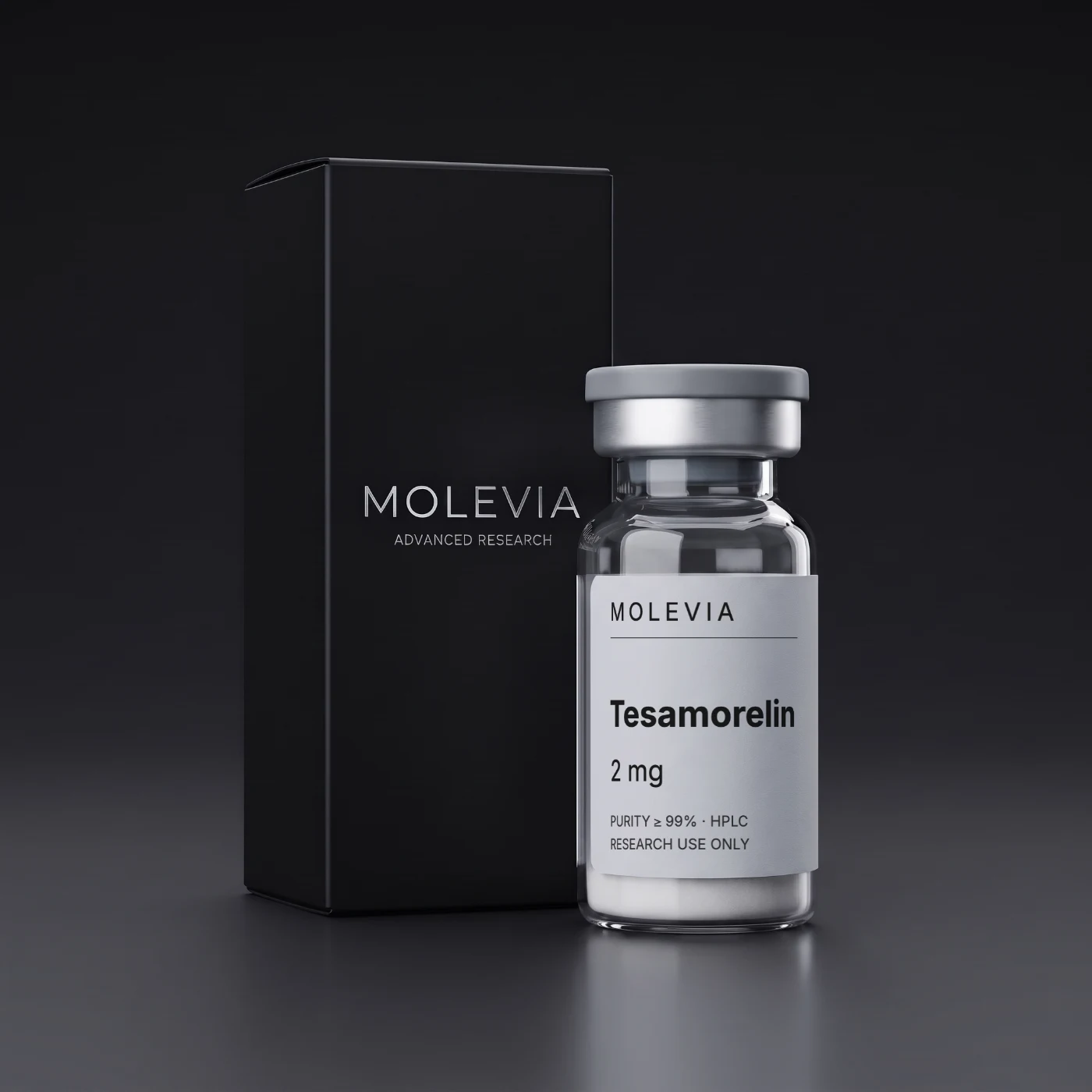
Tesamorelin: research overview
What is tesamorelin
Tesamorelin is a synthetic peptide, an analogue of human growth hormone-releasing hormone (GHRH). The molecule is built from 44 amino acid residues and is produced by chemical synthesis. Its sequence derives from the natural GHRH fragment, and the N-terminus carries a trans-3-hexenoic acid group, a structural feature that distinguishes it from the native peptide.
Tesamorelin is an approved medicine in the United States and has been the subject of clinical studies. This makes it one of the well-described peptides of the growth hormone axis, which helps researchers plan experiments and compare their results with previously published data.
Mechanism described in research
Tesamorelin binds the GHRH receptor on pituitary somatotroph cells. In vitro studies have observed stimulation of growth hormone secretion. Studies on animal models have described the pulsatile character of this response and accompanying changes in IGF-1 levels. The chain of relationships from GHRH through growth hormone to IGF-1 is a standard subject of research into the somatotropic axis.
Research areas
- GHRH, growth hormone and IGF-1 axis in in vitro and animal models
- neuroendocrinology and regulation of pituitary hormone secretion
- metabolism and lipid handling in research models
- peptide stability in solution and methods for analysing it
Product specification
| Parameter | Value |
|---|---|
| Name | Tesamorelin |
| CAS number | 218949-48-5 |
| Molecular formula | C221H366N72O67S |
| Molecular mass | 5135.9 Da |
| Sequence | 44 amino acid residues, modified N-terminus |
| Form | Lyophilised powder |
| Purity | ≥ 99% (HPLC) |
| Sizes | 2 mg, 5 mg, 10 mg, 20 mg |
Laboratory handling
Reconstitution and storage
- Lyophilised powder: store at -20 °C, tightly sealed, away from moisture and light.
- Solution after reconstitution: keep at 2-8 °C and avoid repeated freezing and thawing. Dividing the solution into smaller aliquots helps with this.
- Bacteriostatic water: used as a solvent in laboratory work, following aseptic technique.
- Calculations: work out solvent volumes and concentrations with the concentration calculator.
Good documentation practice
Record each solution with its batch number, reconstitution date, concentration and storage conditions. This makes the preparation reproducible and links experimental results to a specific batch of reagent. Solution stability depends on storage conditions, so storage records matter as much as the measurement itself.
Batch quality
Every batch is tested by HPLC, which confirms purity of at least 99%. Molecular mass is verified by mass spectrometry (MS). Results can be traced back to the batch number. Details of our methods and controls are on the quality page.
Planning comparative studies
Tesamorelin suits comparative research well because its structure is clearly described and its mass and sequence are confirmed analytically. The 2 mg, 5 mg, 10 mg and 20 mg sizes let you match the quantity of reagent to the scale of your experiment without storing surplus material.
Related products
- Ipamorelin, a ghrelin mimetic from the same research axis
- Sermorelin, a shorter GHRH analogue for comparative studies
- CJC-1295 no DAC, a GHRH analogue for studies of growth hormone secretion
- Tesamorelin + Ipamorelin, a combination of tesamorelin and ipamorelin for comparative studies of the GH axis
- GHRP-6, a ghrelin mimetic from the GHRP family for studies of growth hormone secretion
Browse the full GH axis category.


