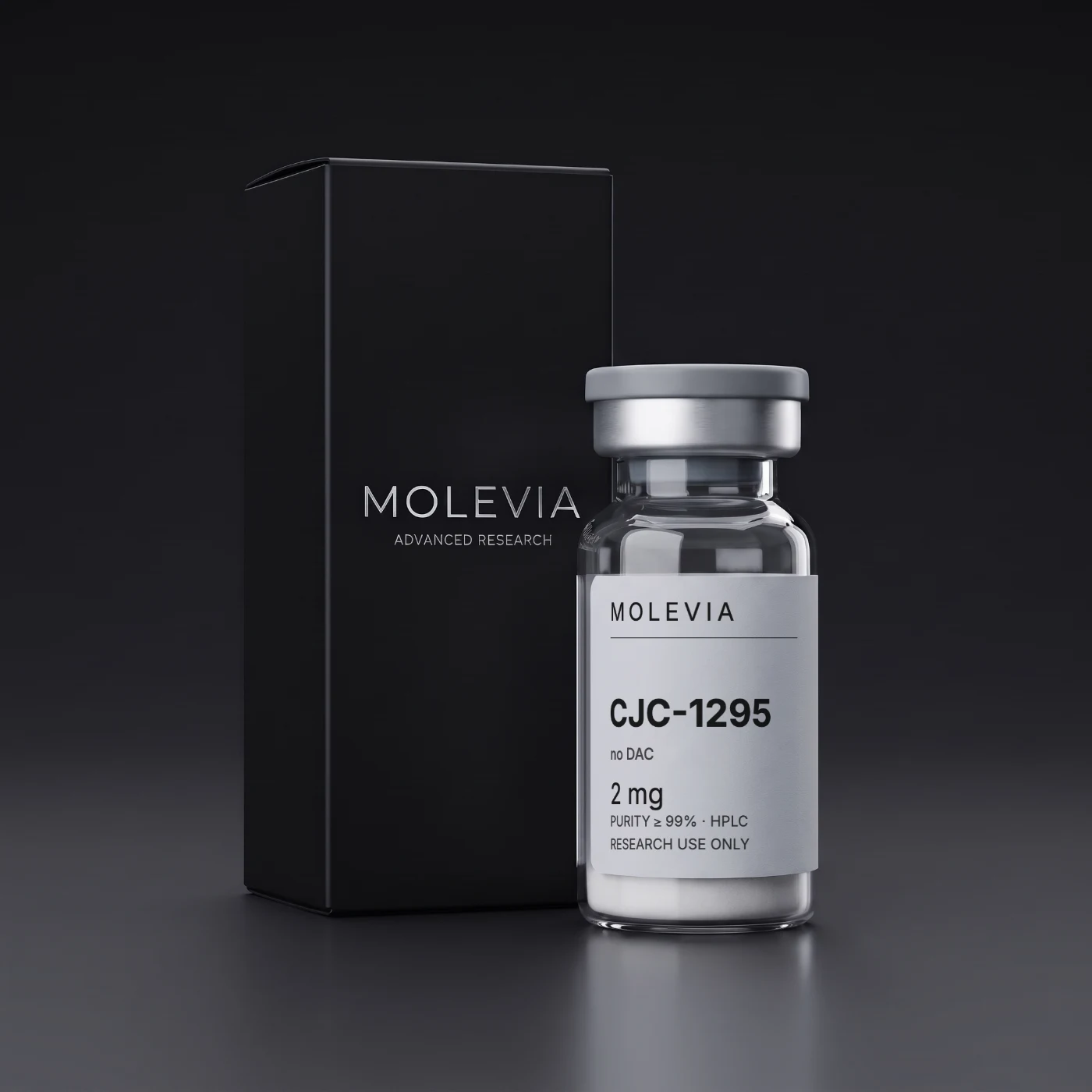
CJC-1295 (no DAC): research overview
What is CJC-1295 (no DAC)
CJC-1295 (no DAC) is a synthetic peptide, an analogue of growth hormone releasing factor (GRF), also known as GHRH. The molecule covers the first 29 amino acid residues of GRF and carries modifications that improve its stability in solution. It is also referred to as Modified GRF (1-29).
The “no DAC” designation means the version without the DAC (drug affinity complex) linker, which in the DAC version binds the molecule to blood albumin. The no DAC form is a plain peptide without that element, so it is a separate research reagent in its own right. The DAC version was studied in clinical trials, which makes this compound family well described in the literature.
Structure and origin
The molecule is built from 29 amino acid residues, with the empirical formula C152H252N44O42 and a molecular mass of 3367.9 g/mol. GRF analogues are made by solid phase chemical synthesis, then purified and analysed to produce material of high purity.
The peptide emerged from work on GHRH analogues with a longer duration of action in preclinical research. Its structure is routinely compared with that of native GRF in analytical studies.
Mechanism described in research
CJC-1295 acts as an agonist of the GHRH receptor on somatotroph cells of the pituitary gland. Binding to the receptor triggers a signalling cascade involving cAMP. In vitro studies observed increased cAMP levels and growth hormone (GH) secretion in pituitary cell cultures. Animal model studies described changes in GH and IGF-1 levels, which makes it possible to examine the entire somatotropic axis.
The mechanism is well defined, but results depend on concentration, incubation time and the model used. Every project therefore needs controls, replicates and clearly documented conditions.
Research areas
- Regulation of growth hormone secretion in in vitro models
- GHRH receptor signalling and the cAMP pathway
- The GH/IGF-1 axis in laboratory animal studies
- Stability of GRF analogues in preclinical research
- Comparisons of GHRH analogues with different structures
Product specifications
| Parameter | Value |
|---|---|
| Name | CJC-1295 (no DAC) |
| CAS number | 863288-34-0 |
| Molecular formula | C152H252N44O42 |
| Molecular mass | 3367.9 g/mol |
| Sequence | GRF (1-29) analogue, 29 amino acid residues |
| Form | lyophilized powder |
| Purity | 99% or higher (HPLC) |
| Sizes | 2 mg, 5 mg, 10 mg |
Laboratory handling
Reconstitution and storage
Store the lyophilized powder at -20 °C, tightly sealed and away from light and moisture. Before opening, let the vial reach room temperature to limit condensation of water vapour onto the substance.
Reconstitute according to your research protocol. Measure the required volume of solvent, add it down the side of the vial and dissolve the contents gently without vigorous shaking. Once dissolved, store the solution at 2-8 °C and use it within the time frame set by your study. Avoid repeated freezing and thawing, since temperature cycling can reduce sample quality.
Bacteriostatic water as a solvent
Bacteriostatic water, which contains a preservative that inhibits microbial growth, is the usual solvent in laboratory work. The choice of solvent always depends on the requirements of the specific experiment.
Batch quality
Every batch is tested by HPLC, which confirms purity at 99% or higher. Mass spectrometry (MS) confirms the molecular mass of 3367.9 g/mol. The batch number lets you tie each result to a specific delivery.
Related products
- Ipamorelin, a secretagogue from the same growth hormone axis research group
- Sermorelin, a GHRH analogue for comparative studies
- CJC-1295 (DAC), the DAC version of the same GRF analogue for comparative studies
- Tesamorelin, a GHRH analogue described in clinical literature
- GH axis category, the full range of products in this group
Read more about our testing on the quality page, and convert weights into solution strengths with the concentration calculator.


