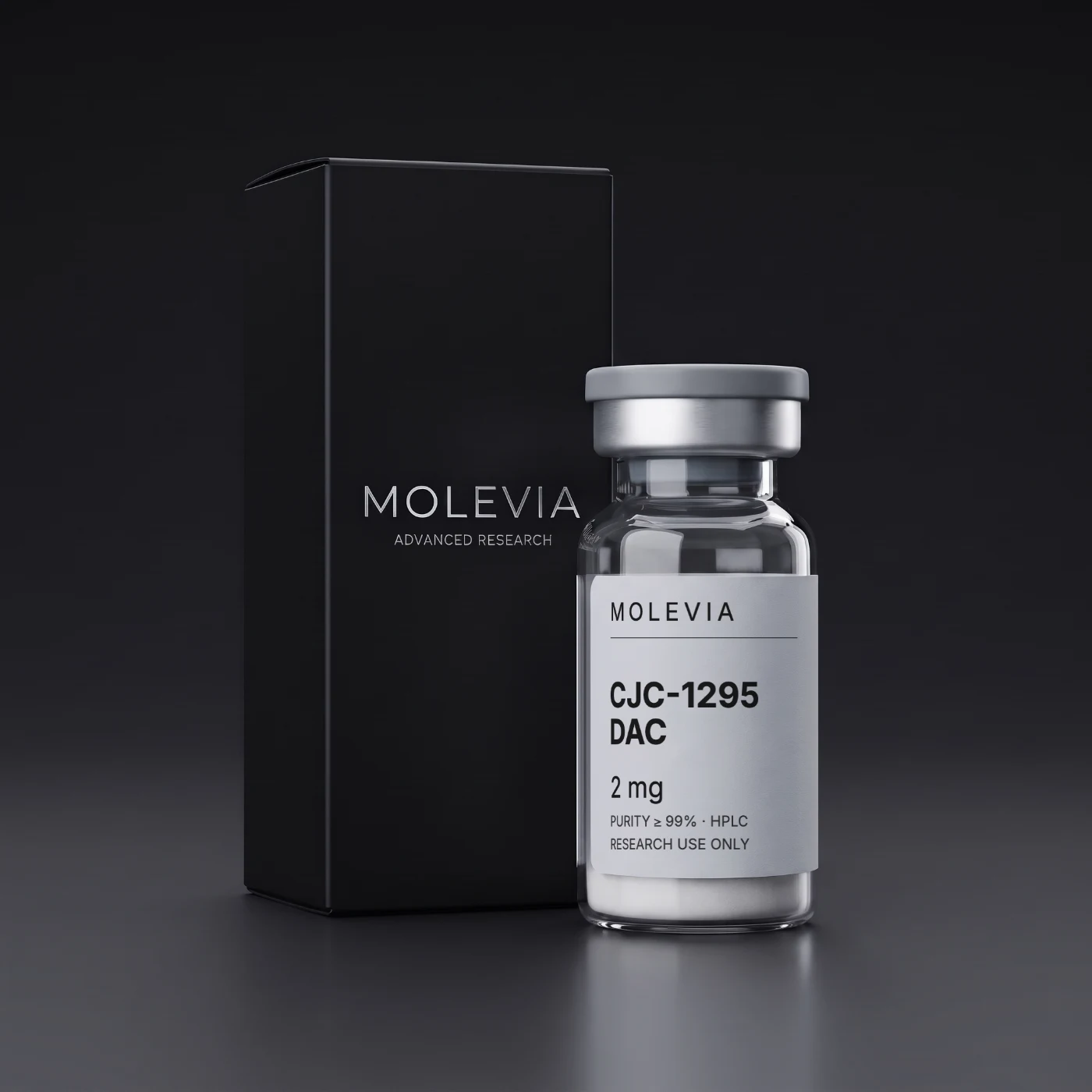
CJC-1295 DAC: research overview
CJC-1295 DAC is a growth hormone releasing hormone (GHRH) analogue, modified so that it remains in the studied system for longer. It is supplied as a lyophilised powder with a purity of ≥ 99%, and every batch comes with a confirmed mass. The product is intended for research and laboratory work.
What is CJC-1295 DAC
Structure and origin
CJC-1295 was developed as a synthetic analogue of GRF(1-29), the first 29 amino acid residues of the natural growth hormone releasing hormone. The sequence carries amino acid substitutions that improve the peptide’s resistance to enzymatic breakdown.
The DAC (Drug Affinity Complex) variant adds a chemical linker that allows the molecule to bind covalently to plasma albumin. This design was created to extend the time the compound stays in the studied system. The version without the linker was studied in early-phase clinical trials, which makes it a well-characterised reference point for comparisons.
Mechanism described in research
CJC-1295 DAC acts on the GHRH receptor in the pituitary gland and stimulates the release of growth hormone (GH). In vitro studies on pituitary cell cultures observed a secretory response to the GHRH analogue. Studies on animal models described increases in circulating GH and, indirectly, IGF-1.
The shape of that response is the central question. Physiological GH secretion is pulsatile, and the rhythm depends on the balance between GHRH and somatostatin. Researchers therefore compare the time profile of each analogue, not only the strength of the response.
Research areas
- Regulation of the GHRH, GH and IGF-1 axis in in vitro and animal models
- Pharmacokinetics of peptides with albumin-binding linkers
- Comparisons between CJC-1295 with DAC and without DAC
- Pituitary physiology and hormone secretion control
- Protein metabolism in preclinical research
Reagent specifications
| Parameter | Value |
|---|---|
| Name | CJC-1295 DAC |
| CAS number | 863288-34-0 |
| Formula | C165H269N47O46 |
| Molar mass | 3647.2 g/mol |
| Sequence | GRF(1-29) analogue with amino acid substitutions and DAC linker |
| Form | lyophilised powder |
| Purity | ≥ 99% |
| Sizes | 2 mg, 5 mg, 10 mg |
Working in the laboratory
Reconstitution and storage
- Lyophilised powder: store at -20 °C, tightly sealed and protected from light.
- After reconstitution: keep the solution at 2-8 °C.
- Freezing: avoid repeated freezing and thawing, and divide the solution into smaller aliquots.
- Before opening: let the vial reach room temperature to limit moisture condensation.
Bacteriostatic water as the solvent
Laboratories reconstitute lyophilised peptides in sterile bacteriostatic water, which serves as the solvent in laboratory work. Before use, check the expiry date and the labelling on the vial, and record the preparation date and batch number in your lab notes. Convert working concentrations with the concentration calculator. Supplies for your bench are in the lab supplies category.
Batch quality
- HPLC: confirms purity at ≥ 99%.
- MS: confirms the molecular mass against the theoretical value of 3647.2 g/mol.
HPLC separates the components of a sample and shows the share of the main peak, which is the basis of the purity result. Mass spectrometry complements it by confirming the identity of the molecule. Read more about our controls on the quality page.
Because each batch of CJC-1295 DAC has its own number, results always refer to the reagent you are working with, which makes it easy to compare results with your own documentation.
Related products
- CJC-1295 without DAC: the version without the DAC linker, useful for comparisons.
- Sermorelin: a GHRH(1-29) analogue for research on the GH axis.
- Ipamorelin: a selective ghrelin receptor agonist used alongside GH axis studies.
- CJC-1295 with Ipamorelin: a GHRH analogue combined with a ghrelin receptor agonist, used in GH axis studies.
- Tesamorelin: a GHRH(1-44) analogue used in research on the GH axis.


