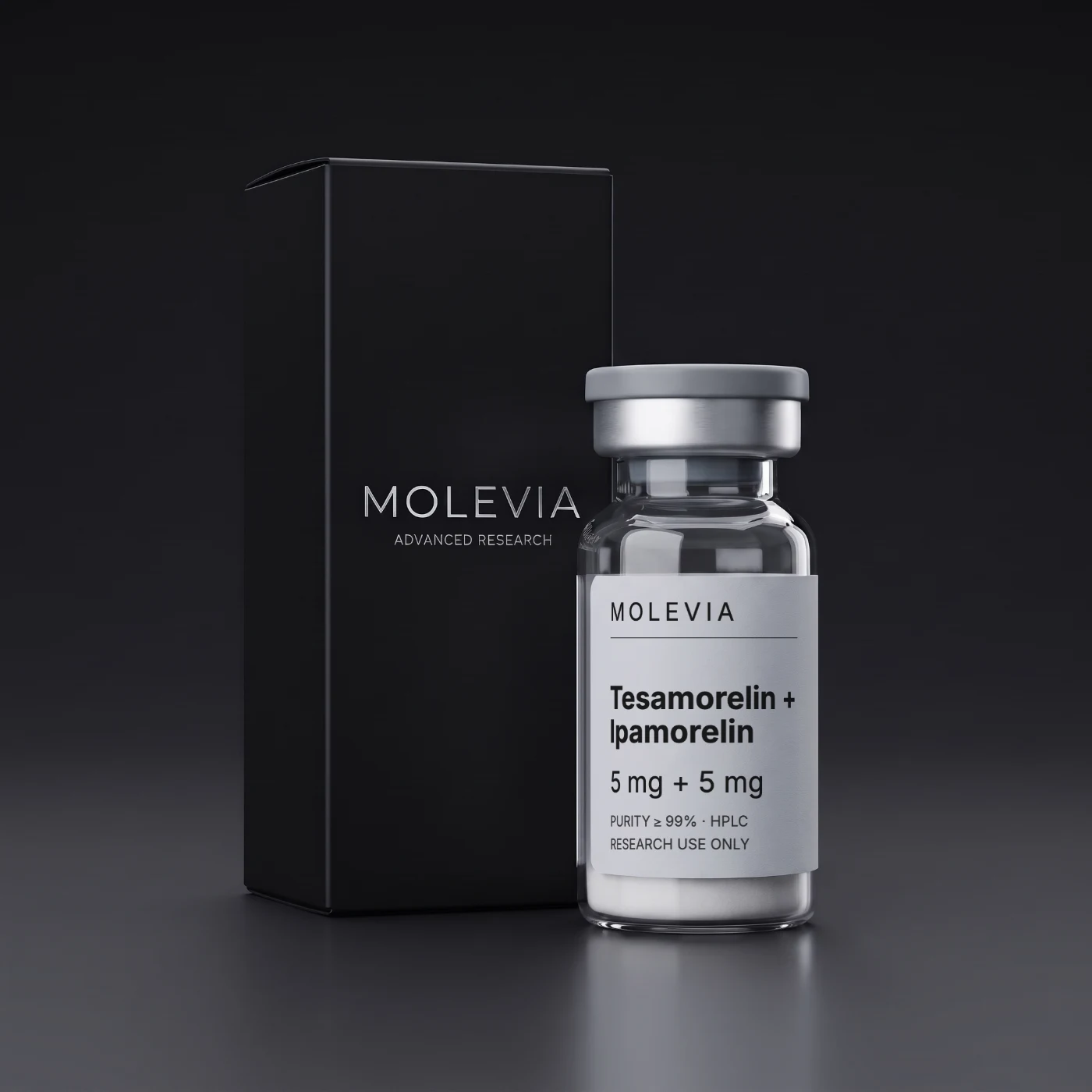
Tesamorelin + Ipamorelin: research overview
What the tesamorelin and ipamorelin blend is
Tesamorelin + ipamorelin is a reagent that combines two peptides in one vial, each described in the literature as a representative of a different pathway controlling the growth hormone axis. Tesamorelin is a synthetic analogue of growth hormone-releasing hormone (GHRH), built on the natural GHRH sequence. Ipamorelin is a short synthetic peptide from the ghrelin mimetic group.
Keeping both components in one lyophilised vial means the researcher works with a single ready material instead of preparing two separate solutions. Both components come from chemical synthesis and pass the same quality control.
Mechanism described in research
Tesamorelin binds the GHRH receptor on pituitary somatotroph cells. Ipamorelin acts on a different receptor, GHS-R1a, which belongs to the ghrelin receptor family. In vitro studies and studies on animal models have described how stimulating both pathways leads to growth hormone secretion, and how their effects complement each other.
This makes the blend a convenient tool for comparing two independent mechanisms within a single experimental setup.
Research areas
- GHRH and growth hormone axis in in vitro and animal models
- ghrelin receptors (GHS) and regulation of pituitary hormone secretion
- interplay between pathways that stimulate growth hormone release
- lipid metabolism in research models
- stability of peptide mixtures in solution and methods for analysing them
Tesamorelin is registered in the United States and has been the subject of clinical studies, and ipamorelin has also been studied in clinical trials. This body of published knowledge helps researchers plan experiments and compare their results with previously published data.
Product specification
| Parameter | Value |
|---|---|
| Name | Tesamorelin + ipamorelin |
| Composition | tesamorelin and ipamorelin in one vial |
| Category | GH axis |
| Form | Lyophilised powder |
| Purity | ≥ 99% (HPLC) |
| Variants | 5 mg + 5 mg, 10 mg + 5 mg |
The amount of each component is stated in the name of each variant.
Laboratory handling
Storage and reconstitution
- Lyophilised powder: store at -20 °C, tightly sealed, away from moisture and light.
- Solution after reconstitution: keep at 2-8 °C and avoid repeated freezing and thawing. Dividing the solution into smaller portions helps with this.
- Bacteriostatic water: the most common solvent in laboratory work, used with aseptic technique.
- Acetic acid: in some protocols it serves as a preliminary solvent, chosen according to the description of the study.
- Calculations: work out solvent volumes and concentrations with the concentration calculator.
Choosing a variant
A larger vial suits a longer series of experiments without frequent opening of the container, while a smaller one fits a pilot study. Label every vial with its batch number, reconstitution date and concentration so that results can be reproduced. Volume discounts apply automatically: 5% for 2 vials, 10% for 3 and 15% for 5.
Batch quality
Every batch is tested by HPLC, which confirms purity of at least 99%. Mass is confirmed by mass spectrometry (MS). Details of the methods and controls are described on our quality page.
Related products
- Ipamorelin, a component of this blend available in its own vial
- Tesamorelin, a GHRH analogue for studies of a single component
- CJC-1295 no DAC, another GHRH analogue for comparison within the growth hormone axis
Browse the full list in the GH axis category.


