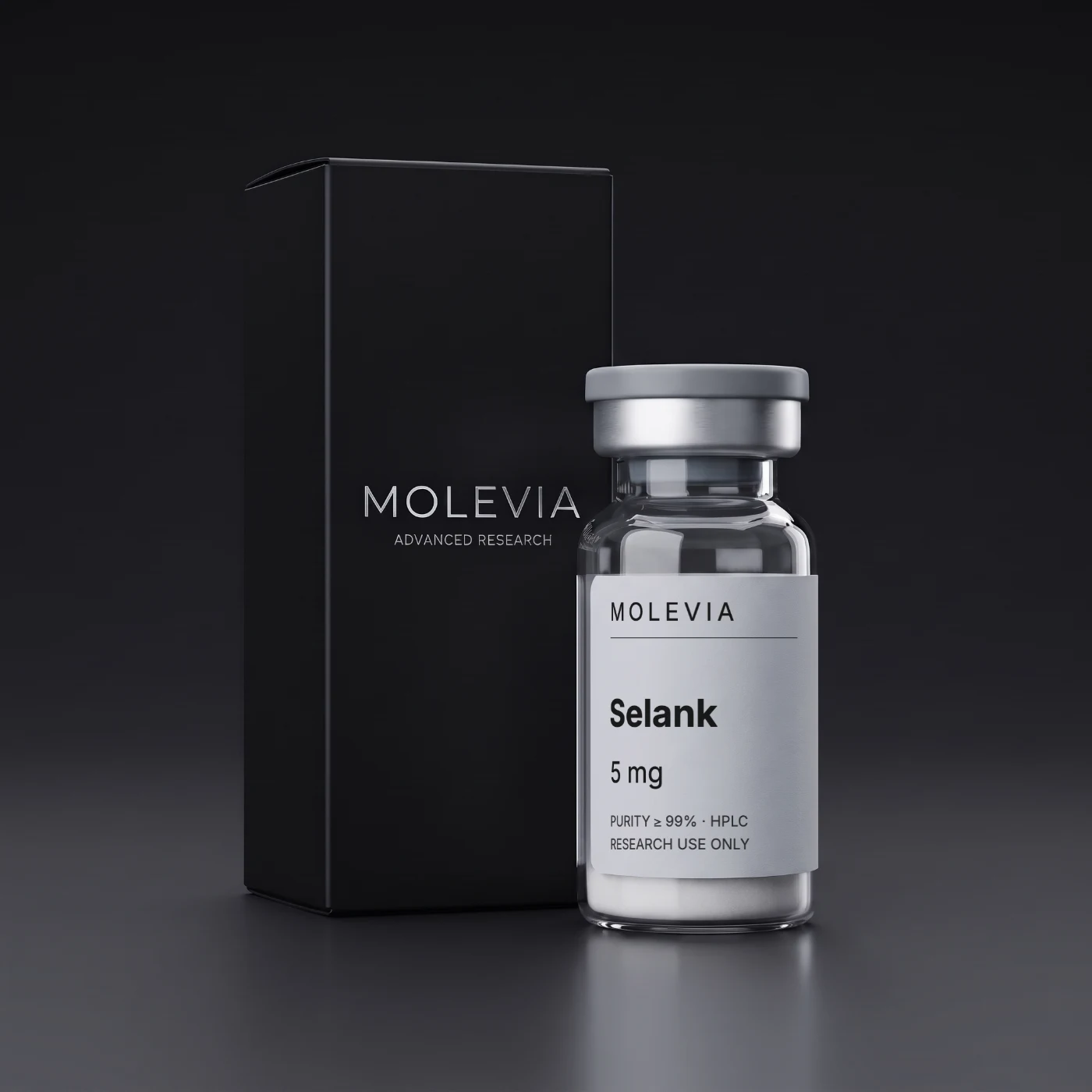
Selank: research overview
What Selank is
Selank is a synthetic heptapeptide, a chain of seven amino acids. Its structure is based on tuftsin, a natural tetrapeptide (Thr-Lys-Pro-Arg) that is a fragment of the immunoglobulin G heavy chain. A Pro-Gly-Pro tail was added to the tuftsin core, and the literature describes this tail as a feature that increases the peptide’s resistance to enzymatic breakdown.
The peptide was developed in Russia, where its properties were studied in animal models and in clinical trials. For a laboratory, the key point is that Selank is a well-described molecule with a known mass and sequence, which can be verified with standard analytical methods.
How Selank is studied
In vitro and animal model studies have described effects on neurotransmission and gene expression. The most frequently discussed topics are the influence on levels of the BDNF neurotrophic factor and on the metabolism of enkephalins, endogenous opioid peptides. In cell cultures, researchers have also described modulation of immune cell responses.
Results depend on the model, concentration and exposure time, so treat them as a starting point for your own study design rather than a finished conclusion. Short sequences such as Selank are convenient in in vitro work because their structure is predictable and their identity can be confirmed by MS.
Research areas
- Neurobiology and neurotransmitter signalling in cell models
- Gene expression studies in cultured cells
- Enkephalin metabolism in biochemical assays
- Immune modulation in in vitro systems
- Peptide stability and enzymatic degradation in analytical work
Product specification
| Parameter | Value |
|---|---|
| Name | Selank |
| CAS number | 129954-34-3 |
| Molecular formula | C33H57N11O9 |
| Molecular mass | 751.9 g/mol |
| Sequence | Thr-Lys-Pro-Arg-Pro-Gly-Pro |
| Form | Lyophilised powder |
| Available sizes | 5 mg, 10 mg |
| Purity | ≥ 99% (HPLC) |
Laboratory handling
Reconstitution and storage
- Store the lyophilised powder at -20 °C, tightly sealed and protected from light.
- After reconstitution, keep the solution at 2-8 °C.
- Avoid repeated freezing and thawing. Divide the solution into working aliquots so that each one is used once.
- Use bacteriostatic water as the solvent, following your laboratory protocol.
Before first use, record the reconstitution date, the batch number and the concentration you prepared. This keeps your experiments reproducible and your documentation complete.
Batch quality
Every batch is tested by HPLC, which confirms purity of at least 99% and helps reveal impurities. Mass spectrometry (MS) confirms the molecular mass.
You can find more about our quality control on the quality page. Convert solution concentrations with the concentration calculator.


