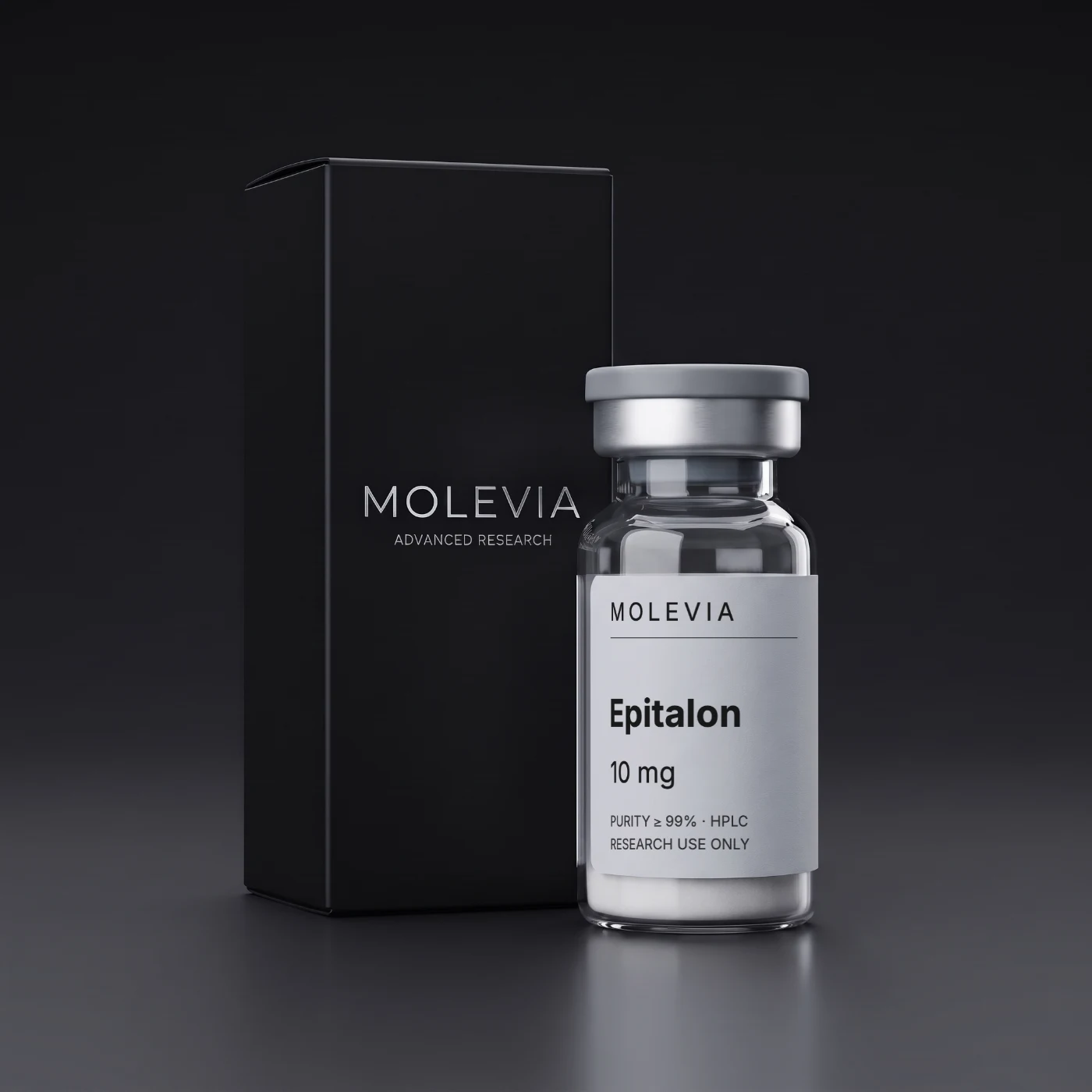
Epitalon: research overview
What is Epitalon
Epitalon, also known as AEDG, is a synthetic tetrapeptide with a short and precisely defined sequence. It was developed in Russia as a synthetic equivalent of a peptide originally isolated from epitalamin, a pineal gland extract. Its simple, well characterised structure makes Epitalon a practical subject for laboratory work, and its identity and quality can be verified analytically.
Specifications
| Parameter | Value |
|---|---|
| Name | Epitalon (AEDG) |
| CAS number | 307297-39-8 |
| Molecular formula | C14H22N4O9 |
| Molecular mass | 390.3 g/mol |
| Sequence | Ala-Glu-Asp-Gly |
| Form | lyophilised powder |
| Purity | ≥ 99% (HPLC) |
| Sizes | 10 mg, 40 mg, 50 mg |
Mechanism described in research
In vitro studies have reported effects of Epitalon on telomerase activity in cell cultures, which is why the peptide draws interest from researchers in cellular ageing. Animal model studies have described links to pineal gland regulation and circadian rhythms. These observations call for further investigation, so each experiment is best designed with its own controls.
Research areas
- Cellular ageing and ageing-related processes in in vitro models
- Telomerase activity in cell cultures
- Pineal gland and circadian rhythm regulation in animal models
- Structure-activity comparisons of short peptides
Epitalon works well as a reference point in studies of short peptides. Its simple sequence keeps data interpretation straightforward, while the known formula and molecular mass let you calculate solution concentrations precisely with the concentration calculator. When planning a series, include negative and positive controls and record the reconstitution parameters for every vial.
Why purity matters
In comparative studies, results depend on the quality of the material. Low purity or an unknown impurity profile can distort readings and make data harder to interpret. That is why every batch of Epitalon is tested by HPLC and MS.
Working in the laboratory
Reconstitution
Dissolve the lyophilised powder in bacteriostatic water, a common laboratory solvent, or another solvent that fits your protocol. Add the solvent slowly down the wall of the vial and swirl gently until fully dissolved. Avoid vigorous shaking.
Storage
| Form | Conditions |
|---|---|
| Lyophilised powder | -20 °C, tightly sealed, protected from light and moisture |
| Reconstituted solution | 2-8 °C |
| Working aliquots | avoid repeated freezing and thawing |
Batch quality
- HPLC: purity ≥ 99%, confirmed for every batch
- MS: confirmation of molecular mass, 390.3 g/mol


