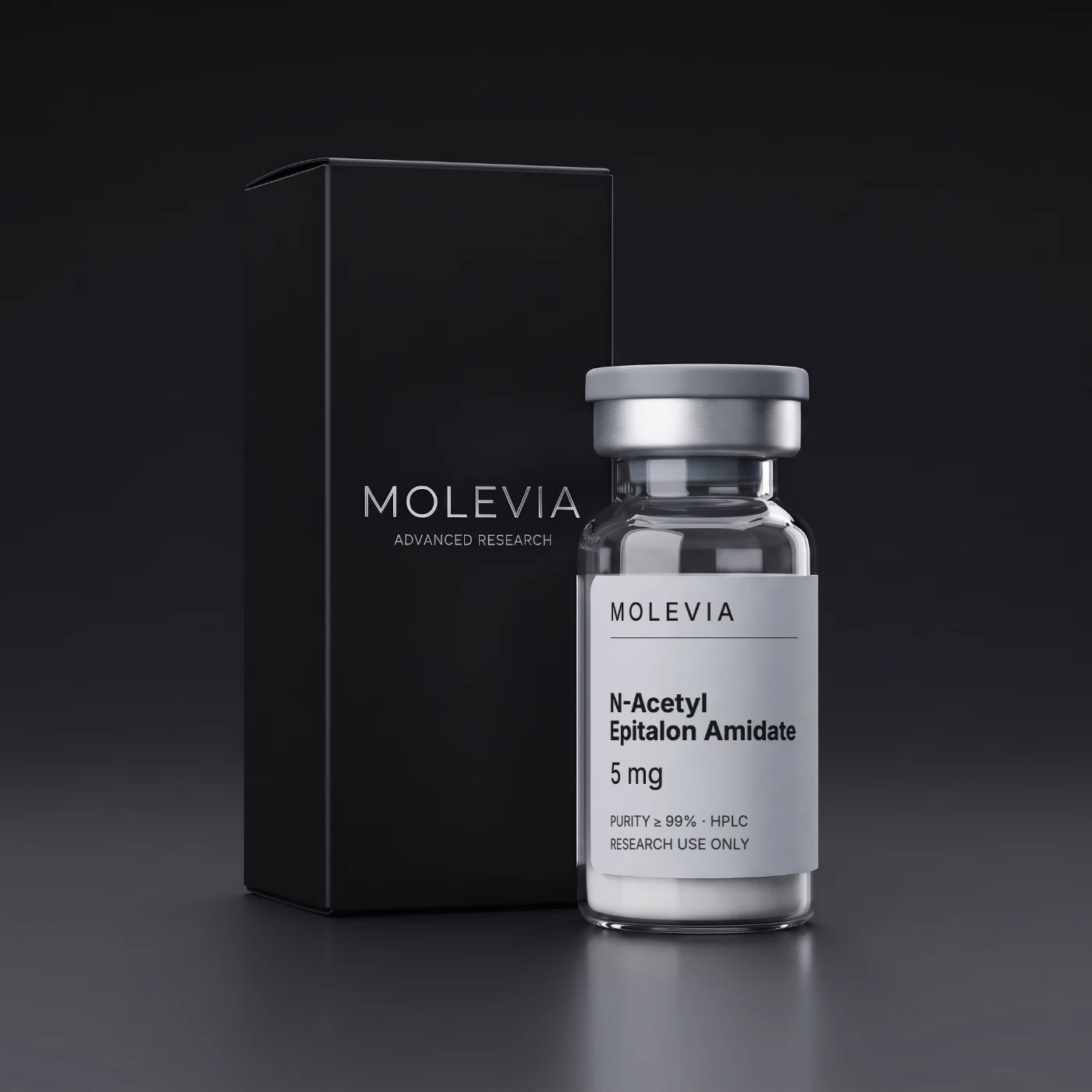
N-Acetyl Epitalon Amidate: research overview
What is N-Acetyl Epitalon Amidate
N-Acetyl Epitalon Amidate is a modified form of epitalon, a tetrapeptide with the sequence Ala-Glu-Asp-Gly. The molecule carries two modifications: an acetylated N-terminus and an amidated C-terminus. Both changes alter how the peptide behaves, and their purpose is greater stability compared with native epitalon.
The structure is written as Ac-Ala-Glu-Asp-Gly-NH2. The short sequence makes it a convenient model for studying how structure relates to peptide stability.
Epitalon is a synthetic tetrapeptide, and its research grew out of interest in the pineal gland. The N-acetylated and amidated form is synthesised in the lab, and every batch goes through the quality control described below.
Mechanism described in research
Research on epitalon has focused on two directions. The first concerns telomerase activity, the enzyme responsible for maintaining telomere length. It has been described mainly in in vitro models using cell cultures. The second direction is the regulation of the pineal gland and the circadian rhythm, studied in animal models.
The N-acetylated and amidated form draws attention for a different reason. Modifications at the ends of a peptide can limit its breakdown by enzymes, which makes its behaviour in an experiment more predictable. That is why N-Acetyl Epitalon Amidate is a common reagent for stability comparisons with the native form.
Research areas
- Cellular ageing and telomere length in in vitro models
- Pineal gland regulation and circadian rhythm in animal models
- Peptide stability: comparisons of native forms with end-modified analogues
- Peptide design and the relationship between structure and activity
Product specifications
| Parameter | Value |
|---|---|
| Name | N-Acetyl Epitalon Amidate |
| Sequence | Ala-Glu-Asp-Gly, acetylated N-terminus, amidated C-terminus |
| Form | Lyophilized powder |
| Purity | 99%+ (HPLC) |
| Mass confirmation | MS |
| Available sizes | 5 mg |
| Intended use | Research use only (RUO) |
Working with the peptide in the lab
Storing the lyophilized powder
Keep the lyophilized powder at -20 °C in a tightly sealed vial, away from light and moisture. Before opening, let the vial reach room temperature so that water does not condense onto the powder.
Reconstitution and storing the solution
Dissolve the peptide in bacteriostatic water, adding the solvent slowly down the side of the vial. Bacteriostatic water gives a clear solution for working use and limits microbial growth in a vial that you open repeatedly. Use dilute acetic acid only if the aqueous solution stays cloudy. Store the ready solution at 2-8 °C and avoid repeated freezing. It is most practical to divide it into aliquots before the first freeze.
Batch quality
Each batch is tested by HPLC, and purity is at least 99%. The molecular mass is confirmed by mass spectrometry (MS). You can read more about our controls on the quality page.
Related products
- Epitalon: the parent tetrapeptide, most often compared with this form
- NAD+: a coenzyme used in research on cellular metabolism
- SS-31: a peptide studied for its effects on mitochondrial function
You will find more reagents in this group in the cellular ageing category. Calculate your dilutions with the concentration calculator.


