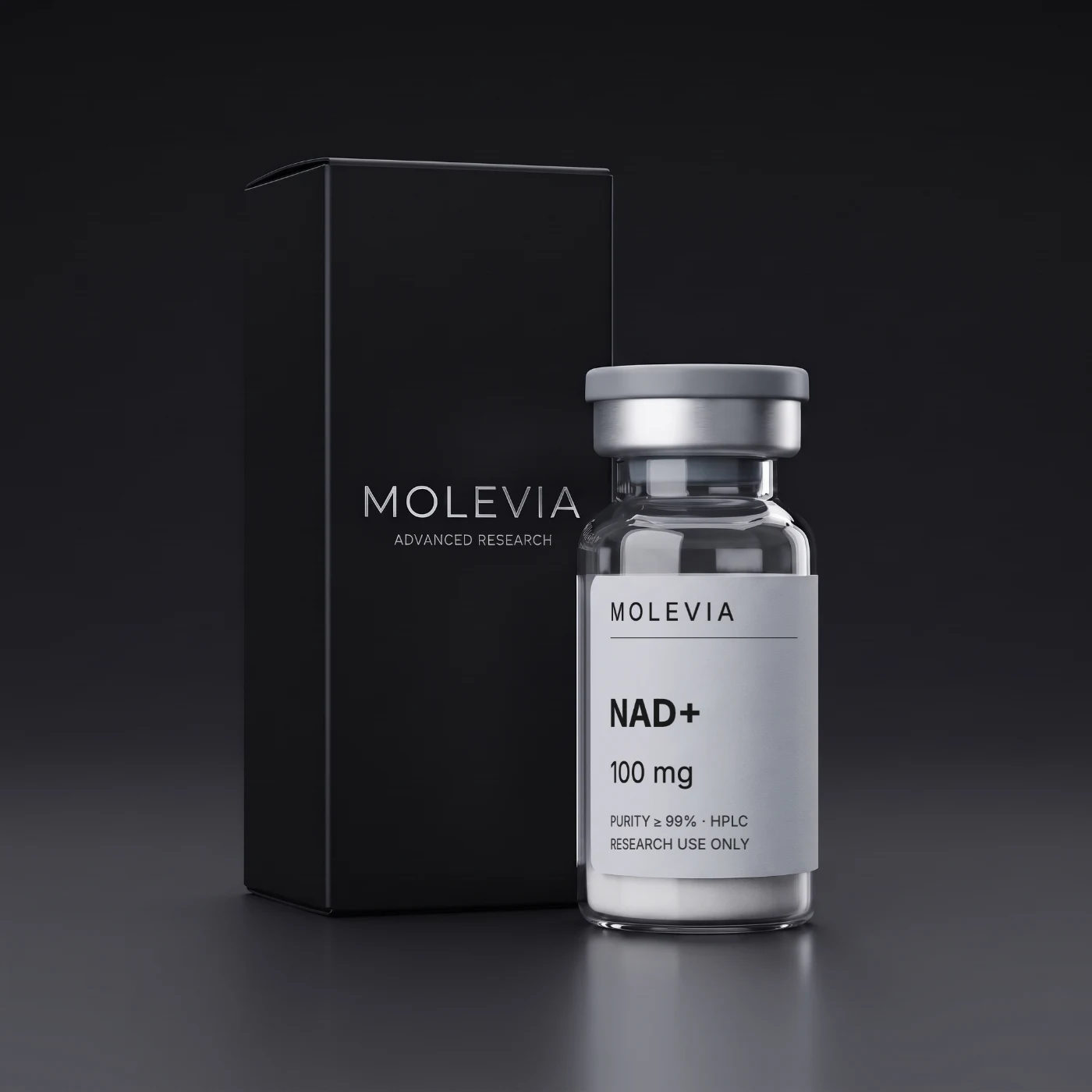
NAD+: research overview
What is NAD+
NAD+, or nicotinamide adenine dinucleotide, is a coenzyme found in every living cell. The molecule consists of two nucleotides joined by a phosphate bridge: an adenine nucleotide and a nicotinamide nucleotide. The oxidised form (NAD+) and the reduced form (NADH) work as a pair that carries electrons in oxidation-reduction reactions.
In cells, NAD+ is produced through several pathways: de novo from tryptophan, from nicotinic acid through the Preiss-Handler pathway, and from nicotinamide through the salvage pathway. As a research reagent, NAD+ is supplied as a high-purity lyophilised powder, ready for reconstitution in the laboratory.
Mechanism described in research
NAD+ serves as a co-substrate for enzymes that use it to transfer chemical groups. These include sirtuins and PARP polymerases, which are studied in the context of metabolic regulation and the cellular response to DNA damage.
- In vitro studies have observed that sirtuin activity depends on the availability of NAD+.
- The NAD+ to NADH ratio is used in research as an indicator of the metabolic state of a cell.
- Animal model studies have described a decline in NAD+ levels in tissues with age.
Research areas
- energy metabolism and mitochondrial function
- redox reactions and the NAD+/NADH balance
- sirtuin and PARP activity
- cellular ageing in in vitro models
- cellular response to oxidative stress
Product specification
| Parameter | Value |
|---|---|
| Name | NAD+ (nicotinamide adenine dinucleotide) |
| CAS number | 53-84-9 |
| Molecular formula | C21H27N7O14P2 |
| Molecular weight | 663.4 g/mol |
| Sequence | not applicable, the compound is not a peptide |
| Form | lyophilised powder |
| Purity | ≥ 99% (HPLC) |
| Sizes | 100 mg, 500 mg, 1000 mg |
Working in the laboratory
Storing the lyophilised powder
Store the lyophilised powder at -20 °C, tightly sealed, away from light and moisture. Before opening the vial, let it reach room temperature. Nucleotides are sensitive to moisture, so limiting exposure to air helps keep the powder stable.
Reconstitution and solution storage
Use sterile bacteriostatic water as the solvent. It is also available in our shop as a supporting reagent. Store the ready solution at 2-8 °C. Avoid repeated freezing and thawing, and plan use within the period set by your laboratory protocol.
Batch quality
HPLC analysis
High-performance liquid chromatography confirms purity of ≥ 99%. The result shows the share of the main component in the sample, which shows the composition of the reagent that reaches your laboratory.
Mass spectrometry (MS)
Mass spectrometry confirms a molecular weight of 663.4 g/mol. This verifies the identity of the compound independently of its purity.
Related products
- SS-31 for research into mitochondrial function
- Epitalon within the cellular ageing range
- MOTS-c for metabolic research
- Humanin for research into mitochondria-derived peptides
- FOXO4-DRI in in vitro models of cellular senescence
Browse more products in the cellular ageing category. Read about our testing on the quality page, and convert concentrations with the concentration calculator.


