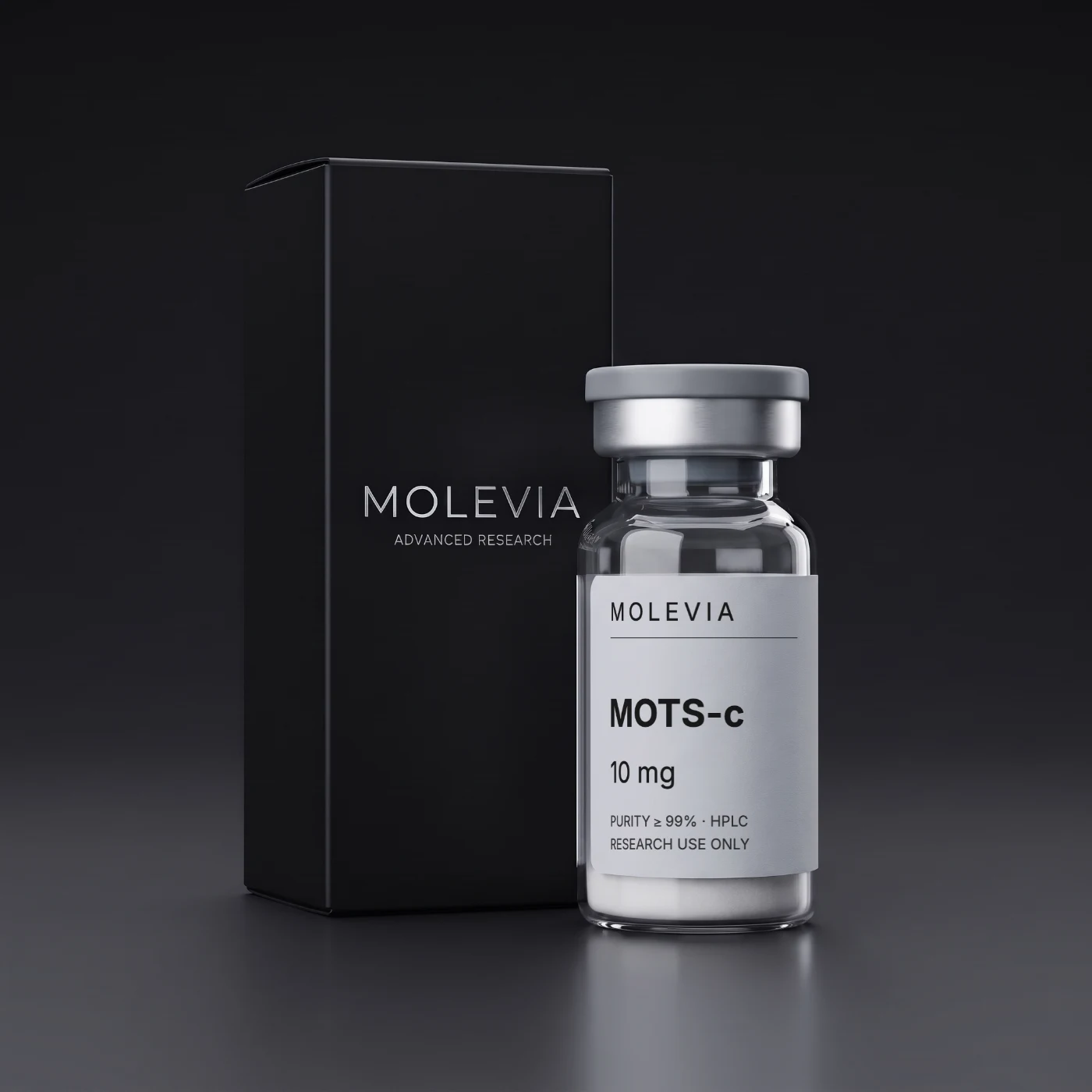
MOTS-c: research overview
MOTS-c is a research peptide that has drawn sustained attention from scientists studying mitochondria and metabolism. Supplied as a lyophilized powder with purity of ≥ 99%. Research Use Only.
What is MOTS-c
MOTS-c is a 16-residue peptide with the sequence MRWQEMGYIFYPRKLR. What sets it apart is its origin. The gene that encodes it is not located in nuclear DNA but in mitochondrial DNA, within the 12S rRNA gene. For this reason MOTS-c is classed as a mitochondria-derived peptide, a molecule that links the energy machinery of the organelle with signalling across the whole cell. It was first described in 2015 and has been studied actively since. For anyone working with peptides, the structure matters as well: the amino acid sequence helps predict how the molecule behaves in solution and guides the choice of dissolution and chromatographic conditions. The mitochondrial origin of MOTS-c makes it an interesting model for research into communication within the cell.
Mechanism described in research
In vitro studies have reported effects of MOTS-c on the AMPK pathway, a central regulator of cellular energy balance. Animal model studies have described changes in glucose metabolism and insulin sensitivity. Under metabolic stress, cell culture work has also reported the peptide moving into the nucleus, where it may influence gene expression. These observations are a starting point for further experiments, not settled conclusions.
Research areas
- glucose metabolism and insulin sensitivity in animal models
- mitochondrial biology and signalling between mitochondria and the nucleus
- AMPK pathway regulation in in vitro systems
- cellular responses to metabolic stress
- cellular ageing and changes in cellular energy handling
Product specification
| Parameter | Value |
|---|---|
| Name | MOTS-c |
| CAS number | 1627580-64-6 |
| Molecular formula | C101H152N28O22S2 |
| Molecular mass | 2174.6 |
| Sequence | MRWQEMGYIFYPRKLR |
| Form | lyophilized powder |
| Purity | ≥ 99% (HPLC) |
| Gene origin | mitochondrial DNA, 12S rRNA gene |
Laboratory handling
Reconstitution and storage
- Lyophilized powder: store at -20 °C, tightly sealed and protected from light.
- After reconstitution: keep the solution at 2-8 °C.
- Freezing: avoid repeated freezing and thawing, as repeated temperature swings reduce peptide stability.
- Solvent: laboratory reconstitution is typically done with bacteriostatic water, which we also stock.
Batch quality
Every batch is tested by HPLC, with purity of ≥ 99% as the acceptance threshold. Molecular mass is confirmed by MS.
When planning an experiment, record the batch number, the HPLC purity result and the MS-confirmed mass in your lab notebook. Results from different batches then stay comparable, and the documentation of your study remains complete. The specification table above collects the key identification data that can be transferred straight into a protocol.
Related products
- SS-31, a peptide studied in the context of mitochondria
- NAD+, a coenzyme central to cellular metabolism
- Bacteriostatic water, a solvent for laboratory work
- AICAR, a compound studied as an AMPK pathway activator in vitro
- 5-Amino-1MQ, an NNMT inhibitor studied in cell models
Explore our quality standards and work out your concentrations with the concentration calculator.


