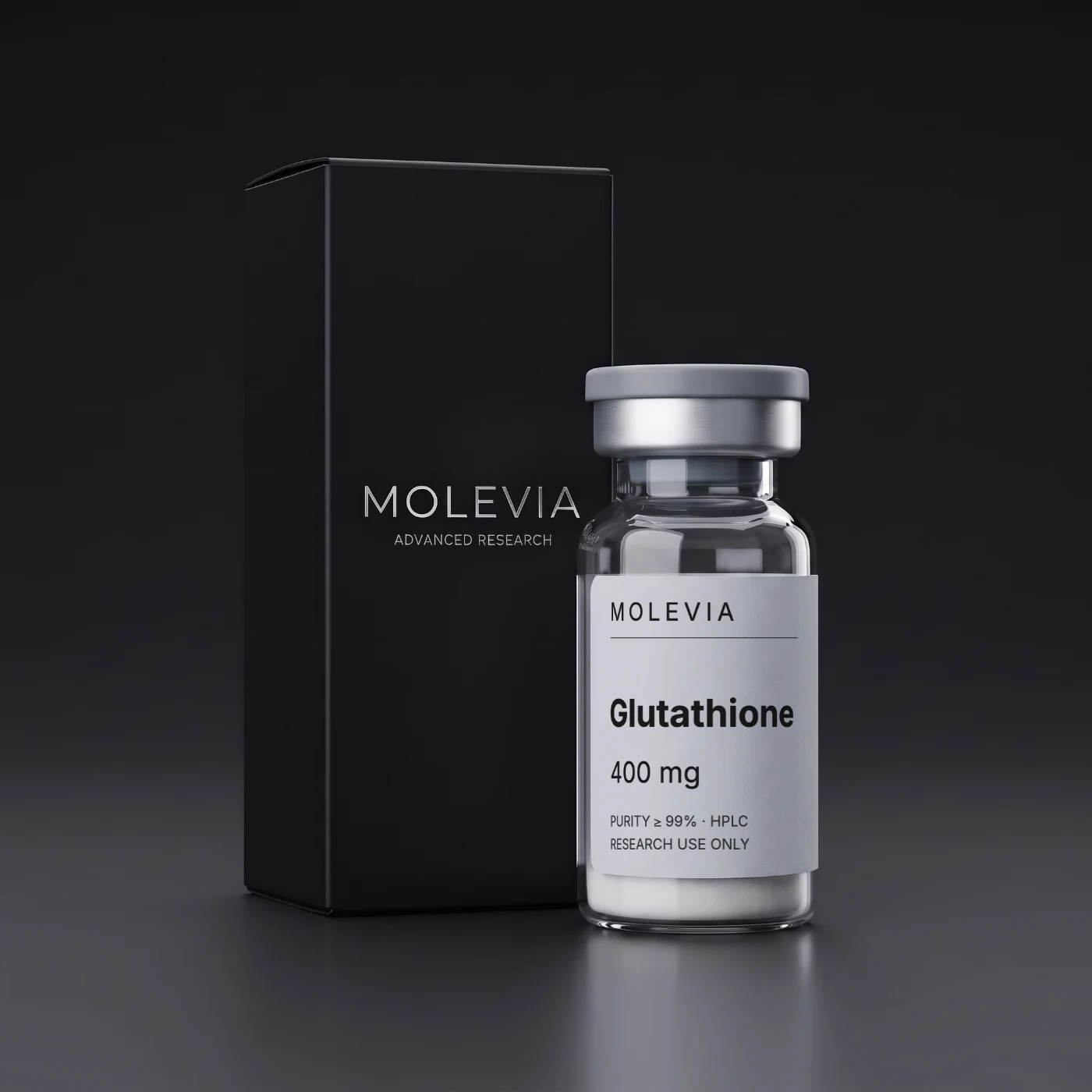
Glutathione: research overview
Glutathione is a tripeptide that serves as the main antioxidant inside cells. The lyophilised research reagent reaches purity ≥ 99%.
What glutathione is
Glutathione (GSH) is a tripeptide built from three amino acids: glutamic acid linked through its gamma carboxyl group, cysteine and glycine. The key feature of its structure is the thiol group (SH) on the cysteine residue. That thiol gives the molecule its ability to donate electrons, and most of its activity in the cell follows from it.
Glutathione occurs naturally in almost every aerobic organism, mostly in the cytosol and mitochondria. It is one of the most thoroughly described molecules in cell biology, and research on it has run for more than a century.
Mechanism described in research
In vitro studies describe glutathione as the central element of the cellular redox system. Its reduced form (GSH) donates electrons and becomes oxidised (GSSG). The enzyme glutathione reductase restores the reduced form at the cost of NADPH. The GSH to GSSG ratio is a standard marker of redox status in cell cultures.
The enzymes most often described together with glutathione:
- glutathione peroxidase (GPx), which reduces hydrogen peroxide and lipid peroxides
- glutathione S-transferases (GST), which catalyse the conjugation of xenobiotics in enzymatic models
- glutathione reductase, which regenerates GSH from GSSG
Areas of research
- oxidative stress in cell cultures
- the GSH/GSSG redox cycle and cell signalling
- enzymology of GPx, GST and glutathione reductase
- xenobiotic detoxification in in vitro liver models
- animal models of oxidative stress
- clinical literature: the literature also describes clinical studies involving glutathione. This is a fact from the published record, not a recommendation for use.
Product specification
| Parameter | Value |
|---|---|
| Name | Glutathione (GSH) |
| CAS number | 70-18-8 |
| Formula | C10H17N3O6S |
| Molecular mass | 307.3 g/mol |
| Form | lyophilised |
| Purity | ≥ 99% (HPLC) |
| Sizes | 400 mg, 600 mg, 1500 mg |
Working in the laboratory
Storage
| Stage | Temperature | Rule |
|---|---|---|
| Lyophilised powder | -20 °C | tightly sealed, protected from light |
| Solution after reconstitution | 2-8 °C | avoid repeated freezing and thawing |
Reconstitution
In the laboratory, water is the standard solvent. Bacteriostatic water, which inhibits bacterial growth, is the usual choice when a vial is sampled many times. Work out your working concentration with the concentration calculator.
Batch quality
| Test | What it confirms |
|---|---|
| HPLC | purity ≥ 99% |
| MS | molecular mass 307.3 |
Full method details are on the quality page.
Ordering and delivery
- same-day dispatch for orders placed by 14:00 on business days
- InPost parcel locker in Poland: next business day
- DPD across Europe: 2-4 business days
- free shipping from 75 EUR (65 GBP, 80 USD)
- Pay online by card, Apple Pay, Google Pay or BLIK (PLN only).
- bacteriostatic water 10 ml free with orders from 50 EUR (40 GBP, 55 USD) that include a peptide vial
| Quantity in cart | Discount |
|---|---|
| 2 pcs | 5% |
| 3 pcs | 10% |
| 5 pcs | 15% |
The quantity discount is applied automatically in the cart.
Related products
Browse the full metabolic research category.


