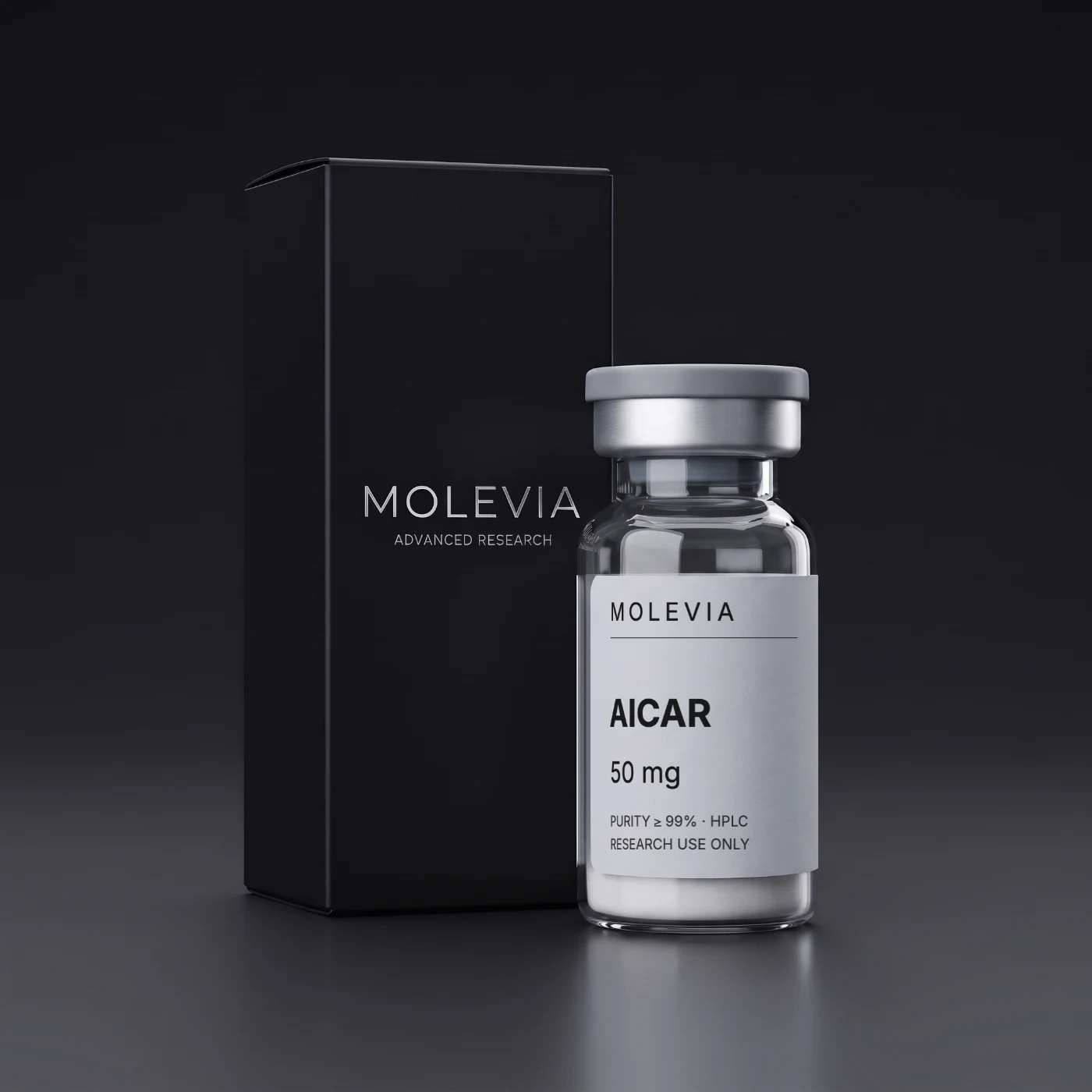
AICAR: research overview
AICAR is a research compound that has been a staple in laboratories studying cellular metabolism for years. We supply it as a lyophilized powder with purity of ≥ 99%, in 50 mg and 100 mg sizes.
What is AICAR
AICAR, short for 5-aminoimidazole-4-carboxamide riboside, is a nucleoside built from a nitrogen base linked to ribose. It is a laboratory compound, produced synthetically. Its nucleotide form, ZMP, occurs naturally as an intermediate of purine biosynthesis, which is why biochemists have long been interested in AICAR. The molecule resembles AMP, the nucleotide through which a cell signals its energy status. That resemblance is the key to its use in research.
Mechanism described in research
After entering the cell, AICAR is converted into ZMP, an AMP analogue. ZMP binds to the protein kinase AMPK and activates it. AMPK works as an energy switch: when energy reserves fall, it turns on pathways that generate ATP and limits processes that consume energy. In vitro studies have reported AMPK activation in several cell types. Animal model studies have described effects on glucose uptake in skeletal muscle.
The same molecule, also known as acadesine, has been studied in clinical trials, including in cardiac surgery. This is information from the scientific literature. MOLEVIA supplies the compound strictly for research purposes.
Areas of research
- the AMPK pathway and regulation of cellular energy balance
- glucose metabolism and glucose uptake in muscle in animal models
- purine biochemistry and nucleotide metabolism
- cellular response to hypoxia and energy stress in culture
- mitochondrial research and cellular energy management
Product profile
| Parameter | Value |
|---|---|
| Name | AICAR |
| CAS number | 2627-69-2 |
| Molecular formula | C9H14N4O5 |
| Molecular mass | 258.2 |
| Form | lyophilized powder |
| Purity | ≥ 99% (HPLC) |
| Sizes | 50 mg, 100 mg |
| Category | metabolic research |
Laboratory handling
Storage and reconstitution
- Lyophilized powder: store at -20 °C, tightly sealed and protected from light.
- Before opening: let the vial reach room temperature to avoid condensation.
- After reconstitution: keep the solution at 2-8 °C.
- Freezing: avoid repeated freezing and thawing, as temperature cycling reduces the stability of the compound.
Role of the solvent
Bacteriostatic water is the standard solvent in laboratory work. AICAR is a polar molecule that dissolves well in water, so water alone is usually sufficient. When planning dissolution, check which solvent suits the specific compound.
Orders above 50 EUR (40 GBP, 55 USD) that include a peptide in a vial also get 10 ml of bacteriostatic water free of charge.
Batch quality
Every batch undergoes HPLC purity analysis, with a result of ≥ 99%. Mass is confirmed by MS analysis. Record the batch number, HPLC result and MS-confirmed mass in your laboratory log, so that results from different batches stay comparable.
Larger orders qualify for an automatic quantity discount at checkout: 5% for 2 pieces, 10% for 3 pieces and 15% for 5 pieces.
Related products
- MOTS-c, a mitochondrial peptide, also used in metabolic research
- SLU-PP-332, a compound studied in the context of energy pathways
- 5-Amino-1MQ, a reagent from the cellular metabolism field
Browse all metabolic research products, review the MOLEVIA quality standards and convert concentrations with the concentration calculator.


