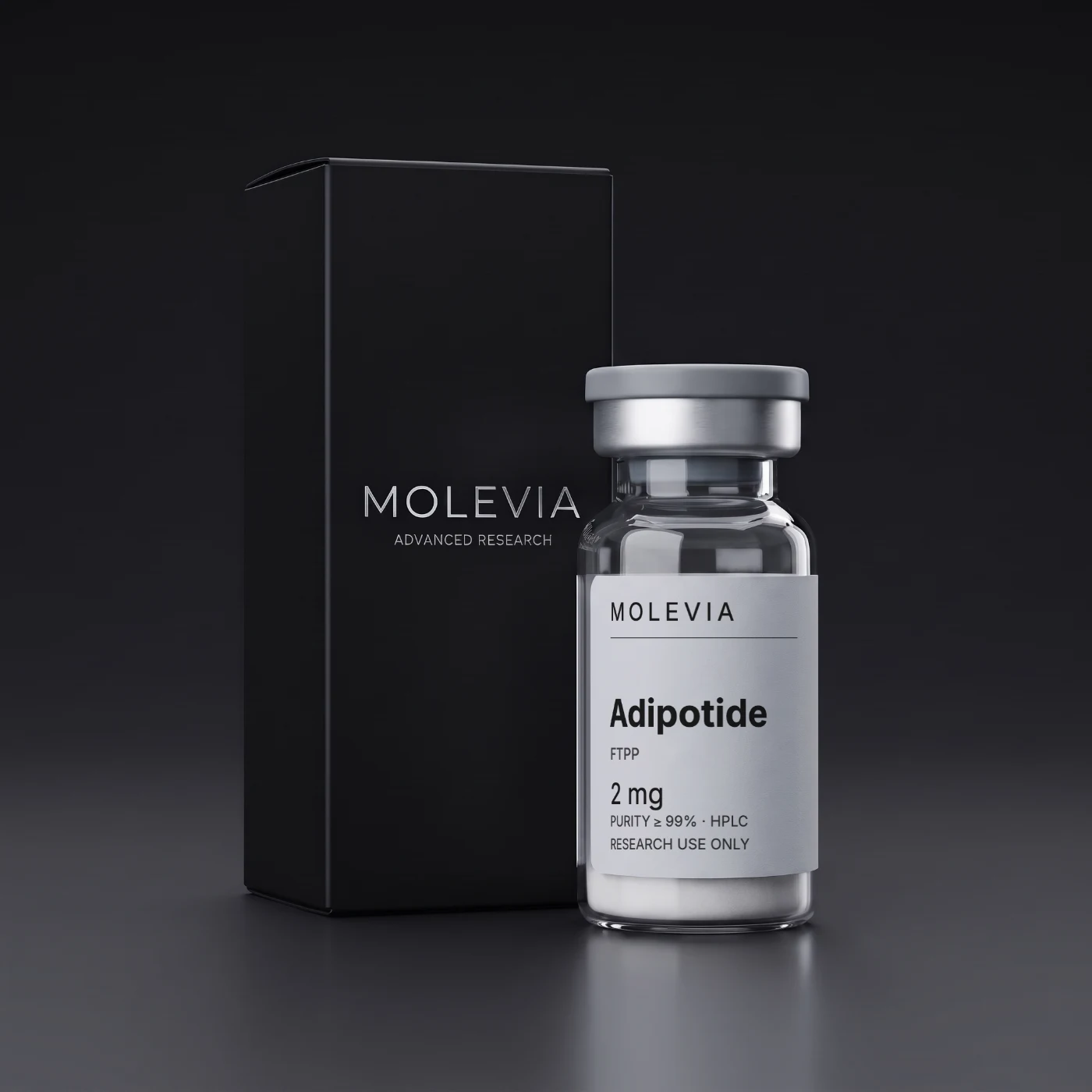
Adipotide (FTPP): research overview
What is adipotide
Adipotide, also known as FTPP, is a peptidomimetic, a compound designed on the model of a peptide. Its defining feature is targeting prohibitin, a protein present in the cells that line blood vessels. The molecule was developed as a tool for research into the blood vessels of adipose tissue and is offered strictly as a laboratory reagent.
Its targeted action makes adipotide a practical reference point for teams studying the selectivity of compounds toward chosen cellular structures. It is supplied as a lyophilized powder, ready to be dissolved in the laboratory.
The substance has long featured in discussions of vascular biology and tissue metabolism. Results obtained in models become the starting point for new projects, and consistent batch quality lets you compare one series of studies with another.
Mechanism described in research
Studies in animal models described adipotide binding to prohibitin on the endothelial surface of vessels that supply adipose tissue. According to these reports, binding led to apoptosis of endothelial cells in those vessels, which makes adipotide a useful tool for research into tissue vascularization and its dependence on prohibitin.
The mechanism remains under investigation. Most of the data come from preclinical models, so they serve as a starting point for your own experiments.
Research areas
- Biology of blood vessels in adipose tissue in animal models
- The role of prohibitin in endothelium and angiogenesis
- Selective targeting of peptidomimetics toward vascular structures
- Adipose tissue metabolism in preclinical research
- Comparison with other compounds from the metabolic research category
Specifications
| Parameter | Value |
|---|---|
| Name | Adipotide (FTPP) |
| Class | Peptidomimetic |
| Research target | Prohibitin |
| Form | Lyophilized powder |
| Purity | ≥ 99% (HPLC) |
| Molecular mass | Confirmed by MS |
| Available sizes | 2 mg, 5 mg, 10 mg |
Working in the laboratory
Storing the lyophilized powder
Store the lyophilized powder at -20 °C, tightly sealed and protected from light. Before opening a vial, let it reach room temperature to avoid moisture condensing on the powder.
Reconstitution and the solution
Choose the solvent to suit your experimental plan. Bacteriostatic water is the standard solvent in laboratory work. Dilute acetic acid is used when water alone does not provide full dissolution.
Once dissolved, keep the solution at 2-8 °C. Avoid repeated freezing and thawing, as it reduces the stability of the material.
Batch quality
Every batch is checked with two analytical methods:
- HPLC confirms purity of at least 99%
- Mass spectrometry (MS) confirms the molecular mass
Each batch is tied to its batch number. You can review our quality checks on the quality page.
Related products
- HGH Fragment 176-191, a growth hormone fragment used in metabolic research
- AOD-9604, a protein fragment from adipose tissue research
- MOTS-c, a mitochondrial-derived peptide used in metabolic research
Browse the full range in the metabolic research category. You can calculate solution concentrations in our concentration calculator.


