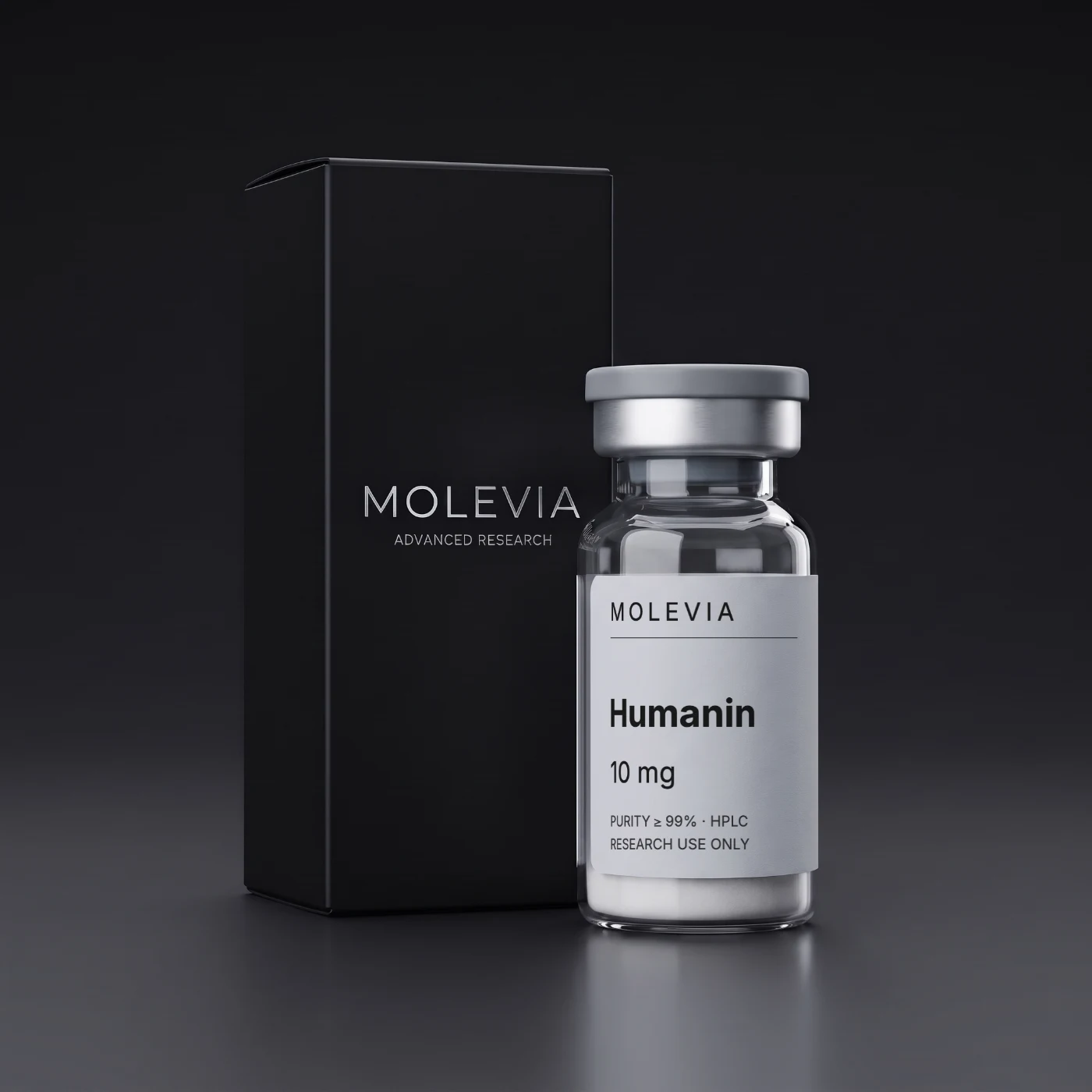
Humanin: research overview
What is Humanin
Humanin is a peptide made of 24 amino acids. Its most interesting feature is where it comes from. The sequence is encoded in mitochondrial DNA, within the region of the gene for 16S ribosomal RNA, rather than in the nuclear genome that encodes most peptides. That is why Humanin has become one of the most studied subjects in mitochondrial biology and in research on cellular ageing.
A stable, well described structure makes Humanin a practical material for the laboratory. The known formula and molecular mass let you calculate concentrations precisely.
Mechanism described in research
In vitro studies have described the cytoprotective activity of Humanin, meaning its capacity to protect cells from apoptosis, or programmed cell death. The effect has been observed in cell cultures exposed to oxidative stress and to toxic agents such as fragments of beta-amyloid. Researchers link this activity to signalling through receptors on the cell surface, which switches on pathways that favour cell survival.
In animal models, the effect of Humanin on glucose metabolism has also been studied. These observations call for further work, so design each model with its own controls.
Research areas
- Cytoprotection and protection against apoptosis in in vitro models
- Oxidative stress in cultures of nerve cells
- Mitochondrial biology and research on the mitochondrial genome
- Neurodegeneration models, including models involving beta-amyloid
- Glucose metabolism in animal models
Specifications
| Parameter | Value |
|---|---|
| Name | Humanin |
| CAS number | 330936-69-1 |
| Molecular formula | C119H204N34O32S2 |
| Molecular mass | 2687.2 g/mol |
| Length | 24 amino acids |
| Origin | encoded in mitochondrial DNA (16S rRNA region) |
| Form | lyophilised |
| Purity | ≥ 99% (HPLC) |
| Available sizes | 10 mg |
Working in the laboratory
Reconstitution
Bacteriostatic water is the standard solvent in laboratory work. Add it slowly along the vial wall and swirl gently until the powder dissolves completely. Avoid vigorous shaking. Where a protocol calls for it, diluted acetic acid is sometimes used as an auxiliary solvent instead.
Storage
| Form | Conditions |
|---|---|
| Lyophilised powder | -20 °C, tightly sealed, protected from light and moisture |
| Solution after reconstitution | 2-8 °C |
| Working aliquots | avoid repeated freezing and thawing |
Quality of every batch
- HPLC: purity of ≥ 99%, confirmed for every batch
- MS: confirmation of the molecular mass, 2687.2 g/mol
Record the batch number in your research log. That way every result can be traced back later, and you can compare the material with your own laboratory documentation.
A purity of ≥ 99% means that impurities make up only a small fraction of the substance, so the result in the model concerns Humanin itself rather than its impurities. Order by 14:00 on a working day and the parcel leaves the same day.


