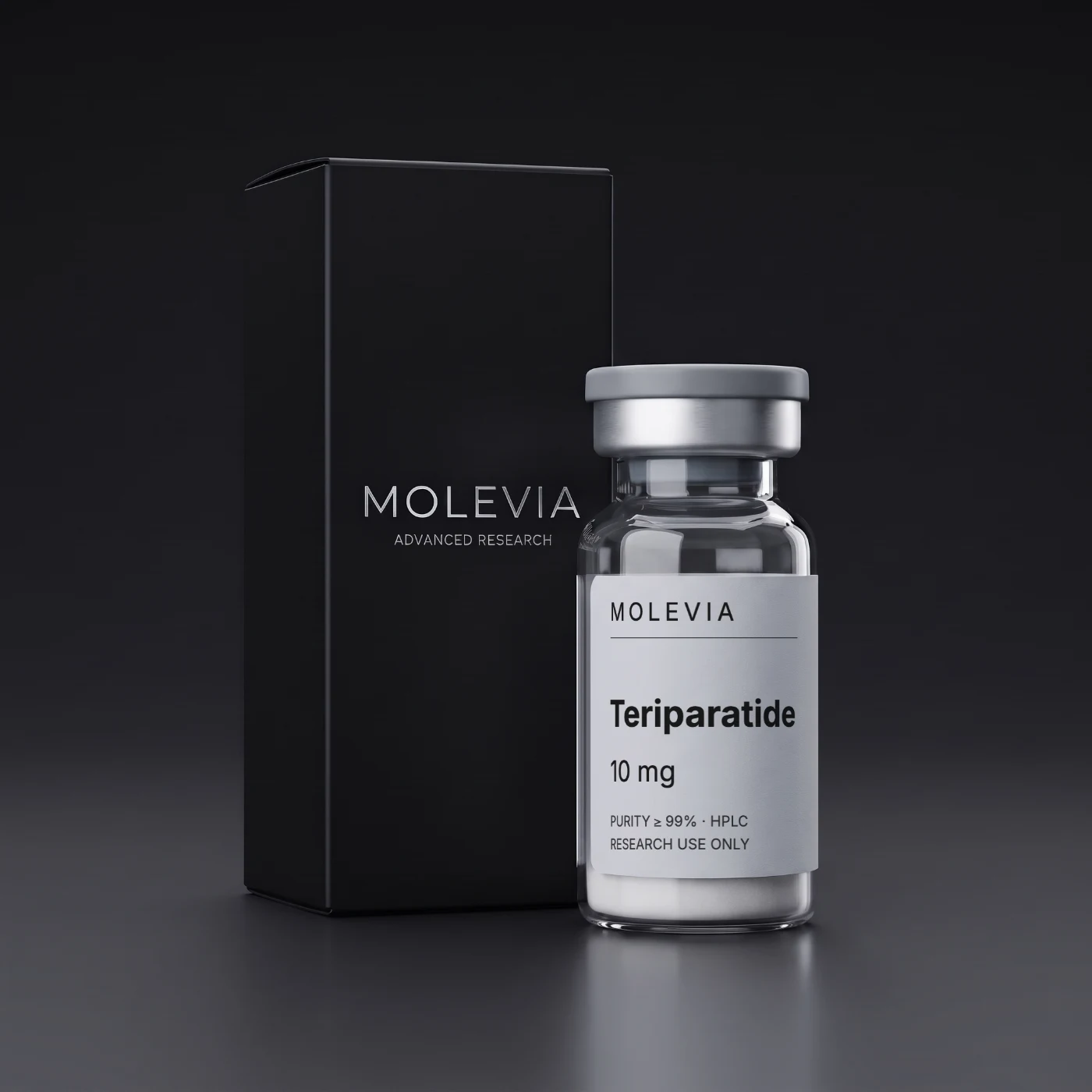
Teriparatide: research overview
What is teriparatide
Teriparatide is a synthetic peptide that corresponds to the first 34 amino acids of human parathyroid hormone, the 1-34 fragment (PTH 1-34). The natural hormone is produced in the parathyroid glands and takes part in regulating calcium and phosphate balance. The molecule keeps the N-terminal region of the hormone, which is responsible for activating its receptor.
Teriparatide is a substance registered as a medicine and has been the subject of clinical studies, as described in the scientific literature. In our shop it is offered only as a research reagent.
Mechanism described in research
- The molecule binds the PTH1R receptor, found among others on osteoblasts and in kidney cells.
- Receptor activation triggers the cAMP and protein kinase A (PKA) pathway, as described in in vitro studies.
- Animal models have been used to study how this signalling affects bone tissue remodelling.
- The literature compares the effects of continuous and pulsatile exposure to PTH, which is one of the main threads of research on this molecule.
Research areas
- bone tissue remodelling and osteoblast activity in in vitro models
- calcium and phosphate homeostasis in animal model studies
- PTH1R receptor signalling and the cAMP pathway
- comparison of continuous and pulsatile exposure in the literature
- hormonal regulation and parathyroid biology
Product specification
| Parameter | Value |
|---|---|
| Name | Teriparatide (parathyroid hormone 1-34 fragment) |
| CAS number | 52232-67-4 |
| Molecular formula | C181H291N55O51S2 |
| Molecular mass | 4117.7 g/mol |
| Sequence | 34 amino acid residues, PTH 1-34 fragment |
| Form | lyophilised powder |
| Purity | ≥ 99% (HPLC) |
| Available sizes | 10 mg |
Working in the laboratory
Storing the lyophilised powder
Store the lyophilised powder at -20 °C, tightly sealed, away from light and moisture. Before opening the vial, let it reach room temperature. Peptides are sensitive to moisture, so limiting contact with air helps keep the powder stable.
Reconstitution and storing the solution
Choose the solvent according to your study protocol. Bacteriostatic water, available in our shop as a supporting reagent, is the most common choice for aqueous solutions. Diluted acetic acid is used when water alone does not fully dissolve the peptide. In both cases the solvent should ensure complete dissolution and a stable pH.
Store the ready solution at 2-8 °C. Avoid repeated freezing and thawing, and plan use within the period set by your laboratory protocol.
Quality of every batch
HPLC analysis
High-performance liquid chromatography confirms purity of ≥ 99%. The result shows the share of the main component in the sample, which is the actual composition of the reagent that reaches your laboratory.
Mass spectrometry (MS)
Mass spectrometry confirms a molecular mass of 4117.7 g/mol. This verifies the identity of the compound independently of its purity.
Related products
- NAD+ for research into cellular metabolism
- SS-31 for research into mitochondrial function
- Epitalon within the cellular ageing range
Browse more products in the cellular ageing category. Read about our testing on the quality page, and convert concentrations with the concentration calculator.


