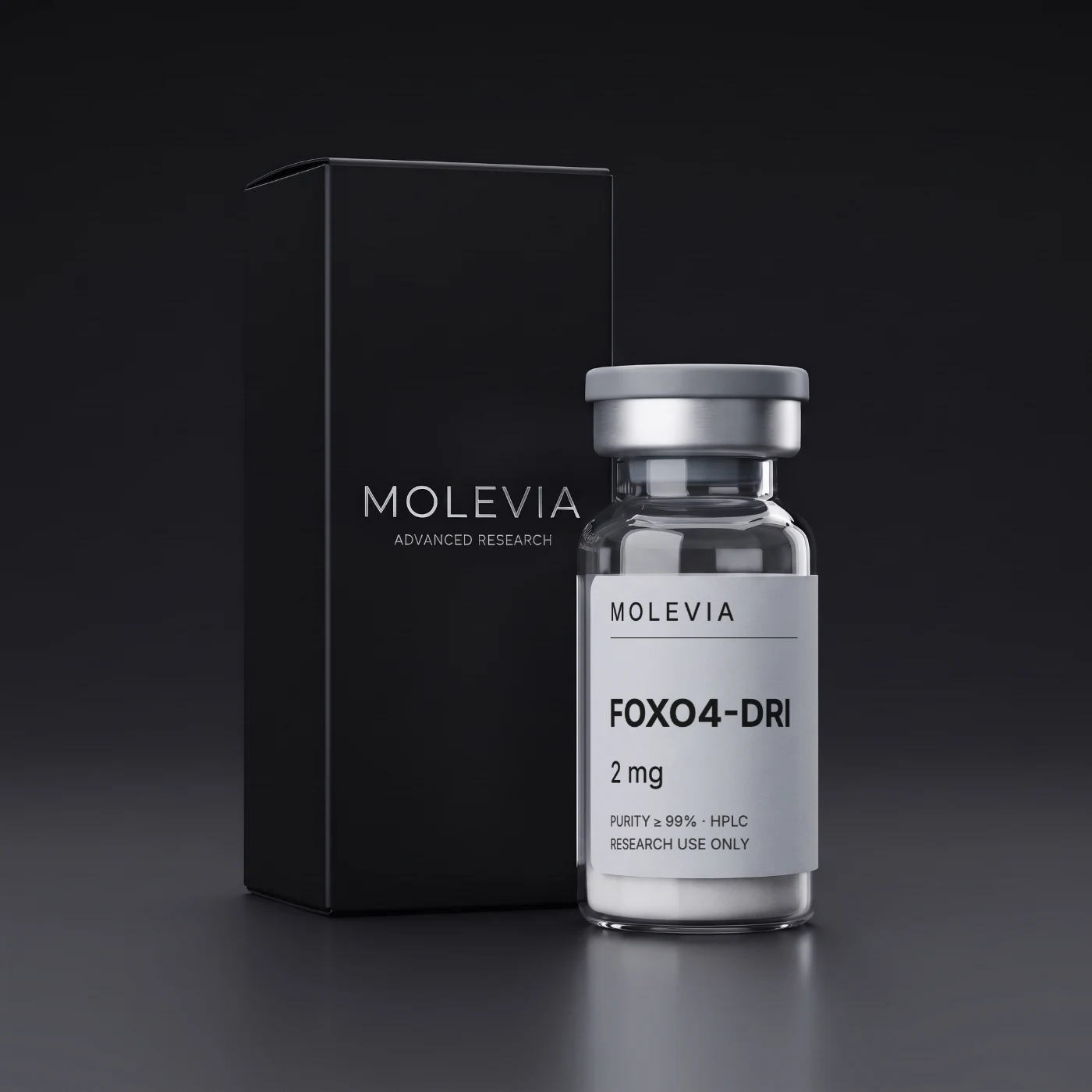
FOXO4-DRI: research overview
What is FOXO4-DRI
FOXO4-DRI is a synthetic peptide from the D-retro-inverso class. The amino acids in its chain have the D configuration, and the sequence runs in reverse order compared with the parent peptide. This arrangement reproduces the orientation of the side chains while making the molecule much less susceptible to breakdown by proteolytic enzymes. The result is a peptide that stays stable under experimental conditions.
The molecule is studied in research on the biology of ageing cells. Its main advantage is a precisely defined molecular target, which makes it possible to design experiments with a clear hypothesis and proper controls.
For teams planning a series of experiments, reproducibility matters too. The same batch and documented reconstitution parameters make it possible to compare results across successive experiments.
Mechanism reported in research
In senescent cells, the FOXO4 protein binds p53 in the nucleus and blocks its ability to trigger apoptosis. FOXO4-DRI disrupts this interaction. In the models described in the literature, p53 moved from the nucleus into the cytoplasm, and senescent cells entered the apoptotic pathway. The effect was observed mainly in ageing cells, which makes the peptide a convenient tool for studying the selective removal of senescent cells in culture.
Research areas
- Biology of senescent cells in in vitro models
- Selective elimination of ageing cells in cell cultures
- The FOXO4-p53 pathway and its role in cell survival
- Models of tissue ageing in laboratory animal studies
- Comparisons with other compounds from the cellular ageing field
Specification
| Parameter | Value |
|---|---|
| Name | FOXO4-DRI |
| Type | D-retro-inverso peptide |
| Category | cellular ageing |
| Form | lyophilized powder |
| Purity | ≥ 99% (HPLC) |
| Mass confirmation | MS |
| Available sizes | 2 mg, 10 mg |
Laboratory handling
Storing the lyophilized powder
Store the lyophilized powder at -20 °C, tightly sealed, away from moisture and light. Before opening a vial, let it reach room temperature so that condensation does not form on the substance.
Reconstitution and solution storage
The solvent is most often bacteriostatic water or other clean laboratory-grade water. Some protocols use dilute acetic acid to support dissolution. Always choose the solvent according to your study protocol. Add the liquid slowly along the wall of the vial and swirl gently until fully dissolved.
Store the ready solution at 2-8 °C. Avoid repeated freezing and thawing by dividing the solution into working aliquots.
Batch quality
Every FOXO4-DRI batch is tested by HPLC, which confirms purity ≥ 99%. MS analysis confirms the molecular mass. Results are tied to that specific batch, so your experimental results can be traced to a defined lot.
Related products
- NAD+ for research on cellular metabolism
- SS-31 for research on mitochondria
- Epitalon for research on cellular ageing
The full range is available in the cellular ageing category. Batch parameters are described on the quality page, and the concentration calculator helps you convert solution concentrations.


