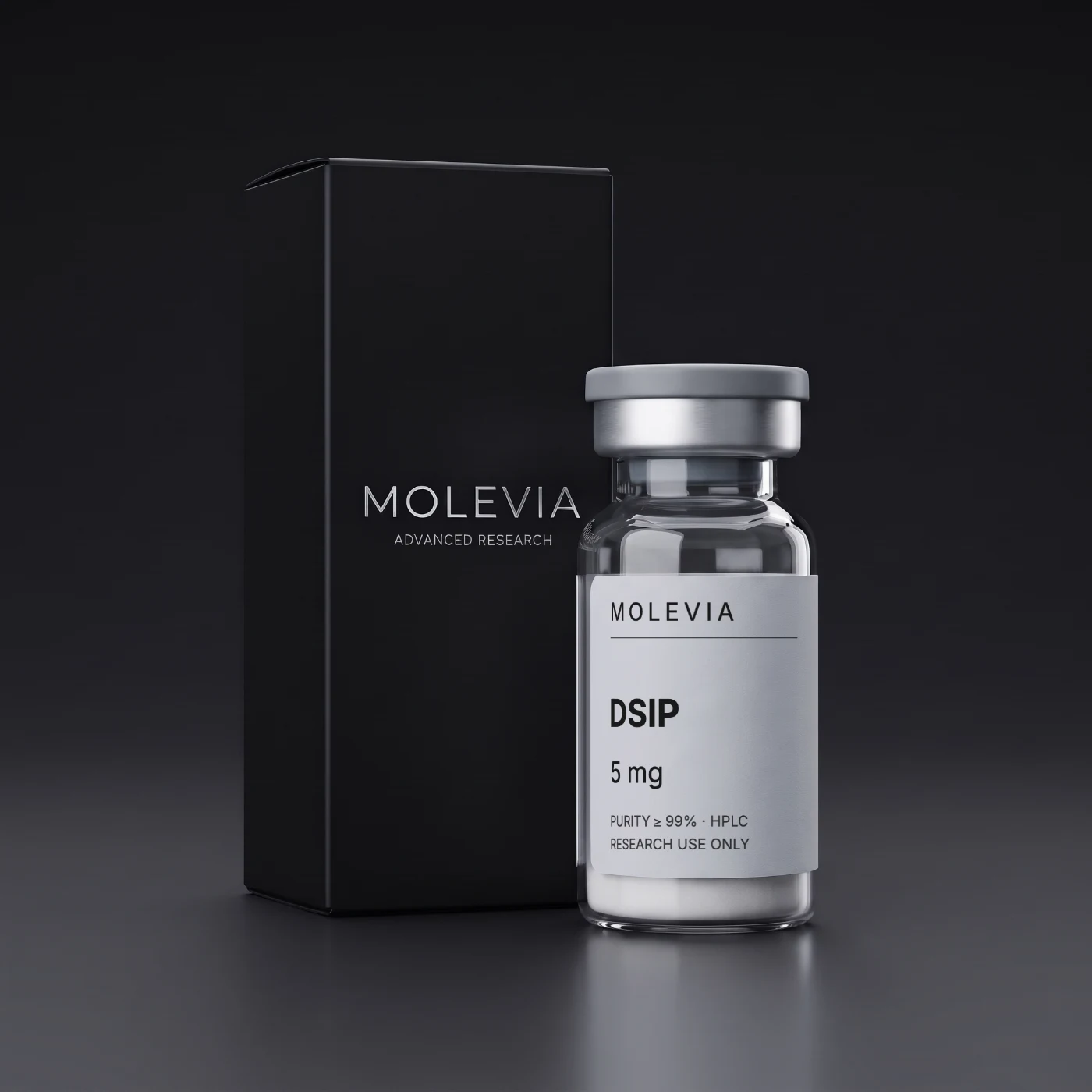
DSIP: research overview
What is DSIP
DSIP, short for delta sleep-inducing peptide, is a nonapeptide: a chain of nine amino acid residues linked by peptide bonds. Its sequence, Trp-Ala-Gly-Gly-Asp-Ala-Ser-Gly-Glu, is well documented, and the molecule has long served as a reference point in neurobiological literature.
The peptide was first isolated from the venous blood of rabbits during sleep research. Its name comes from the changes in delta wave activity observed in those experiments. Today DSIP is supplied as a research reagent in lyophilised form, ready to be reconstituted in the laboratory. Its low molecular mass and known sequence make experiments easier to plan and every batch easier to check.
Lyophilised vials in 5, 10, 15 and 20 mg and purity of ≥ 99% give you a solid starting point for reproducible work.
Mechanism described in research
Animal model studies have described links between DSIP and sleep-wake rhythms as well as EEG recordings. In vitro and preclinical work has also examined how the peptide relates to the hypothalamic-pituitary-adrenal axis and to the stress response.
The mechanism of action is not fully understood. The literature still debates which receptors and signalling pathways are involved, so research teams treat DSIP as a tool for precise questions rather than as a compound with a settled activity profile.
Research areas
- Neurobiology of sleep-wake rhythms in animal models
- Stress axis and neuroendocrine regulation in experimental studies
- Neuroprotection and oxidative stress studied in vitro
- Effects of neuropeptides on nerve cells in preclinical research
- Comparative studies of short peptide sequences
Reagent specification
| Parameter | Value |
|---|---|
| Name | DSIP (delta sleep-inducing peptide) |
| CAS number | 62568-57-4 |
| Formula | C35H48N10O15 |
| Molecular mass | 848.8 g/mol |
| Sequence | Trp-Ala-Gly-Gly-Asp-Ala-Ser-Gly-Glu |
| Form | lyophilised powder |
| Purity | ≥ 99% |
| Pack sizes | 5 mg, 10 mg, 15 mg, 20 mg |
Laboratory handling
Reconstitution and storage
- Lyophilised powder: store at -20 °C, tightly sealed and protected from light.
- Reconstitution: dissolve in sterile bacteriostatic water, swirling the vial gently. Do not shake the solution.
- After reconstitution: store the solution at 2-8 °C.
- Freezing: avoid repeated freezing and thawing, and divide the solution into smaller aliquots.
- Before opening: let the vial reach room temperature to reduce moisture condensation.
Bacteriostatic water as a solvent
Bacteriostatic water is the standard solvent for peptide work in the laboratory. It contains a preservative that limits microbial growth in a vial that has been opened. It is also available in our shop as a separate reagent.
Batch quality
Every DSIP batch is tested by HPLC, which confirms purity at ≥ 99%. The molecular mass of 848.8 g/mol is verified by mass spectrometry (MS). Each batch is identified by its batch number, which links the HPLC and MS results to a specific vial. Specifications can be compared from one order to the next, which matters when experiments are repeated and results are compared.
Related reagents
- Selank, from the same neuropeptide group
- Semax, another neuropeptide studied in research settings
- Kisspeptin-10 for neuroendocrine research
- PE-22-28 from the same neuropeptide category
- Dihexa from the same neuropeptide category
- Bacteriostatic water as a laboratory solvent
- The full neuropeptides category
- Quality
- Concentration calculator for preparing solutions


