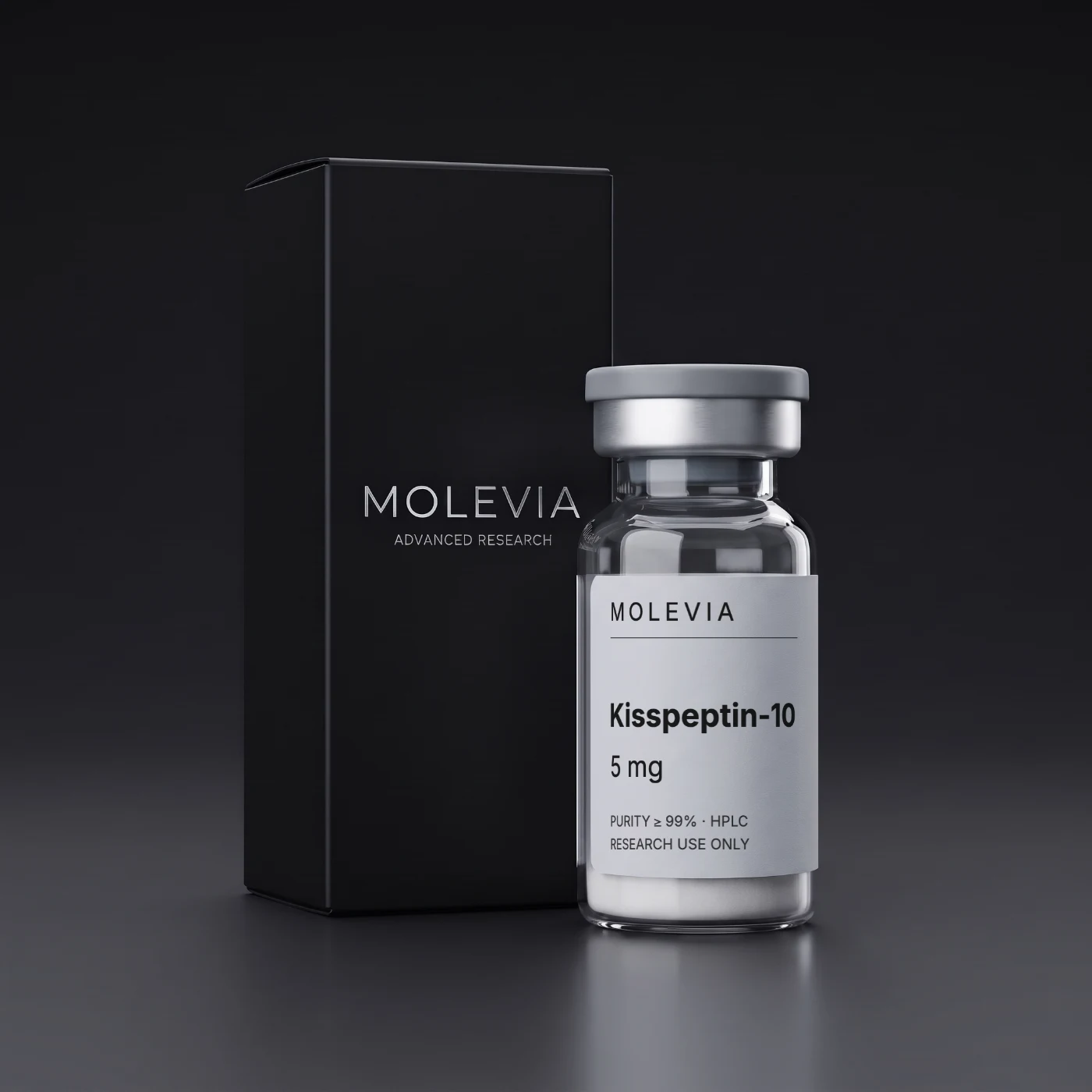
Kisspeptin-10: research overview
What is kisspeptin-10
Kisspeptin-10 is a decapeptide, a peptide built from ten amino acid residues. It belongs to the kisspeptin family, which derives from a precursor protein encoded by the KISS1 gene. The gene was first described in connection with metastasis suppression, and later work linked its products to the regulation of reproductive function.
The fragment keeps the C-terminal amide found in the naturally occurring form of this family. That structure makes kisspeptin-10 a convenient reference reagent for neuropeptide research.
The mechanism studied in research
Kisspeptins bind to the GPR54 receptor, also known as KISS1R. This G protein-coupled receptor starts an intracellular signalling cascade when it is activated.
In vitro studies have examined how receptor stimulation affects neurons that release gonadotropin-releasing hormone (GnRH). Animal model studies have described how this pathway influences the hypothalamic-pituitary-gonadal axis. The compound has also been the subject of clinical studies in humans, which gives researchers a well-documented point of reference when they design experiments.
Research areas
- neuroendocrinology and control of the hypothalamic-pituitary-gonadal axis
- GPR54 receptor signalling in cell models
- neurobiology of the kisspeptin system in animal studies
- GnRH release dynamics in in vitro systems
- peptide analytics, including purity and mass verification
Specifications
| Parameter | Value |
|---|---|
| Name | Kisspeptin-10 |
| CAS number | 374675-21-5 |
| Formula | C63H83N17O14 |
| Molecular mass | 1302.4 g/mol |
| Sequence | Tyr-Asn-Trp-Asn-Ser-Phe-Gly-Leu-Arg-Phe-NH2 |
| Form | lyophilised |
| Purity | 99% or higher (HPLC) |
Laboratory handling
Storage and reconstitution
| Form | Conditions |
|---|---|
| Lyophilised powder | -20 °C, tightly sealed, away from moisture and light |
| Reconstituted solution | 2-8 °C, avoid repeated freeze-thaw cycles |
The lyophilised form keeps its properties best when frozen. Once dissolved, divide the solution into smaller aliquots to limit freeze-thaw cycles.
Solvent
Bacteriostatic water is the standard solvent for reconstitution in laboratory work. Your research protocol sets the volume and concentration, and our concentration calculator converts the mass of the substance into solution strength.
Batch quality
Each batch is checked by HPLC and MS:
- HPLC: purity of 99% or higher, with separation of components and impurity profiling
- MS: confirmation of the 1302.4 g/mol molecular mass
This way every result links to a specific lot, and your documentation is complete from the first day you work with the reagent.
Related products
- Selank, a neuropeptide from the same research group
- DSIP, a neuropeptide studied in the context of sleep rhythms
- PT-141, a melanocortin analogue studied in the context of the nervous system
- PE-22-28, another research peptide available in 5 mg and 10 mg
- Dihexa, a research peptide available in 5 mg and 10 mg
Browse all neuropeptides in the range. Read about our testing on the quality page, and run your numbers in the concentration calculator.


