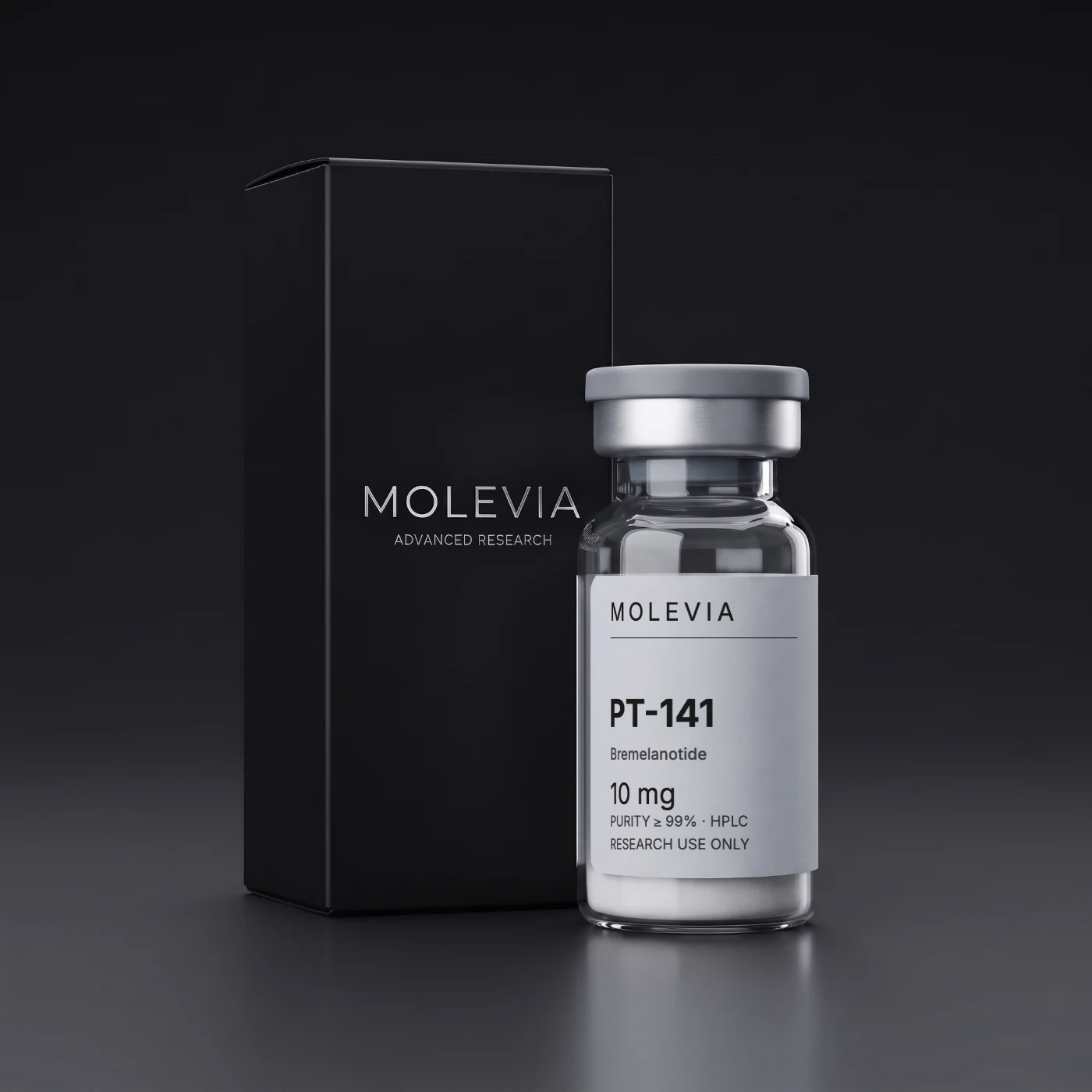
PT-141 (Bremelanotide): research overview
What is PT-141 (Bremelanotide)
PT-141, also known as bremelanotide, is a synthetic cyclic heptapeptide. It was developed in research on melanocortin analogues, a family of peptides derived from alpha-MSH, a naturally occurring hormone fragment. The molecule contains seven amino acid residues, and its ring is closed by an amide bond between aspartate and lysine.
The compound originates from research on melanotan II. Its cyclic structure gives the molecule a more constrained three-dimensional shape than linear analogues. The substance has been the subject of clinical studies, so a substantial body of published literature exists and is worth reviewing before you design your own experiment.
Mechanism described in research
PT-141 acts as an agonist at melanocortin receptors, chiefly MC3R and MC4R, and also at MC1R. These receptors belong to the G protein-coupled receptor family and take part in signal transmission in several tissues.
In vitro studies have observed activation of melanocortin receptors in cell lines that express them. Animal model studies have described effects on melanocortin pathways in the central nervous system. Results from preclinical models are best treated as a starting point for designing your own research protocol.
Areas of research
- Signalling through melanocortin receptors MC1R, MC3R and MC4R in in vitro models
- Melanocortin pathways in the central nervous system in animal model studies
- Structure-activity relationships of cyclic melanocortin analogues
- Stability of cyclic peptides in solution and analysis of their degradation products
- Purity and identity testing of the compound by HPLC and MS
Product profile
| Parameter | Value |
|---|---|
| Name | PT-141 (Bremelanotide) |
| CAS number | 189691-06-3 |
| Formula | C50H68N14O10 |
| Molecular mass | 1025.2 g/mol |
| Sequence | Ac-Nle-cyclo[Asp-His-D-Phe-Arg-Trp-Lys]-OH |
| Form | lyophilised powder |
| Purity | ≥ 99% (HPLC) |
| Variants | 10 mg |
Working in the laboratory
Reconstitution and storage
| Form | Temperature | Guidance |
|---|---|---|
| Lyophilised powder | -20 °C | Tightly sealed, protected from light |
| Solution after reconstitution | 2-8 °C | Use within the period set by your laboratory protocol |
| Repeated freezing | avoid | Divide the solution into aliquots |
Let the vial reach room temperature before opening it, to limit condensation of moisture. Choose the solvent to suit your planned experiment. Bacteriostatic water is a widely used solvent in laboratory work.
Batch quality
- HPLC: purity of at least 99%
- MS: confirmation of the molecular mass of 1025.2 g/mol
This lets you check the analytical result before the reagent enters your study.
See also
- Selank, a peptide from the neuropeptide research area
- Semax, an ACTH fragment analogue studied in neurological models
- DSIP, a neuropeptide associated with sleep research
- Melanotan 2, the linear melanocortin analogue this compound was derived from
- Melanotan 1, an MC1R receptor agonist studied in in vitro models
Read how we verify every batch on our quality page, and use the concentration calculator to work out solution concentrations.


