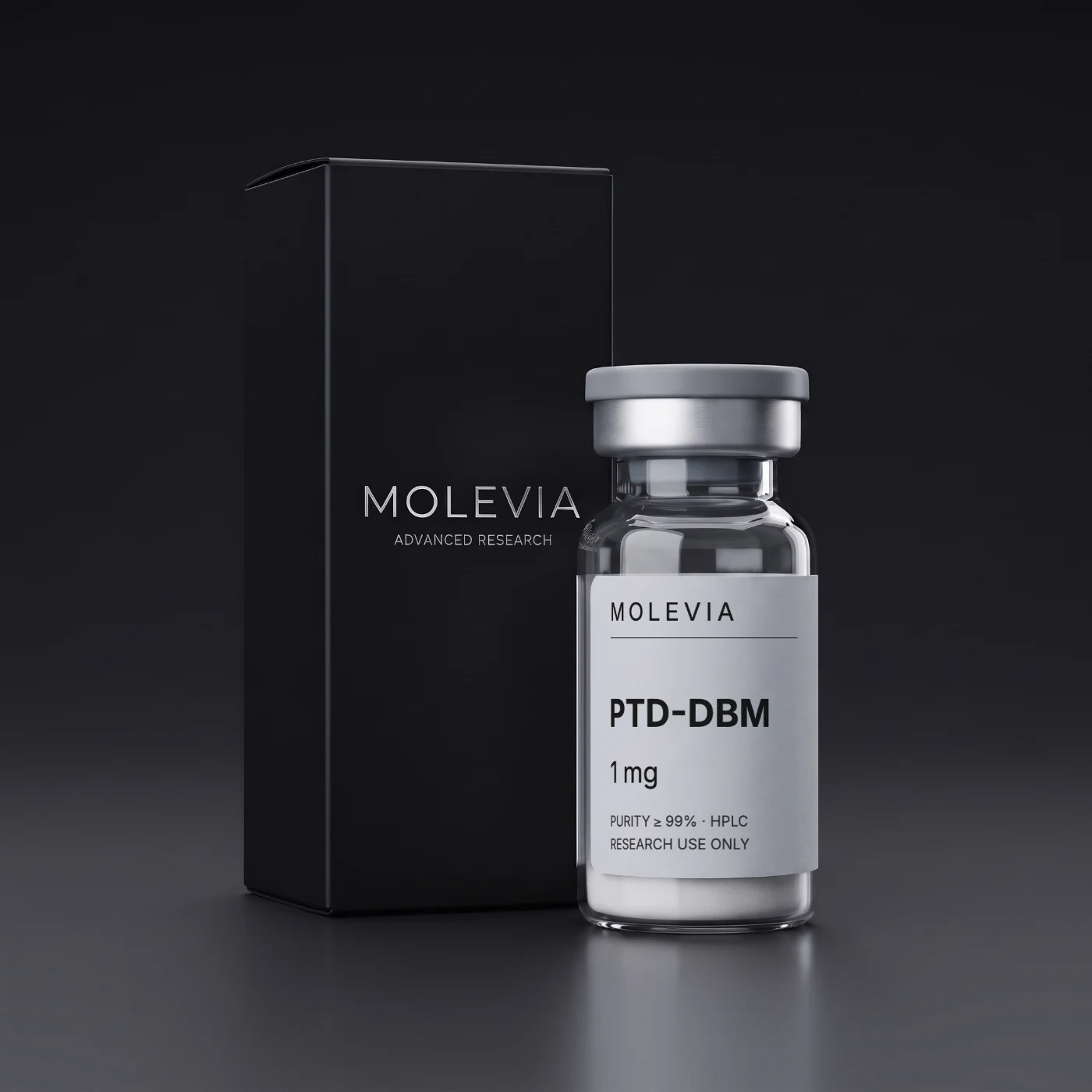
PTD-DBM: research overview
What is PTD-DBM
PTD-DBM is a synthetic peptide carrying a protein transduction domain, abbreviated PTD. Such a domain is a short sequence that helps a molecule cross the cell membrane in vitro. This allows the peptide to act inside cultured cells rather than only on their surface.
We supply PTD-DBM as a lyophilized powder. Every batch has a purity of ≥ 99% confirmed by HPLC and a molecular mass verified by MS.
Mechanism described in research
Research on PTD-DBM focuses on the Wnt signalling pathway, which takes part in many developmental and regenerative processes. In the published work, the peptide disrupts the binding of the CXXC5 protein to Dishevelled, a key component of this pathway. This lets researchers examine how Wnt signalling changes in cells and tissues.
The mechanism has been described in experimental models and is not yet fully understood. Every experiment needs a control group without the peptide and a solvent control, so that the effect of disrupting the interaction can be separated from the effect of simply having the molecule in the system.
Areas of research
- hair follicle models in laboratory studies
- the Wnt pathway and the interaction of CXXC5 with Dishevelled
- passage of peptides across cell membranes in culture
- biology of skin and follicle epithelial cells
- analysis of cell signalling with biochemical methods
- comparisons with other skin peptides in the same model
Reagent profile
| Parameter | Value |
|---|---|
| Name | PTD-DBM |
| Category | skin peptides |
| Form | lyophilized powder |
| Purity | ≥ 99% (HPLC) |
| Molecular mass | confirmed by MS in every batch |
| Available sizes | 1 mg |
Working in the laboratory
Lyophilized powder
Store the powder at -20 °C, tightly sealed and protected from light. Before opening the vial, let it warm to room temperature.
Solution after reconstitution
Keep the ready solution at 2-8 °C. Avoid repeated freezing and thawing, so it is better to divide the solution into smaller working aliquots.
Role of the solvent
The standard solvent in the laboratory is bacteriostatic water. Diluted acetic acid is sometimes used for peptides with weaker solubility in water. Always confirm the choice of solvent against your study protocol.
Quality of every batch
- HPLC confirms purity of ≥ 99%
- MS confirms the molecular mass
- the HPLC and MS results can be checked before you start work, which simplifies laboratory documentation
Related products
- GHK-Cu, a copper complex of a tripeptide, also from the skin peptide group
- AHK-Cu, another copper peptide for skin research
- Matrixyl, a palmitoylated pentapeptide from the same category
You can browse all reagents in this group in the skin peptides category. Quality parameters are described on the quality page, and the concentration calculator helps with dilution planning.


