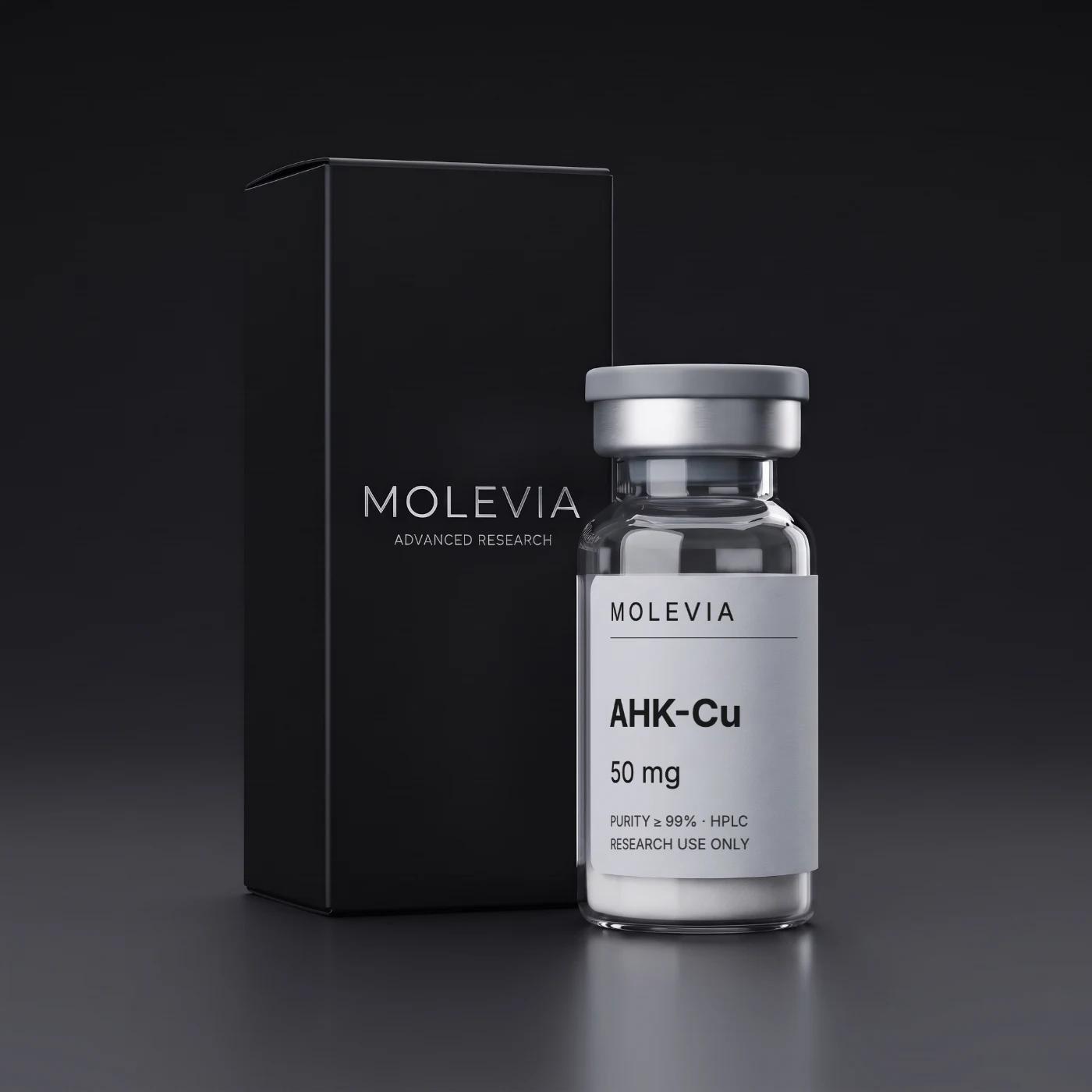
AHK-Cu: research overview
What AHK-Cu is
AHK-Cu is a copper(II) complex of the tripeptide alanine-histidine-lysine (Ala-His-Lys). The Cu2+ ion is bound to the peptide molecule, and this is the form we supply as a research reagent. AHK-Cu belongs to the family of copper peptides, which also includes the better-known GHK-Cu. The difference lies in the first amino acid of the sequence: GHK-Cu contains glycine where AHK-Cu has alanine.
Our AHK-Cu is chemically synthesized and supplied as a lyophilized powder. Every batch goes through purity and molecular mass testing.
Mechanism described in research
Research on AHK-Cu focuses on hair follicles. In in vitro models, researchers have described the effect of the complex on dermal papilla cells, the mesenchymal cell population that regulates hair growth. Changes in cell signalling and in the expression of genes linked to follicle activity have been observed.
An important part of this work is the role of the copper ion itself, which acts as a cofactor for many enzymes. For that reason, well-designed experiments include a control with copper alone under the same conditions, so the effect of the peptide can be separated from the effect of the metal.
The mechanism of action has not yet been fully described, and the results come from different experimental models. Each project requires its own control group and carefully selected culture conditions.
Research areas
- biology of hair follicles in in vitro cultures
- dermal papilla cells and the signalling that regulates hair growth
- gene expression analysis after exposure to the peptide
- the role of the copper ion in skin and follicle cells
- copper transport and homeostasis in cell cultures
Reagent profile
| Parameter | Value |
|---|---|
| Name | AHK-Cu |
| Category | skin peptides |
| Sequence | Ala-His-Lys with Cu2+ ion |
| Form | lyophilized powder |
| Purity | ≥ 99% (HPLC) |
| Available sizes | 50 mg, 100 mg |
Working in the laboratory
Lyophilized powder
Store the vial at -20 °C, tightly closed and protected from light. Before opening, let it reach room temperature to avoid moisture condensing on the powder. Before reconstitution, check that the powder is uniform and the vial is intact, and record any changes in your lab log.
Solvent
The role of the solvent is to dissolve the lyophilized powder into a solution of predictable composition. Bacteriostatic water is the most common choice, as it limits microbial growth in a solution kept in the refrigerator. Some protocols use acetic acid at a defined concentration instead. The choice of solvent and its volume always follow the research protocol.
Reconstitution and solution storage
Carry out reconstitution in the laboratory, adding the solvent slowly along the wall of the vial without vigorous shaking. Store the finished solution at 2-8 °C. Avoid repeated freezing and thawing, because repeated temperature changes can affect the stability of the peptide. Set the use-by period based on your laboratory protocol.
Batch quality
Every AHK-Cu batch is analysed by HPLC, which confirms purity at ≥ 99%, and by mass spectrometry (MS), which confirms the molecular mass. Each batch is identified by its batch number, so you can match the result to a specific vial. We describe our quality control rules on the quality page.
Related products
- GHK-Cu, the closest analogue in the same copper peptide family
- GHK, the tripeptide without the copper ion
- Matrixyl, a peptide from the skin peptides group
You can browse the full range in the skin peptides category. Calculate concentrations and solvent volumes in the concentration calculator.


