All products are chemical reagents for scientific research only. Not for consumption or use in humans or animals. Policy
Orders placed by 2 pm (CET) on a business day ship the same day. Free shipping from €75 Purity ≥ 99% (HPLC)
In stock

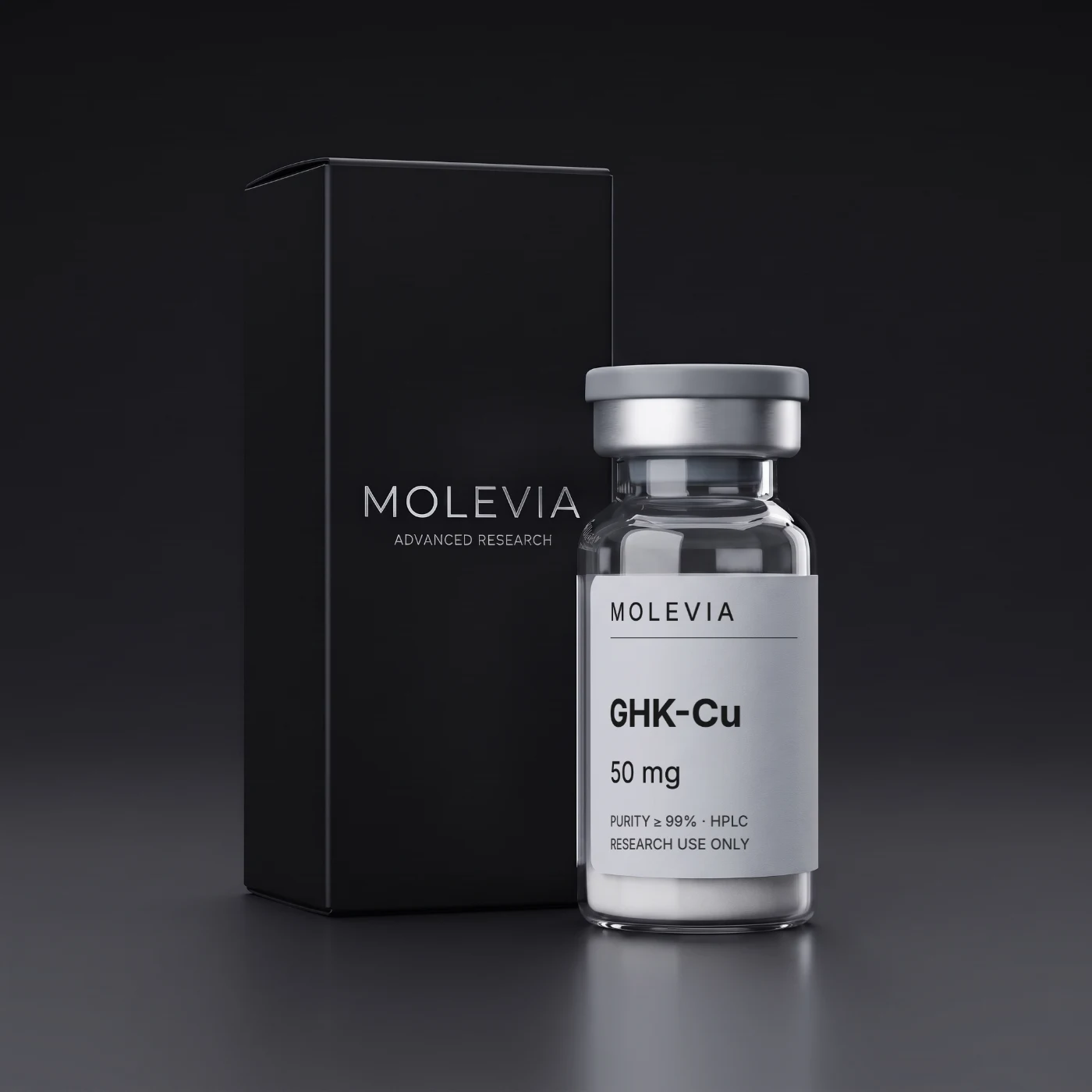
GHK-Cu copper peptide complex, lyophilised

A research reagent for laboratory use: GHK-Cu, a copper(II) complex of the Gly-His-Lys tripeptide supplied as a lyophilised powder. Every batch comes with HPLC purity and MS.

€18.99 Price includes VAT

Lowest price in the last 30 days: €18.99

Research Use Only: for laboratory and scientific research only
Size

Secure payment: encrypted connection, processed by Stripe

Choose quantity and save

The discount is applied automatically in the cart, no code needed. All peptides and compounds count, lab supplies excluded.

Complete your research set

Total:

The volume discount is applied automatically in the cart.

Free 10 ml bacteriostatic water with orders from €50 that include a vial peptide.
Orders placed by 2 pm (CET) on a business day ship the same day.

Ask about this product

  • Purity ≥ 99% (HPLC)
  • Free shipping from €75
  • Storage: −20 °C

GHK-Cu specifications

FormLyophilised powder in a vial
Also known asGHK Cu, GHKCu
Purity≥ 99% (HPLC)
CAS number49557-75-7
Molecular formulaC14H22CuN6O4
Molar mass401.9 g/mol
SequenceGly-His-Lys · Cu²⁺
StorageLyophilised: −20 °C, protected from light. After reconstitution: 2 to 8 °C.

Size comparison: GHK-Cu

SizePricePrice per mgPage
50 mg€18.99€0.38 View
100 mg€32.99€0.33 View

GHK-Cu: research overview

What is GHK-Cu

GHK-Cu is a copper(II) complex of the tripeptide glycyl-histidyl-lysine. The Cu2+ ion is bound to the peptide, and this complex is the form we supply as a research reagent. The tripeptide GHK was first described in human plasma in the 1970s and has been studied in laboratories ever since, mainly because of its strong affinity for copper.

Our GHK-Cu is chemically synthesised and supplied as a lyophilised powder. The molecular weight of 401.9 g/mol is confirmed for every batch by mass spectrometry.

Mechanism studied in research

In vitro studies have observed the effects of the copper complex on fibroblasts, the cells responsible for building the extracellular matrix. Researchers have described changes in gene expression linked to tissue remodelling and to the synthesis of collagen and elastin.

Animal model studies have described the compound in the context of wound healing and connective tissue repair. Some reports also focus on antioxidant activity and on the role of copper as a cofactor for enzymes.

The mechanism is not fully understood, and results come from different experimental models. Every study therefore needs its own control group and carefully chosen conditions.

Research areas

  • fibroblast biology and extracellular matrix synthesis
  • wound healing and connective tissue repair models in animal studies
  • skin ageing research using in vitro models
  • copper transport and homeostasis in cell cultures
  • gene expression analysis following peptide exposure
  • antioxidant research and interactions with copper-dependent enzymes

Product specifications

Parameter Value
Name GHK-Cu
CAS number 49557-75-7
Molecular formula C14H22CuN6O4
Molecular weight 401.9 g/mol
Sequence Gly-His-Lys with Cu2+ ion
Form lyophilised powder
Purity 99% or higher (HPLC)
Variants 50 mg, 100 mg

Laboratory handling

Lyophilised powder

Store the vial at -20 °C, tightly sealed and protected from light. Before opening, let it reach room temperature so that moisture does not condense on the powder.

Reconstitution and solution

Carry out reconstitution in the laboratory, using bacteriostatic water as the solvent. Keep the ready solution at 2-8 °C. Avoid repeated freezing and thawing, as repeated cycles may affect the stability of the peptide. Set the period of use according to your laboratory protocol.

Solvent

Bacteriostatic water is available in our range as a separate product for laboratory work, chosen to suit your research protocol.

Batch quality

Every batch of GHK-Cu is tested by HPLC, which confirms purity of 99% or higher, and by mass spectrometry (MS), which confirms the molecular weight. Each batch is identified by its batch number, so each result can be traced to a specific vial. Read more about our testing standards on the quality page.

To work out solution concentrations, use our concentration calculator.

GHK-Cu: frequently asked questions

How should I store GHK-Cu in lyophilised form?

Store the lyophilised powder at -20 °C, tightly sealed and protected from light. Before opening the vial, let it reach room temperature to limit moisture condensation on the powder.

How do I reconstitute GHK-Cu and how long can the solution be kept?

Reconstitution is carried out in the laboratory, using bacteriostatic water as the solvent. Keep the solution at 2-8 °C and avoid repeated freezing and thawing. Your laboratory protocol sets the recommended period of use.

What is the difference between the 50 mg and 100 mg variants?

The variants differ only in the amount of lyophilised powder in the vial. Composition, form, purity and recommended storage conditions are identical, so the choice depends on the scale of your planned experiment.

How does shipping work within Poland and across Europe?

Within Poland we deliver to InPost Paczkomat lockers with next working day delivery. To 29 European countries we ship by DPD courier in 2-4 working days. Orders placed by 14:00 on a working day are dispatched the same day. Delivery is free from 75 EUR, 65 GBP or 80 USD.

What is the molecular structure of GHK-Cu?

GHK-Cu is a copper(II) complex of the Gly-His-Lys tripeptide, with the molecular formula C14H22CuN6O4 and a molecular weight of 401.9 g/mol. The Cu2+ ion binds to the histidine residue and to the terminal amino group of the peptide.

Rate this product

Average: 4.9/5 · 771 reviews

Click a star: from 1 to 5.

Related reagents

Skin peptides

PTD-DBM

1 mg
€25.99