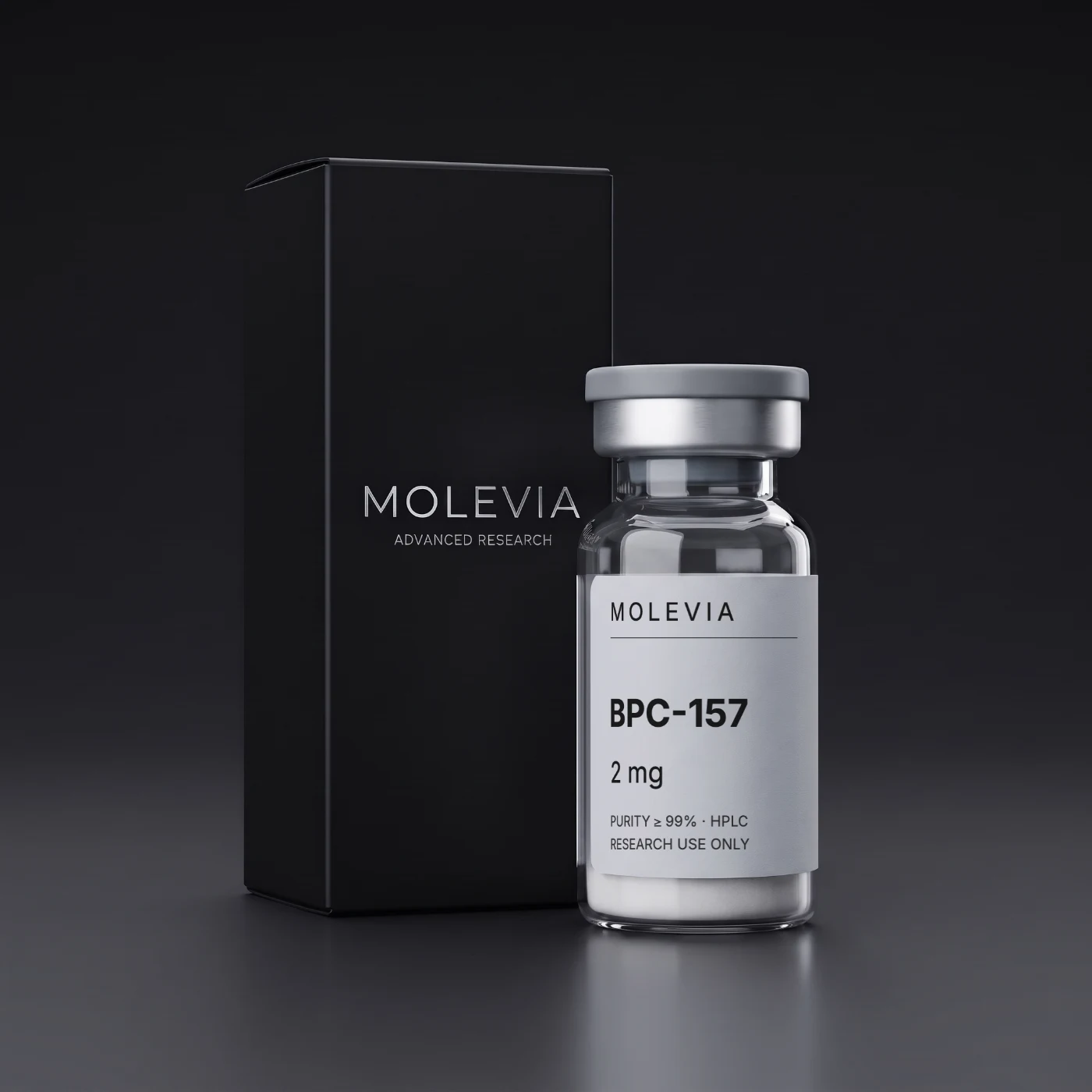
BPC-157: research overview
What is BPC-157
BPC-157 is a pentadecapeptide, a chain of 15 amino acid residues. The molecule is described as a fragment of a protein found in gastric juice, which is why it appears often in the literature on tissue repair and regeneration. For research teams it is supplied as a lyophilised powder, ready to be reconstituted in the laboratory.
A well-defined sequence makes BPC-157 a practical reference compound for comparative work. Sequence and mass are confirmed analytically, so every batch matches the same specification. Knowing the structure also helps you choose a suitable solvent for laboratory work.
Mechanism described in research
In vitro studies have observed effects of BPC-157 on the migration and proliferation of fibroblasts and endothelial cells. Animal model studies have described a link with the expression of vascular endothelial growth factor (VEGF) and with processes involved in the formation of new blood vessels.
Some work has also examined the gut-brain axis and the enteric nervous system. These mechanisms remain an active field of research, and most of the data come from preclinical models, so they are best treated as a starting point for your own experiments.
Areas of research
- Tendon and connective tissue biology in in vitro models
- Angiogenesis and tissue vascularisation in experimental settings
- Protection of the gastrointestinal mucosa in animal models
- The gut-brain axis in neuropharmacological studies
- Inflammatory and repair processes in experimental models
Product profile
| Parameter | Value |
|---|---|
| Name | BPC-157 |
| CAS number | 137525-51-0 |
| Formula | C62H98N16O22 |
| Mass | 1419.5 g/mol |
| Sequence | Gly-Glu-Pro-Pro-Pro-Gly-Lys-Pro-Ala-Asp-Asp-Ala-Gly-Leu-Val |
| Form | lyophilised powder |
| Available sizes | 2 mg, 5 mg, 10 mg, 20 mg |
| Purity | ≥ 99% |
Working in the laboratory
Reconstitution and storage
- Lyophilised powder: store at -20 °C, tightly sealed and protected from light.
- After reconstitution: keep the solution at 2-8 °C.
- Freezing: avoid repeated freezing and thawing, and divide the solution into smaller aliquots.
- Before opening: let the vial reach room temperature to limit moisture condensation.
Bacteriostatic water as a solvent
Sterile bacteriostatic water is the usual solvent for reconstitution in laboratory work. Before use, check the expiry date and the markings on the vial, and record the reconstitution date and batch number in your laboratory log. You can find the full range of reagents and accessories in the lab supplies category.
Batch quality
- HPLC: confirms purity at 99% or higher.
- MS: confirms the molecular mass.
HPLC separates the components of the sample and shows the share of the main peak, which is the basis of the purity result. Mass spectrometry confirms that the molecular mass matches the theoretical value of 1419.5 g/mol. Combining both methods gives a fuller picture of the reagent.
Each batch of BPC-157 has its own number, so the data always refer to the specific reagent you are working with.
Related products
- TB-500: a second peptide from the tissue research group.
- BPC-157 + TB-500: a combination set for parallel studies.
- KPV: a peptide from the inflammation research area.
- GLOW: a blend of BPC-157, TB-500 and GHK-Cu for parallel studies.
- ARA-290: a peptide from the tissue research group.
You can also review our quality standards and try the concentration calculator, which works out the concentration of a solution after reconstitution.


