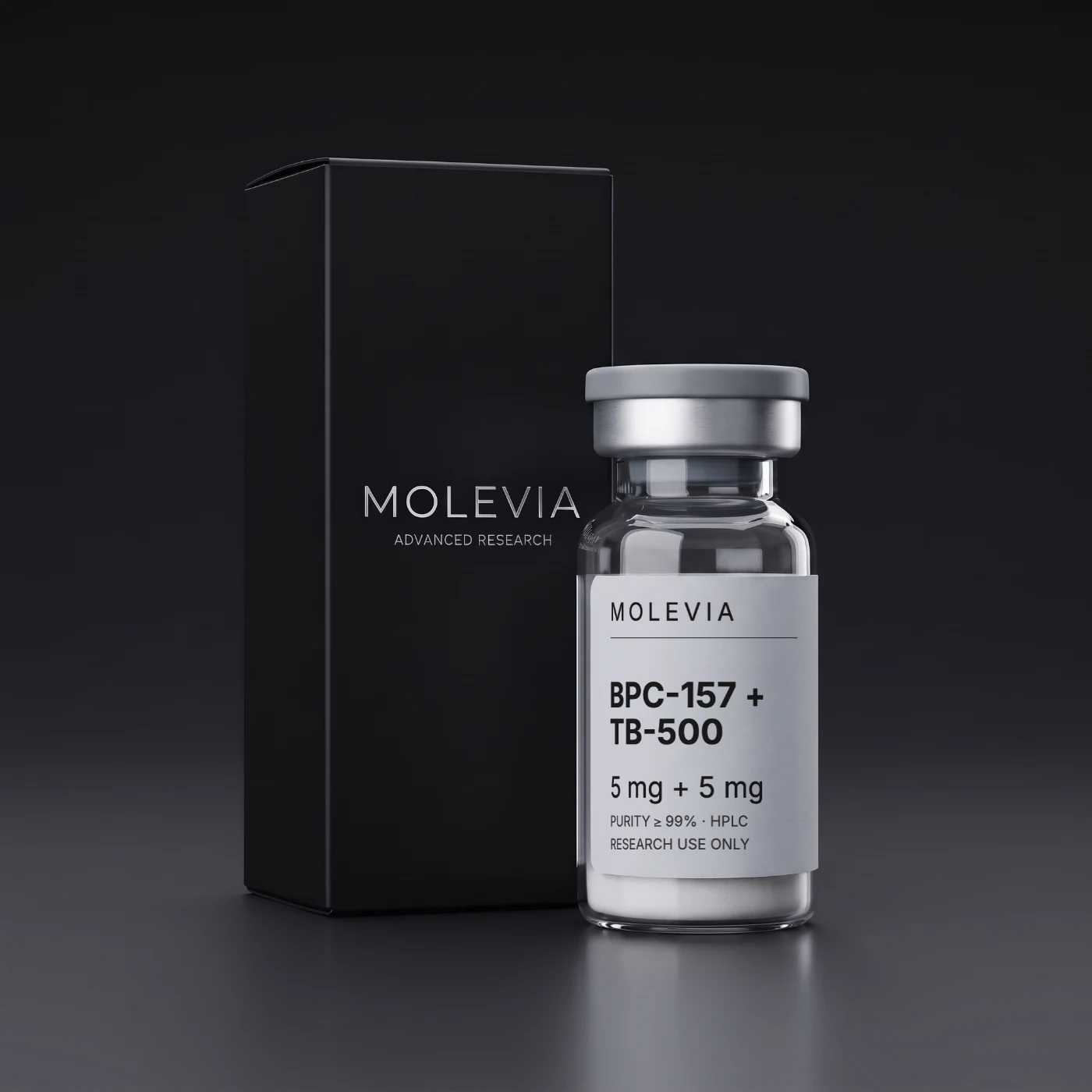
BPC-157 + TB-500: research overview
BPC-157 + TB-500 combines two research peptides in one vial, prepared for laboratory work. Both compounds appear in the scientific literature as subjects of studies on tissue repair, angiogenesis and cell migration. This is a research reagent, intended solely for in vitro work and laboratory practice.
What BPC-157 and TB-500 are
BPC-157 is a peptide built from 15 amino acids. The literature describes it as a fragment of a sequence found in gastric juice. Its compact, stable structure makes it a frequent choice for research models.
TB-500 is a synthetic fragment of thymosin beta-4, a naturally occurring peptide of 43 amino acids. Researchers work with its shorter, acetylated form, Ac-LKKTETQ, which retains the region responsible for binding actin.
Mechanisms described in research
In vitro studies and animal models describe several connected pathways that both peptides are associated with:
- Animal model studies have described the effect of BPC-157 on angiogenesis, the formation of new blood vessels, involving the VEGF pathway.
- In vitro studies have observed BPC-157 engaging the FAK-paxillin pathway, which regulates cell adhesion and movement.
- In vitro, TB-500 bound monomeric G-actin, a process relevant to cytoskeleton organisation and cell migration.
Research areas
- Soft tissue repair models in animal research
- Angiogenesis in endothelial cell cultures
- Fibroblast and endothelial cell migration in in vitro assays
- Cytoskeleton dynamics and actin function
- Comparative studies of short-sequence peptides
Product specifications
| Parameter | BPC-157 | TB-500 (Ac-LKKTETQ) |
|---|---|---|
| Name | BPC-157 | TB-500 |
| CAS number | 137525-51-0 | 77591-33-4 |
| Formula | C62H98N16O22 | C38H68N10O14 |
| Molecular weight | approx. 1419.5 g/mol | approx. 889.0 g/mol |
| Sequence | GEPPPGKPADDAGLV | Ac-LKKTETQ |
| Form | lyophilized powder | lyophilized powder |
| Available amounts | 5, 10 or 15 mg | 5, 10 or 15 mg |
| Purity | ≥ 99% (HPLC) | ≥ 99% (HPLC) |
The overview makes it quick to see which compound fits the assumptions of your research project and which parameters need checking before work begins. For many teams, this is the first step in planning an experiment, before the control group and measurement method are set.
Working in the laboratory
Reconstitution and storage
- Lyophilized powder should be stored at -20 °C until use.
- After reconstitution, keep the solution at 2-8 °C.
- Avoid repeated freezing and thawing. For regular work, it is practical to prepare aliquots.
- Bacteriostatic water serves as the solvent in laboratory work. It is available in our shop.
Quality of every batch
- HPLC confirms purity at ≥ 99%.
- MS (mass spectrometry) confirms a molecular mass consistent with the peptide structure.
You can read more about our testing process on the quality page.
Related products
- BPC-157 as a separate lyophilized peptide for comparative studies
- TB-500 as a standalone thymosin beta-4 fragment
- GLOW as a blend of BPC-157, TB-500 and GHK-Cu
- KLOW as a blend of BPC-157, TB-500, GHK-Cu and KPV
- Bacteriostatic water for preparing solutions
Calculate your solution concentrations with the concentration calculator.


