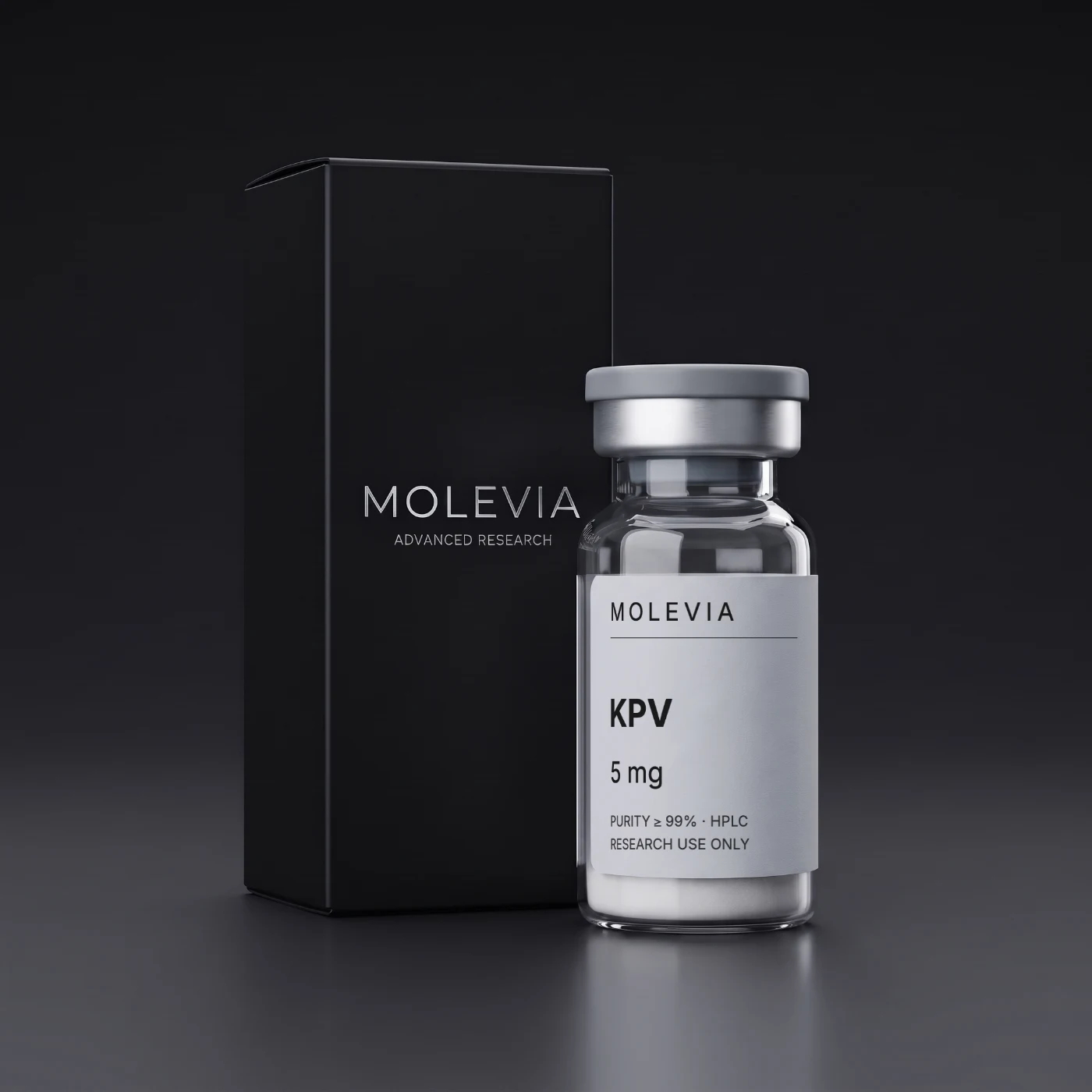
KPV: research overview
What is KPV
KPV is a tripeptide made of lysine, proline and valine, written Lys-Pro-Val. Its structure matches the C-terminal end of alpha-MSH, a naturally occurring peptide from the melanocortin family. Each vial is made by chemical synthesis and supplied as a lyophilised powder with purity of 99% or higher, ready for the lab bench.
A short, well-defined chain of three amino acids makes KPV a clean model for research into how peptide structure relates to biological activity. Fewer residues mean results are easier to interpret and easier to compare with longer sequences.
The mechanism described in research
In vitro and animal model studies have described effects of KPV on pathways linked to the inflammatory response, including the production of pro-inflammatory cytokines. Some reports mention an influence on NF-κB, a central regulator of inflammatory signalling.
The details depend heavily on the model used. How KPV behaves at the cellular level is still being mapped by researchers, and the picture changes with each new experimental setup. Results are best read against a control group run in the same system, because only that comparison makes a difference clearly visible.
Research areas
- inflammatory response in cell culture models,
- animal models of intestinal mucosal inflammation,
- stability and handling of short peptides in solution,
- links between amino acid sequence and activity in in vitro models.
Because the molecule is small, handling in solution is often the first thing a lab checks when it sets up a new study. Starting from a well-characterised material keeps the variables under control from the first pipetting step.
Product specifications
| Parameter | Value |
|---|---|
| Name | KPV (Lys-Pro-Val) |
| CAS number | 67727-97-3 |
| Molecular formula | C16H30N4O4 |
| Molecular mass | 342.4 g/mol |
| Sequence | Lys-Pro-Val |
| Form | lyophilised powder |
| Purity | 99% or higher (HPLC) |
| Pack sizes | 5 mg and 10 mg |
Laboratory handling
Reconstitution and storage
- Lyophilised powder: store at -20 °C, tightly sealed and protected from moisture.
- Reconstituted solution: store at 2-8 °C.
- Freezing: avoid repeated freezing and thawing. Split the solution into aliquots early on.
- Solvent: choose one that suits your experiment. Bacteriostatic water, available in our shop, is a common solvent in laboratory work.
Before first use, record the batch number, the reconstitution date and the number of freezes of the solution in your lab notebook. Such notes make it easier to repeat experiments and to explain differences between measurement series.
Batch quality
Every batch is checked by HPLC for purity and by mass spectrometry (MS) to confirm molecular mass. Each batch is identified by its batch number. You can read more about our standards on the quality page.
Related products
- BPC-157, a compound from the same tissue research range
- TB-500, another peptide in tissue research
- Thymosin alpha-1, a peptide studied in immunological in vitro models
- LL-37, a human peptide from the cathelicidin family, studied in innate immunity models
- ARA-290, an erythropoietin-derived peptide used in research on the IRR receptor
Browse the full tissue research category, or work out your concentrations with the concentration calculator.


