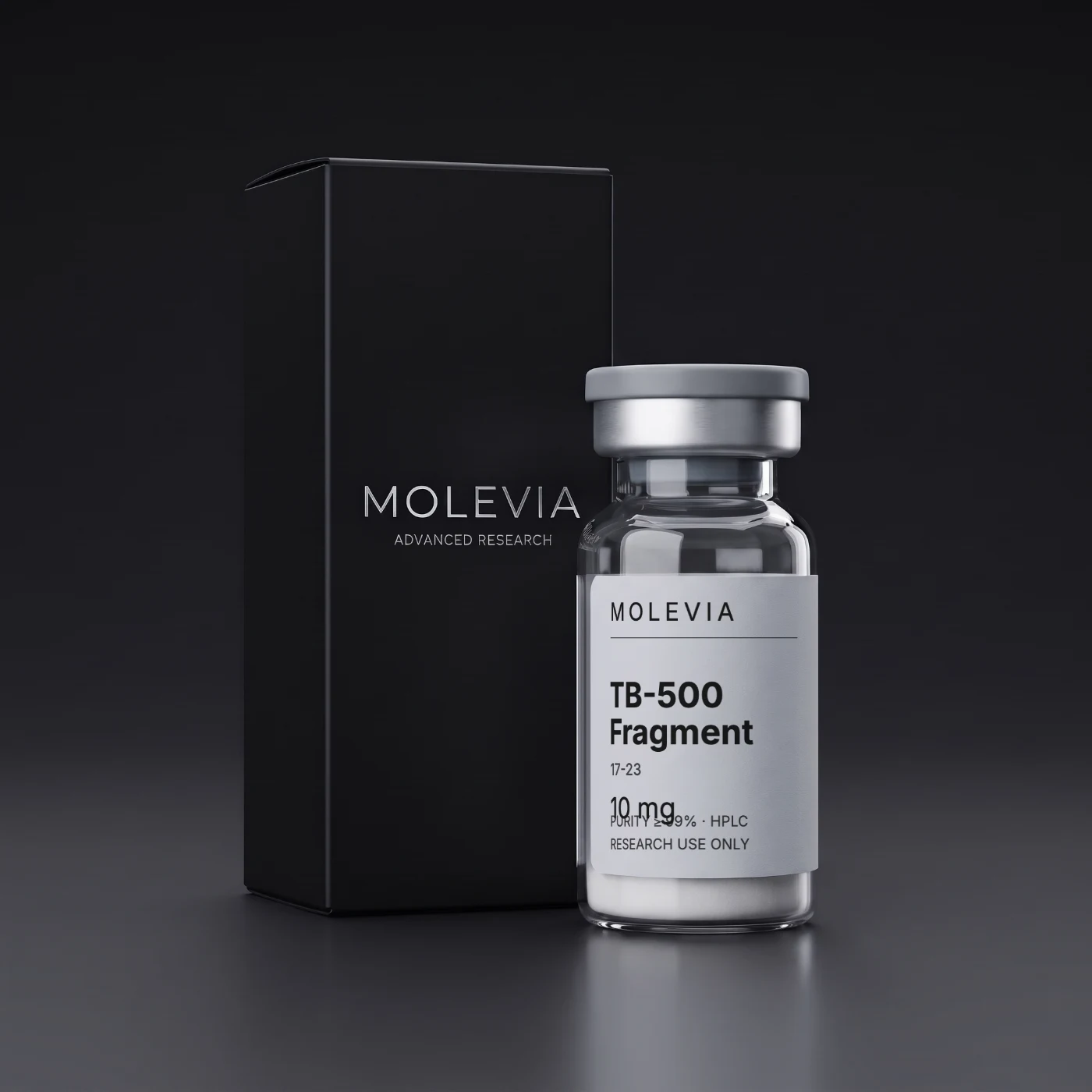
TB-500 Fragment (17-23): research overview
Looking for a thymosin beta-4 fragment for laboratory work? TB-500 Fragment (17-23) is a MOLEVIA research peptide supplied in a convenient 10 mg vial. Every batch comes with confirmed purity and mass.
What is TB-500 Fragment (17-23)
TB-500 Fragment (17-23) is a short fragment of thymosin beta-4, a member of the thymosin family first isolated from the thymus gland. The reagent corresponds to region 17-23 of the parent protein and has the sequence Ac-LKKTETQ: seven amino acid residues with an acetylated N-terminus.
A short and well-defined sequence makes experiments easier to repeat and results easier to interpret. That is why laboratories studying cytoskeleton dynamics and cell behaviour in culture often choose this fragment.
Mechanism described in research
The 17-23 region of thymosin beta-4 is the part of the molecule that binds actin. In vitro studies describe how this peptide interacts with monomeric G-actin and influences the balance between monomers and actin filaments. That balance drives cytoskeleton dynamics, the internal scaffold that shapes a cell and enables it to move.
Observations from cell cultures link this mechanism to cell motility and migration. Results depend on the model, the concentration and the conditions of the experiment, so every study needs its own controls.
Research areas
- actin binding and cytoskeleton dynamics in in vitro models
- cell migration and motility in culture
- tissue repair processes in animal models
- blood vessel formation in angiogenesis models
Clinical context
The full-length thymosin beta-4 has been studied in clinical trials, as reported in the published literature. The 17-23 fragment itself remains a laboratory reagent, supplied strictly for research use only.
Product specification
| Parameter | Value |
|---|---|
| Name | TB-500 Fragment (17-23) |
| Sequence | Ac-LKKTETQ |
| Form | lyophilised powder |
| Purity | ≥ 99% (HPLC) |
| Molecular mass | confirmed by MS |
| Available size | 10 mg |
Working in the laboratory
Storing the lyophilisate
- Keep the lyophilised vial at -20 °C, tightly sealed and protected from moisture.
- Before opening, let the vial reach room temperature to limit condensation.
Reconstitution and the role of the solvent
Your protocol decides which solvent to use. Bacteriostatic water is the most common choice in laboratories: it dissolves the peptide to form the working solution, and its bacteriostatic preservative slows microbial growth during handling. Some protocols use water with a small amount of acetic acid, which helps dissolve peptides. Both solvents are available in our shop: bacteriostatic water and acetic acid in water.
Working solution
- Once reconstituted, keep the solution at 2-8 °C.
- Avoid repeated freezing and thawing. Divide the solution into working aliquots.
Batch quality
Every batch undergoes HPLC analysis, which confirms purity of at least 99%. Molecular mass is checked by mass spectrometry (MS).
Ordering and delivery
Orders placed by 14:00 on a working day ship the same day. InPost Paczkomat in Poland delivers on the next working day, and DPD delivers to 29 European countries in 2-4 working days. Delivery is free from 75 EUR, 65 GBP or 80 USD.
Quantity discounts apply automatically: 2 units -5%, 3 units -10%, 5 units -15%. Orders from 50 EUR (40 GBP, 55 USD) that include a peptide vial also get 10 ml of bacteriostatic water free. Pay online by card, Apple Pay, Google Pay or BLIK (PLN only).
Related products and tools
- TB-500, a peptide from the same thymosin family, useful for comparisons in tissue research
- BPC-157, a peptide often studied alongside thymosin in tissue models
- BPC-157 and TB-500, a product combining both peptides
- Tissue research category
- Quality
- Concentration calculator


