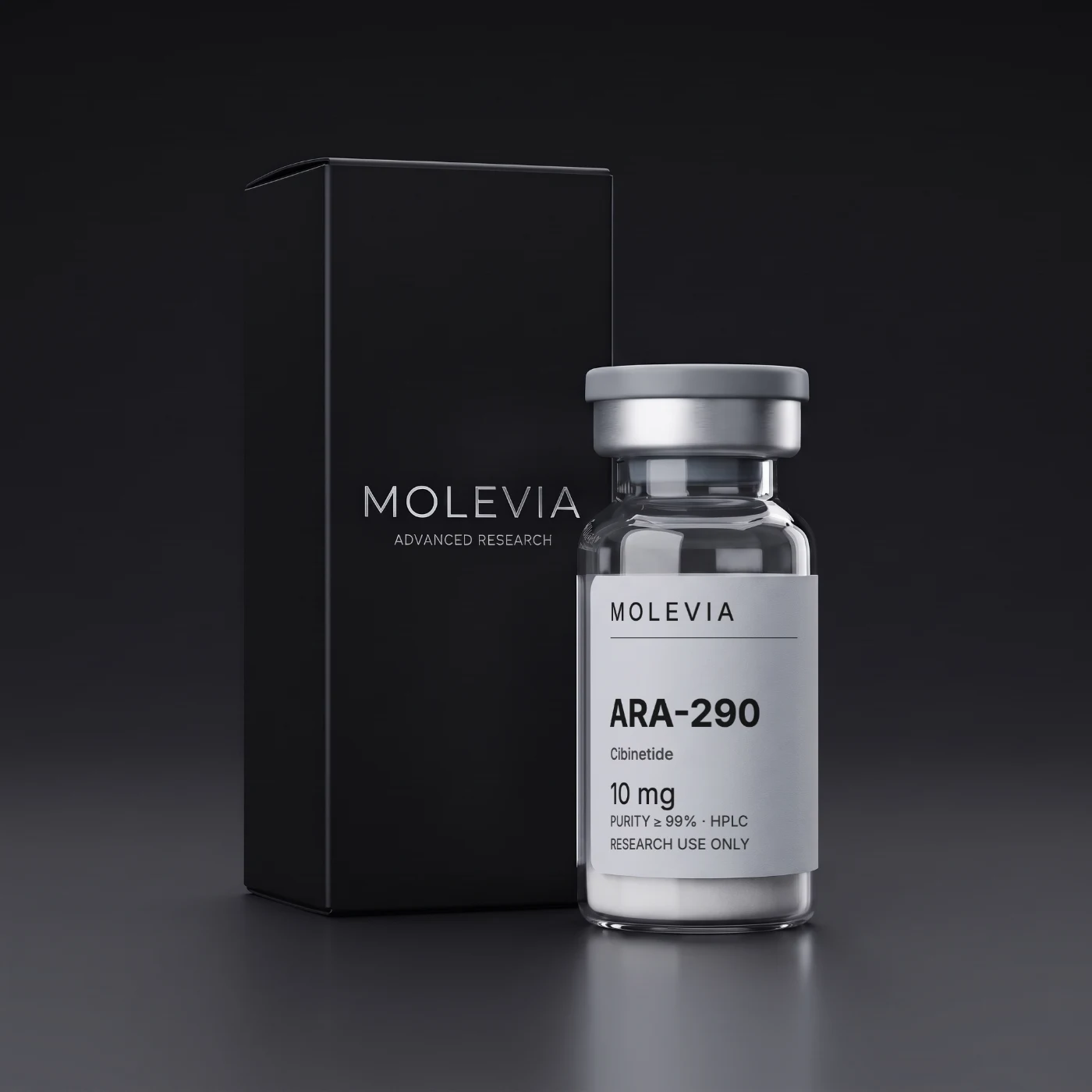
ARA-290 (Cibinetide): research overview
ARA-290, also known as cibinetide, is an 11-amino-acid peptide. It is derived from erythropoietin (EPO), the hormone that drives red blood cell production. A short fragment from the helix B surface of that molecule was isolated and rebuilt as a standalone peptide. As a result, the compound is studied for its tissue-protective activity, without the erythropoietic effect of the parent hormone: it does not stimulate red blood cell production.
Mechanism described in research
Erythropoietin acts through the EPOR receptor, which forms a homodimer and controls erythropoiesis. According to the published literature, ARA-290 engages a different system: the innate repair receptor (IRR), built from EPOR and the CD131 common beta subunit. Signalling through this receptor is studied as a way to limit tissue damage.
In experimental models, ARA-290 was reported to:
- reduce apoptosis, the programmed death of cells
- modulate inflammatory responses
- improve nerve function in neuropathy models
Research areas
- small fibre neuropathy and peripheral nerve injury in animal models
- tissue protection under ischaemia and reperfusion conditions
- inflammatory processes and cell responses in vitro
- tissue repair in injury models
Clinical research and regulatory status
The published literature describes clinical studies of ARA-290, including studies in patients with small fibre neuropathy. The substance is not approved as a medicine. In our store it is offered exclusively as a research reagent.
Characteristics
| Parameter | Value |
|---|---|
| Name | ARA-290 (cibinetide) |
| Form | lyophilized powder |
| Purity | 99%+ (HPLC) |
| Mass | confirmed by MS |
| Available sizes | 10 mg, 16 mg |
| Category | tissue research |
| Intended use | Research Use Only |
Working in the laboratory
Storage
| State | Temperature | Notes |
|---|---|---|
| Lyophilized powder | -20 °C | protect from light and moisture |
| After reconstitution | 2-8 °C | avoid repeated freezing |
Solvents
- Bacteriostatic water is the standard solvent for reconstitution. Its preservative slows microbial growth when samples are drawn repeatedly from one vial.
- Acetic acid, in dilute form, is used when the peptide dissolves less readily in water. The choice of solvent always follows the study protocol.
The concentration calculator helps convert vial contents into working concentrations.
Batch quality
Every batch undergoes HPLC analysis, which confirms purity of at least 99%. Molecular mass is verified by mass spectrometry (MS). A full description of our quality control is available on the quality page.
Ordering
- quantity discounts applied automatically: 2 pcs -5%, 3 pcs -10%, 5 pcs -15%
- free delivery from 75 EUR, 65 GBP, 80 USD
- 10 ml bacteriostatic water free with orders of 50 EUR (40 GBP, 55 USD) or more that include a peptide vial
- Pay online by card, Apple Pay, Google Pay or BLIK (PLN only).
Related products
- BPC-157, a pentadecapeptide often studied alongside other tissue peptides
- TB-500, a peptide studied in tissue repair models
- Thymosin alpha-1, an immunomodulatory peptide
All reagents in this group are listed in the tissue research category.


