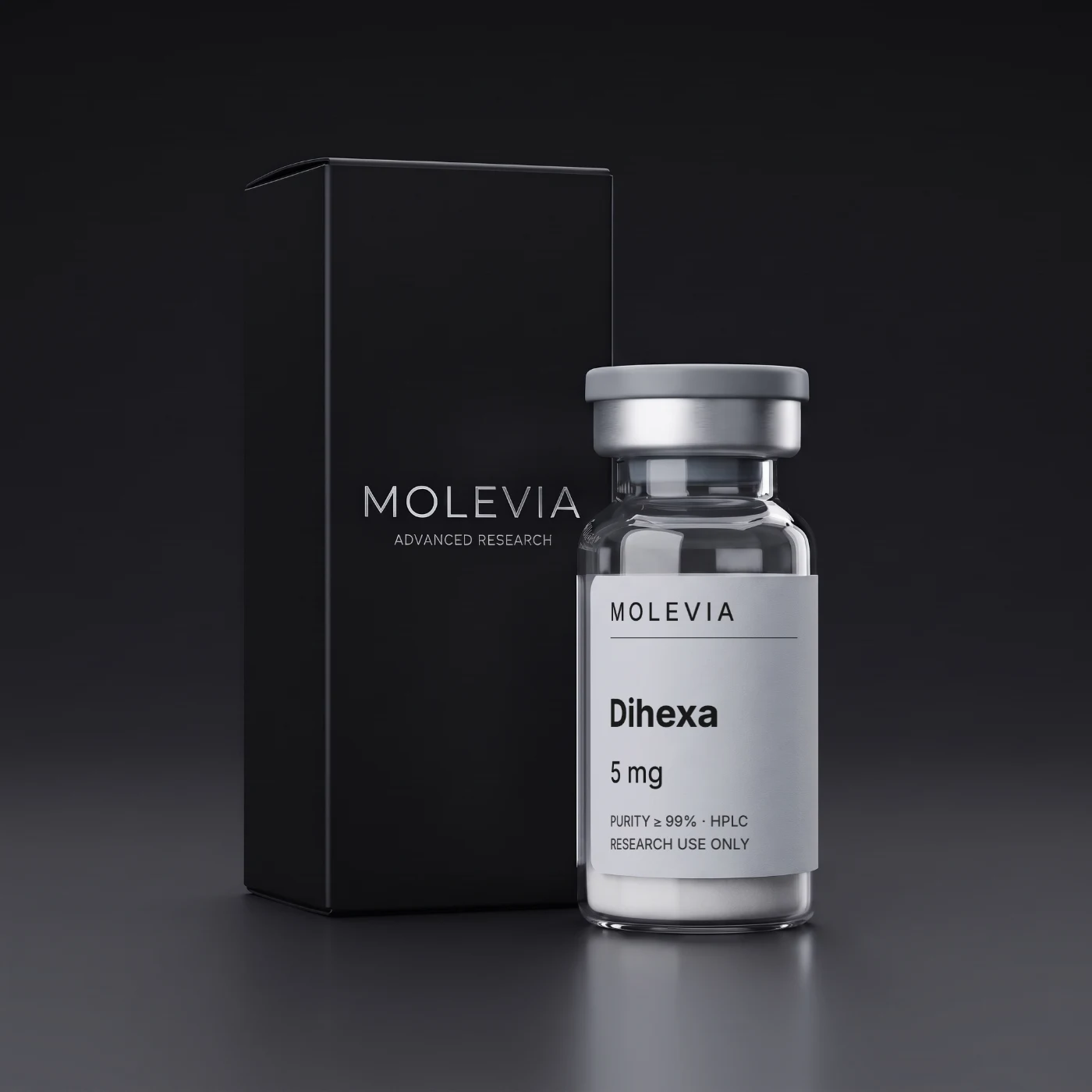
Dihexa: research overview
What is Dihexa
Dihexa is a synthetic oligopeptide and a derivative of angiotensin IV. It was developed in research on analogues of this peptide fragment. The molecule combines tyrosine and isoleucine residues, with a hexanoyl chain on the N-terminal end and a 6-aminohexanoic amide on the C-terminal end. This construction gives a compound with the formula C27H44N4O5 and a molecular mass of 504.7 g/mol, and both values are confirmed analytically for every batch.
For research teams, a well-defined molecule makes the work easier to plan and repeat. Knowing the exact mass lets you convert the weight of lyophilized material into molar concentration, which is the foundation of any experimental design. We supply Dihexa as a lyophilized powder that you prepare in the laboratory according to a controlled, repeatable scheme. Recording the batch number, the date of reconstitution and the storage conditions from the start will make later analysis much simpler.
Mechanism described in research
The mechanism most often described for Dihexa involves hepatocyte growth factor (HGF) and its receptor, c-Met. In vitro studies reported that Dihexa potentiates HGF/c-Met signalling, a pathway involved in cell survival, growth and the formation of connections between cells. In neuronal cultures, this activity was linked to the formation of synaptic contacts.
In rodent models, researchers examined the effect of Dihexa on memory and learning, using standard behavioural tests. Most of this data comes from preclinical work, so treat it as a starting point for your own controlled experiments rather than a settled answer.
Research areas
- Synaptic plasticity in neuronal cultures
- HGF/c-Met signalling in cell-based studies
- Memory and learning in animal models
- Regeneration of neural connections in injury models
- The angiotensin system in neuropharmacological research
Product specifications
| Parameter | Value |
|---|---|
| Name | Dihexa |
| CAS number | 1401708-83-5 |
| Formula | C27H44N4O5 |
| Molecular mass | 504.7 g/mol |
| Form | lyophilized powder |
| Purity | ≥ 99% (HPLC) |
| Available sizes | 5 mg, 10 mg |
Working in the laboratory
Storage
- Lyophilized powder: keep at -20 °C, tightly sealed, protected from light and moisture.
- Before opening: let the vial reach room temperature so that water does not condense on the powder.
- After reconstitution: store the solution at 2-8 °C.
- Freezing: avoid repeated freezing and thawing, and divide the solution into smaller aliquots.
Solvent
Bacteriostatic water is the standard solvent for working with lyophilized peptides and you can find it in our shop. Dilute acetic acid is used as an auxiliary solvent when a peptide dissolves poorly in water alone. Choose the solvent according to your research protocol.
Batch quality
Every batch of Dihexa is analysed by HPLC, which confirms purity of ≥ 99%. Mass spectrometry (MS) confirms the molecular mass of 504.7 g/mol. With a high purity profile, by-products from synthesis make up only a small share of the material, which makes your results easier to reproduce. You can read more about our procedures on the quality page.
Related products
See also PE-22-28, Selank and Semax. Browse the full neuropeptides category for more options. A concentration calculator helps you prepare solutions with the right molar concentration.


