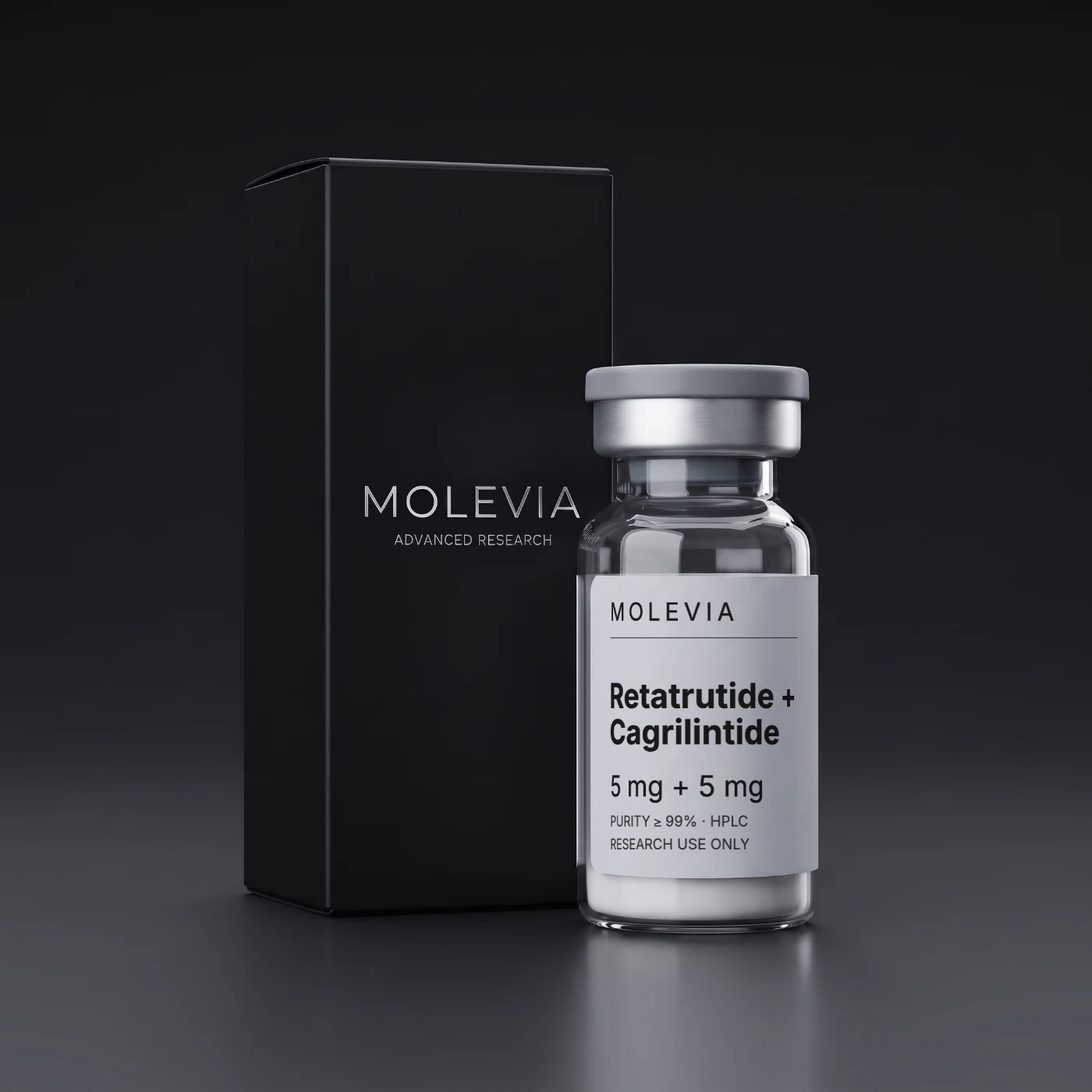
Retatrutide + Cagrilintide: research overview
What is retatrutide + cagrilintide
Retatrutide and cagrilintide are two peptides combined in one vial as a blend for scientific research. Each component has its own molecular structure and its own role in research, and using them together in models lets you observe activity across several signalling pathways at once.
Retatrutide is a synthetic peptide from the incretin analogue group. Cagrilintide is an amylin analogue modified by the attachment of a fatty acid chain. Both compounds have been the subject of clinical research, which makes the literature on them broad and well documented.
Mechanism described in research
Retatrutide acts on three receptors: GIP, GLP-1 and glucagon. In in vitro work and animal models, researchers described how this combined activation affects insulin signalling, glucose homeostasis and energy metabolism. Body weight and appetite were also examined in models.
Cagrilintide binds to amylin receptors. Amylin interacts with gut hormones and with the centres that regulate satiety, which is why its analogues appear in many studies of metabolic regulation. Most of the literature describes each component separately, so the blend is a good starting point for your own comparative experiments.
Research areas
- Signalling of GIP, GLP-1 and glucagon receptors in in vitro models
- Effects of amylin and its analogues on satiety regulation in animal models
- Glucose homeostasis and insulin handling in preclinical studies
- Body weight and energy metabolism in experimental models
- Comparison of combined analogues with single peptides
Reagent specifications
| Parameter | Value |
|---|---|
| Name | Retatrutide + cagrilintide (blend) |
| Components | retatrutide, cagrilintide |
| Retatrutide, CAS | 2381089-83-2 |
| Retatrutide, formula | C221H342N46O68 |
| Retatrutide, mass | 4731.3 g/mol |
| Category | Incretin analogues |
| Form | lyophilised powder |
| Purity | ≥ 99% (HPLC) |
| Available sizes | 5 mg + 5 mg, 10 mg + 10 mg |
Laboratory handling
Storage and reconstitution
- Lyophilised powder: store at -20 °C, tightly sealed and protected from light.
- After reconstitution: keep the solution at 2-8 °C.
- Freezing: avoid repeated freezing and thawing, and divide the solution into smaller portions.
- Before opening: let the vial reach room temperature to limit moisture condensation.
The role of the solvent
The solvent in laboratory work is sterile bacteriostatic water. It carries the lyophilised powder into solution, and its bacteriostatic component limits microbial growth when samples are drawn from the vial many times. Label the solution with the reconstitution date and the batch number to keep your research log clear.
Batch quality
- HPLC: separates the sample components and confirms purity of 99% or higher.
- MS: confirms the molecular mass of both components in the blend.
Every batch has its own number, so the data always refers to the reagent you are working with.
Ordering and delivery
- Volume discount applied automatically: 2 pcs -5%, 3 pcs -10%, 5 pcs -15%.
- 10 ml bacteriostatic water free with orders from 50 EUR (40 GBP, 55 USD) that include a peptide vial.
- Free shipping from 75 EUR, 65 GBP, 80 USD. We ship to 29 European countries.
- Pay online by card, Apple Pay, Google Pay or BLIK (PLN only).
Related products
- Retatrutide: an incretin analogue acting on GIP, GLP-1 and glucagon receptors.
- Tirzepatide: an incretin analogue with a related receptor profile.
- Cagrilintide: the amylin analogue, the second component of this blend.
Browse the full range in the incretin analogues category. Before you start work, check batch quality and use the concentration calculator.


