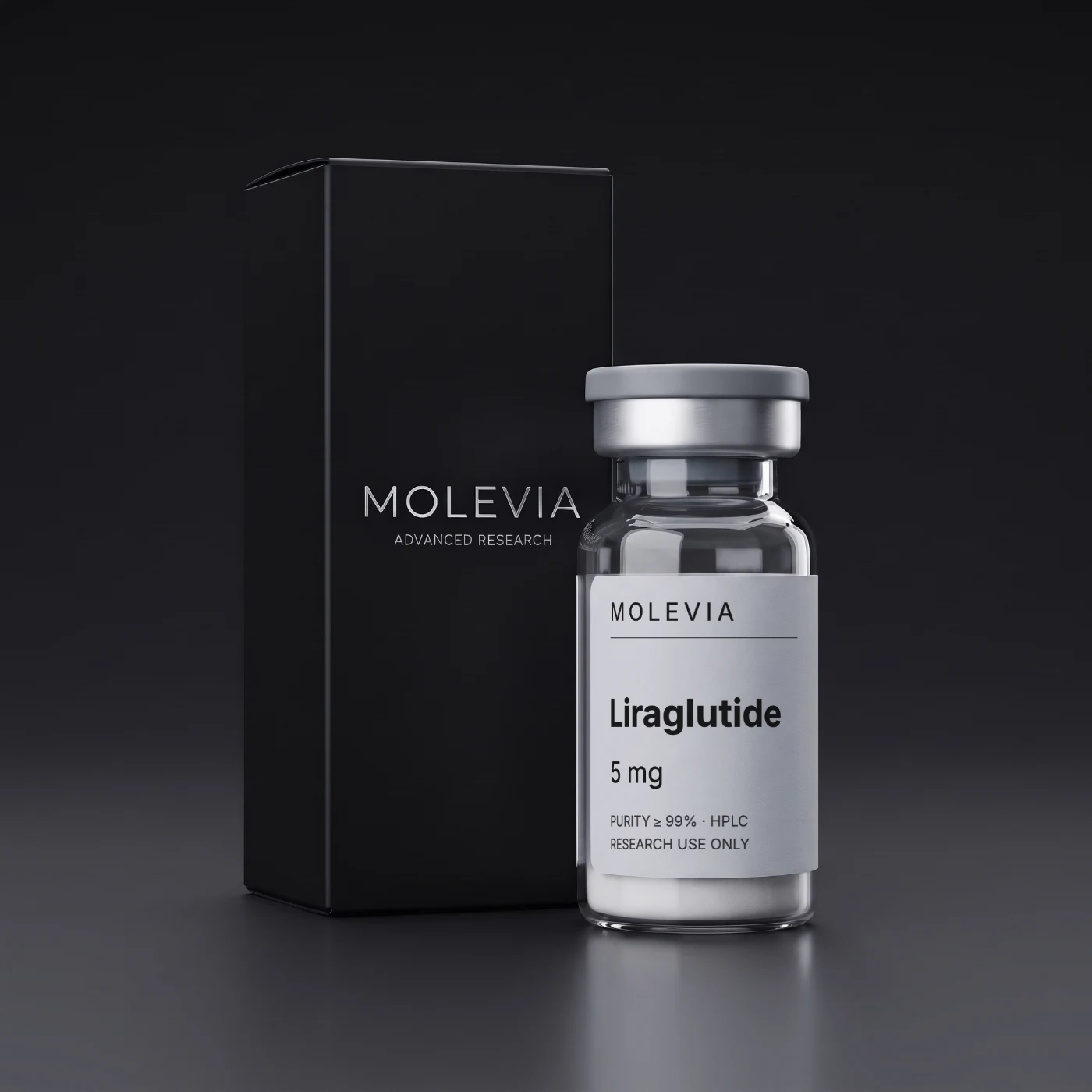
Liraglutide: research overview
What liraglutide is
Liraglutide is an analogue of human GLP-1, the incretin hormone released in the gut after a meal. The molecule was engineered from the GLP-1 sequence, and a palmitic acid (C16) chain was attached to it. This modification is the structural feature most often described for liraglutide in the literature.
Liraglutide is the active substance of registered medicines, and its effects have been studied in clinical trials. For research teams, this means a well documented reference compound with a clearly defined structure.
Mechanism described in research
Liraglutide acts as a GLP-1 receptor agonist. After binding the receptor, it triggers intracellular signalling, which in in vitro studies has been linked to glucose-dependent insulin secretion. Animal models have described effects on glucose homeostasis and body mass, and clinical studies have reported similar metabolic effects.
The fatty acid chain allows binding to plasma albumin. The literature points to this binding as a factor that affects how long the molecule remains in circulation. The phenomenon is studied in preclinical models, which makes it possible to compare the liraglutide profile with other incretin peptides.
Research areas
- GLP-1 receptor signalling in cell cultures
- Glucose-dependent insulin secretion in in vitro models
- Glucose homeostasis in animal models
- Regulation of body mass in studies on animal models
- Comparative studies of GLP-1 and other incretin analogues
Reagent specification
| Parameter | Value |
|---|---|
| Name | Liraglutide |
| CAS number | 204656-20-2 |
| Formula | C172H265N43O51 |
| Mass | 3751.2 g/mol |
| Form | lyophilised powder |
| Purity | ≥ 99% (HPLC) |
| Available sizes | 5 mg, 10 mg, 30 mg |
Working in the laboratory
Storage and reconstitution
- Lyophilised powder: store at -20 °C, tightly sealed and protected from light.
- Before opening: let the vial reach room temperature to limit moisture condensation.
- After dissolving: keep the solution at 2-8 °C.
- Freezing: avoid repeated freezing and thawing, and divide the solution into smaller portions.
Dissolving in the laboratory
Reconstitution is carried out with a sterile solvent under laboratory conditions. Bacteriostatic water, which we add free of charge to orders that include a peptide vial, contains a preservative that limits microbial growth in a vial opened many times.
Batch quality
- HPLC: confirms purity of 99% or higher.
- MS: confirms the molecular mass of 3751.2 g/mol.
HPLC separates the components of a sample and shows the share of the main peak, which is the basis of the purity result. Mass spectrometry confirms that the mass of the molecule matches its theoretical value. Each batch has its own batch number, so the data always refers to the reagent you are working with.
Ordering and delivery
- Dispatch: orders placed by 2 pm on working days ship the same day.
- Poland: InPost parcel locker, delivery on the next working day.
- Europe: DPD, 2-4 working days, shipping to 29 countries.
- Free shipping: from 75 EUR, 65 GBP, 80 USD.
- Volume discount: 2 pcs 5% off, 3 pcs 10% off, 5 pcs 15% off, applied automatically.
- Free gift: 10 ml bacteriostatic water with orders from 50 EUR (40 GBP, 55 USD) that include a peptide vial.
- Pay online by card, Apple Pay, Google Pay or BLIK (PLN only).
Related products
- Semaglutide: another GLP-1 analogue in our research range.
- Tirzepatide: a GIP and GLP-1 receptor agonist used in comparative studies.
- Retatrutide: a triple agonist of the GIP, GLP-1 and glucagon receptors in metabolic research.
Also browse the incretin analogues category, reagent quality and the concentration calculator, which works out the concentration of your solution after reconstitution.


