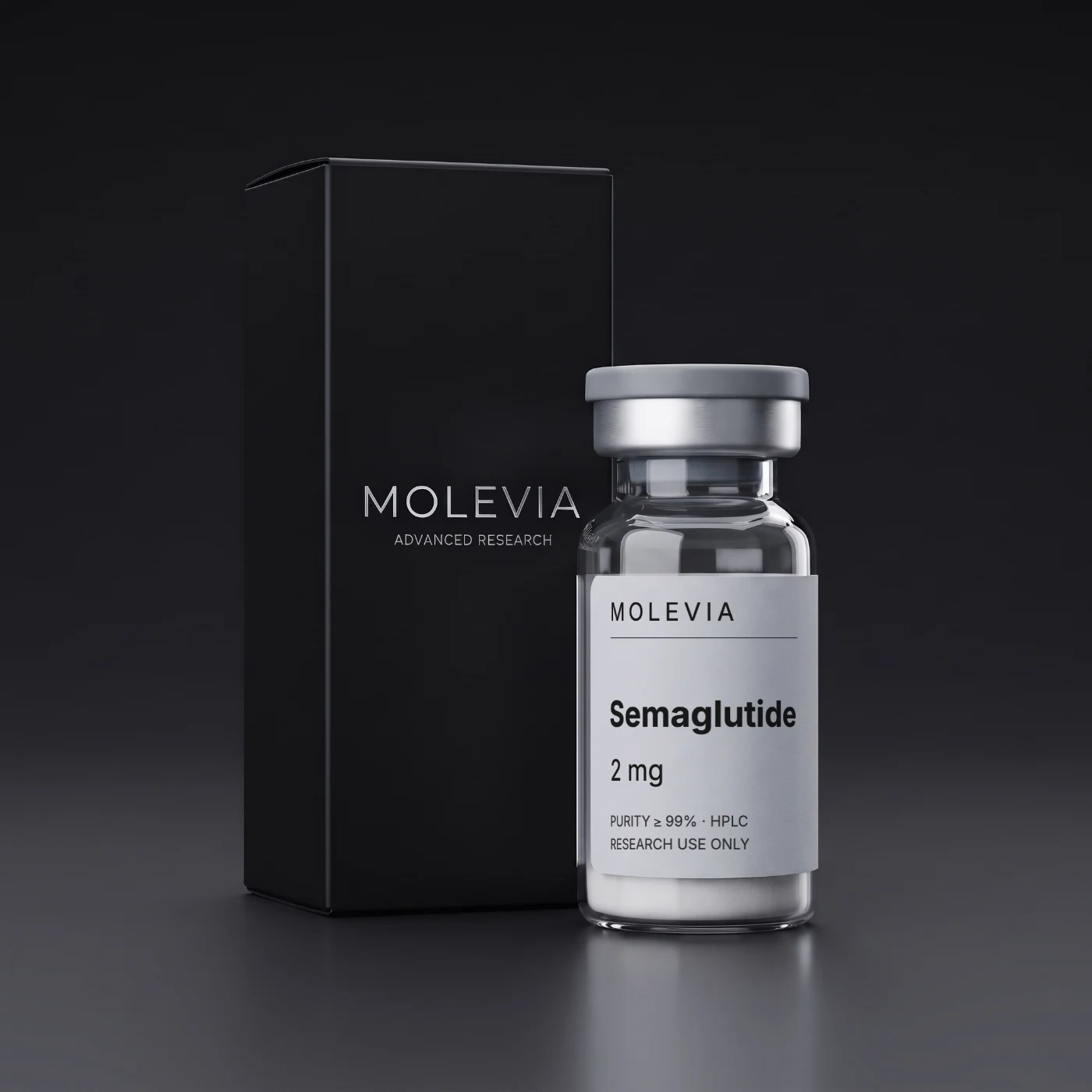
Semaglutide: research overview
What is semaglutide
Semaglutide is a peptide from the GLP-1 analogue family. Its backbone resembles glucagon-like peptide 1, the natural incretin hormone released in the gut, but the molecule has been modified to be more stable in solution. The key feature is a fatty acid chain attached to the peptide. It allows the compound to bind albumin, which extends its half-life in experimental models.
Semaglutide is one of the best-described compounds in its class. Scientific literature documents clinical trials and the registration of the substance as the active ingredient of approved medicines. For research teams, this means a broad base of published data against which they can benchmark their own results.
Mechanism described in research
Semaglutide acts as an agonist of the GLP-1 receptor, a G protein-coupled receptor found in the pancreas, the brain and the gastrointestinal tract. In vitro studies describe activation of the receptor and the downstream signalling that leads to insulin secretion in islet cell cultures.
Animal models have examined the effects of the compound on glucose homeostasis and body mass. The full signalling path, from ligand binding at the receptor to the cellular response, is the core of laboratory work with this reagent.
Research areas
- GLP-1 receptor signalling in cell models
- Glucose homeostasis in animal studies
- Body mass and appetite in experimental models
- Pharmacokinetics of long-acting incretin analogues
- Albumin binding and stability of the molecule in solution
Reagent specifications
| Parameter | Value |
|---|---|
| Name | Semaglutide |
| CAS number | 910463-68-2 |
| Formula | C187H291N45O59 |
| Molar mass | 4113.6 g/mol |
| Form | lyophilized powder |
| Purity | ≥ 99% (HPLC) |
| Mass confirmation | MS |
| Available sizes | 2 mg, 5 mg, 10 mg, 15 mg, 20 mg, 30 mg, 40 mg, 50 mg |
| Intended use | research use only (RUO) |
Working in the laboratory
Storage
- Lyophilized powder: store at -20 °C, tightly sealed and protected from light.
- Before opening: let the vial reach room temperature to limit moisture condensation.
- After reconstitution: keep the solution at 2-8 °C.
- Freezing: avoid repeated freezing and thawing, and divide the solution into smaller portions.
Solvent
Bacteriostatic or sterile water is the primary solvent. The choice of solvent and the further preparation of the solution follow your research protocol, so plan them before you open the vial. Orders of 50 EUR (40 GBP, 55 USD) or more that include a peptide vial receive 10 ml of bacteriostatic water free of charge.
Batch quality
Every batch undergoes HPLC analysis, which confirms purity of at least 99%, and MS analysis, which confirms the molecular mass. The batch number printed on the vial identifies the exact material you are ordering.
Delivery and payments
| Area | What we offer |
|---|---|
| Dispatch | orders placed by 2 p.m. on a business day ship the same day |
| Poland | InPost Parcel Locker, next business day |
| Europe | DPD, 2-4 business days, 29 countries |
| Free shipping | from 75 EUR, 65 GBP, 80 USD |
| Volume discount | 2 pcs 5%, 3 pcs 10%, 5 pcs 15%, applied automatically |
| Payments | Card, Apple Pay, Google Pay, BLIK (PLN only) |
Related products
- Retatrutide, an agonist of the GLP-1, GIP and glucagon receptors in metabolic research
- Tirzepatide, a dual agonist of the GIP and GLP-1 receptors
- Cagrilintide with semaglutide, a blend for research into combined signalling
Browse the full incretin analogues category. Read about our quality control and use the concentration calculator to plan your preparations.


