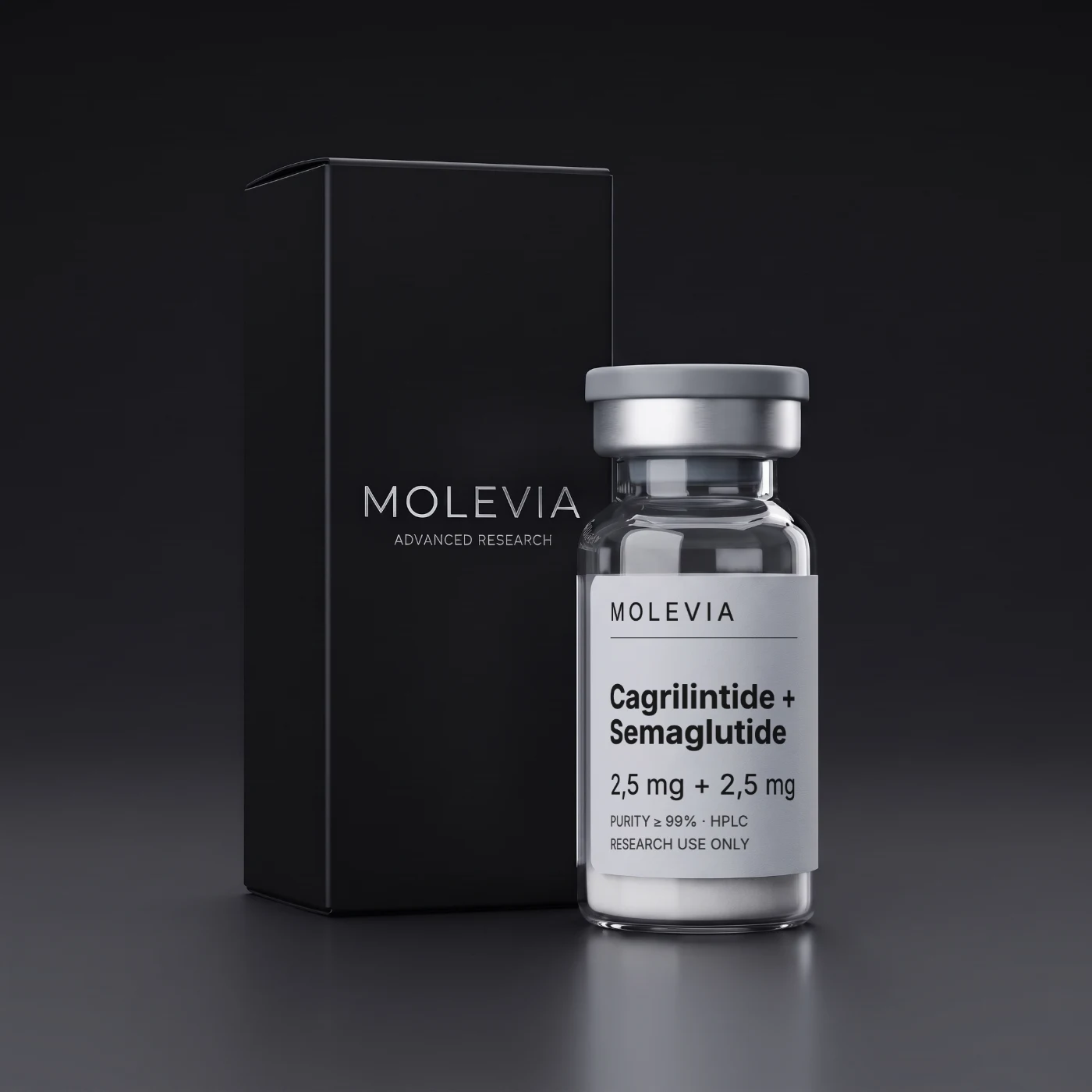
Cagrilintide + Semaglutide: research overview
What is cagrilintide with semaglutide
Cagrilintide with semaglutide is a blend of two peptides sealed in a single vial. Cagrilintide is a long-acting amylin analogue, while semaglutide is a GLP-1 analogue with a fatty acid chain that binds albumin, which extends how long the molecule remains active in models. The combination matches the clinically studied pairing known as CagriSema.
The reagent is supplied as a lyophilised powder in three sizes, always at a 1:1 ratio of the two components. Every batch goes through the same analytical checks, so results from one batch to the next are easy to compare.
Mechanism described in research
Cagrilintide acts on amylin and calcitonin receptors, while semaglutide acts on the GLP-1 receptor. Animal model studies have described how signalling through both receptors affects gastric emptying, insulin and glucagon secretion, and glucose homeostasis. Models have also described effects on satiety signals in the central nervous system.
Clinical studies have described the effects of this combination on body weight and glycaemic parameters. These findings come from the published literature, and the reagent is intended solely for research work, with the literature serving as a starting point for your own experiments.
Areas of research
- GLP-1, amylin and calcitonin receptor signalling in in vitro models
- Glucose homeostasis and insulin secretion in animal models
- Gastric emptying and satiety signalling in neurophysiological studies
- Body mass and energy metabolism in preclinical models
- Comparative studies of incretin analogues at the receptor level
Reagent specification
| Parameter | Value |
|---|---|
| Name | Cagrilintide + semaglutide |
| Composition | cagrilintide and semaglutide in one vial, 1:1 ratio |
| Category | incretin analogues |
| Form | lyophilised powder |
| Purity | ≥ 99% (HPLC) |
| Available sizes | 2.5 + 2.5 mg, 5 + 5 mg, 10 + 10 mg |
Working in the laboratory
Powder and solution
- Lyophilised powder: store at -20 °C, tightly sealed and protected from light.
- After reconstitution: keep the solution at 2-8 °C.
- Freezing: avoid repeated freezing and thawing, and divide the solution into smaller portions.
- Before opening: let the vial reach room temperature.
The role of the solvent
Sterile bacteriostatic water or water with acetic acid is used for reconstitution. Bacteriostatic water contains a preservative that limits microbial growth when the vial is opened many times. Aqueous acetic acid is an alternative solvent, and the choice always follows your study plan. You can browse the full range of lab accessories in the laboratory supplies category.
Batch quality
- HPLC: confirms purity of 99% or higher.
- MS: confirms the masses of the blend components.
HPLC separates the components of a sample and shows the share of the main peak, which is the basis of the purity result. Mass spectrometry confirms that the component masses match the specification. Every batch has its own number, so the data always refers to the reagent you are working with.
Volume discounts and bonuses
Buy 2 vials and get 5% off, 3 vials for 10% off, and 5 vials for 15% off. The discount is applied automatically in the cart. Orders from 50 EUR (40 GBP, 55 USD) that include a peptide vial also receive a 10 ml bacteriostatic water vial free of charge.
Related products
- Semaglutide: a long-acting GLP-1 analogue and the second component of this blend.
- Cagrilintide: the amylin analogue, the first component of this blend.
- Retatrutide + cagrilintide: a pairing of cagrilintide with another incretin-class analogue.
The incretin analogues category collects the other compounds in this group. You can also check reagent quality and the concentration calculator, which calculates the solution concentration after reconstitution.


