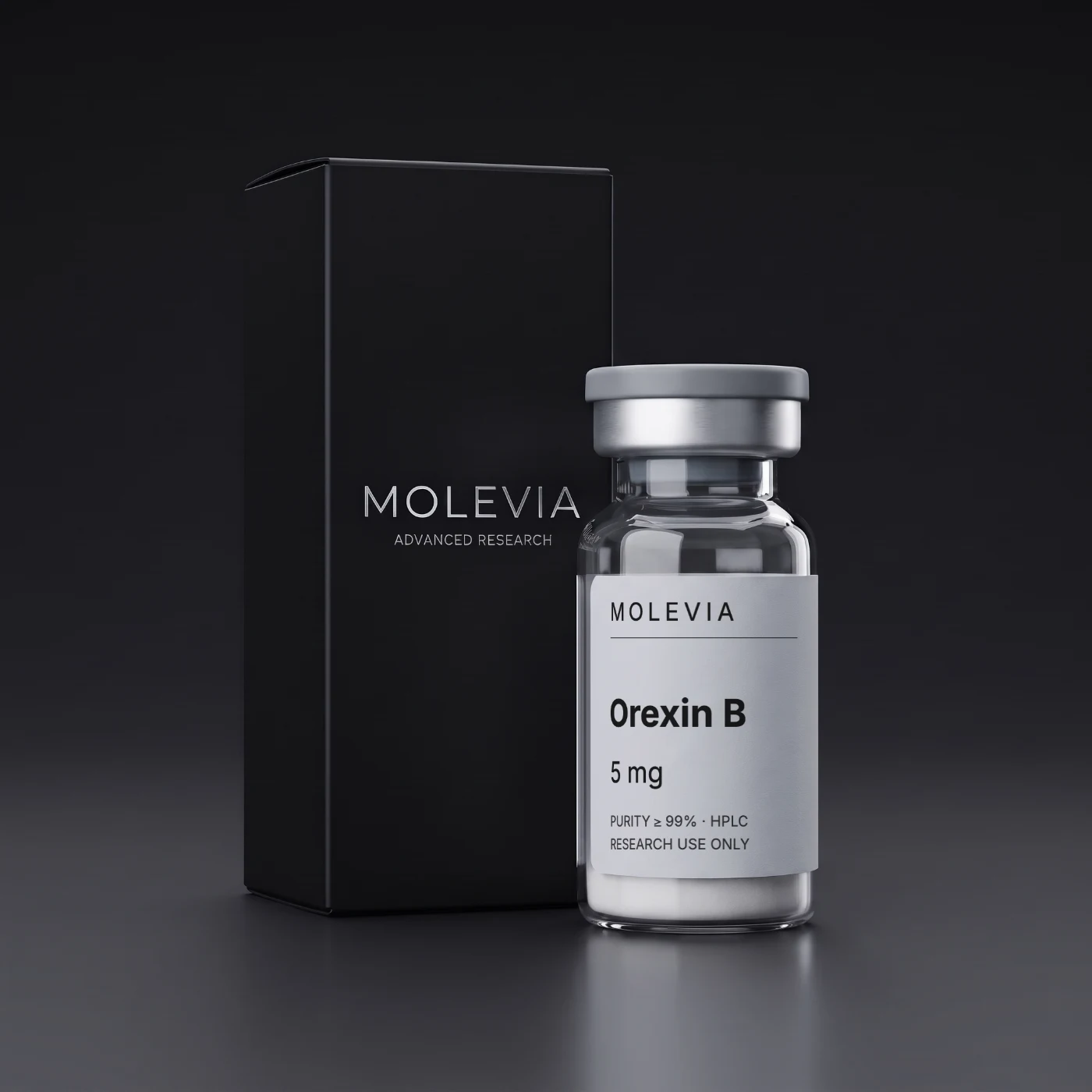
Orexin B: research overview
What is Orexin B
Orexin B, also known as hypocretin-2, is a neuropeptide produced in the hypothalamus. Its chain contains 28 amino acids. It derives from the same precursor as orexin A, a longer peptide of 33 amino acids. Together the two form the orexin system, one of the most intensively studied signalling systems in the brain.
We supply Orexin B as a lyophilised powder, a dry preparation that you reconstitute in the laboratory to the volume your experiment needs. Each batch is checked analytically, so you can confirm its composition and purity on paper before the material reaches your bench.
Mechanism described in research
Studies describe Orexin B as binding preferentially to the OX2 receptor, with lower affinity for the OX1 receptor. Both receptors belong to the G protein-coupled receptor family. Once the peptide binds, a signalling cascade starts that changes neuronal activity and the response of the cell.
In animal models, the orexin system has been linked to the regulation of sleep and wakefulness, to appetite and to the response to stress. Results depend on the model, the concentration and the exposure time, so treat them as a starting point for your own project rather than a conclusion.
Research areas
- Regulation of sleep and wakefulness in animal models
- Orexin signalling in cell cultures
- Binding to OX1 and OX2 receptors in in vitro assays
- Appetite and energy balance in model studies
- Stress response and neuronal activity in experimental work
Product specifications
| Parameter | Value |
|---|---|
| Name | Orexin B (hypocretin-2) |
| Amino acids | 28 |
| Form | lyophilised powder |
| Purity | ≥ 99% (HPLC) |
| Available sizes | 5 mg, 10 mg |
Working in the laboratory
Storage and reconstitution
- Keep the lyophilised powder at -20 °C, tightly sealed and protected from light.
- Before opening the vial, let it reach room temperature so that moisture does not condense inside.
- After reconstitution, keep the solution at 2-8 °C.
- Avoid repeated freezing and thawing. Divide the solution into working aliquots.
The role of the solvent
Reconstitute the powder in bacteriostatic water or, where your protocol requires it, in water with a small addition of acetic acid. Water is the main solvent. Acetic acid is an auxiliary solvent, used only when the procedure calls for it. Define the exact steps in your own laboratory.
Batch quality
- Purity ≥ 99% confirmed by HPLC
- Molecular mass confirmed by MS
More detail is on our quality page.
Related products
- Orexin A, the second member of the orexin system, useful for comparative studies
- Selank, a heptapeptide studied in neurobiological models
- Semax, a neuropeptide used in research on signalling in the nervous system
Browse all neuropeptides and use the concentration calculator to plan your dilutions before a series of experiments.


