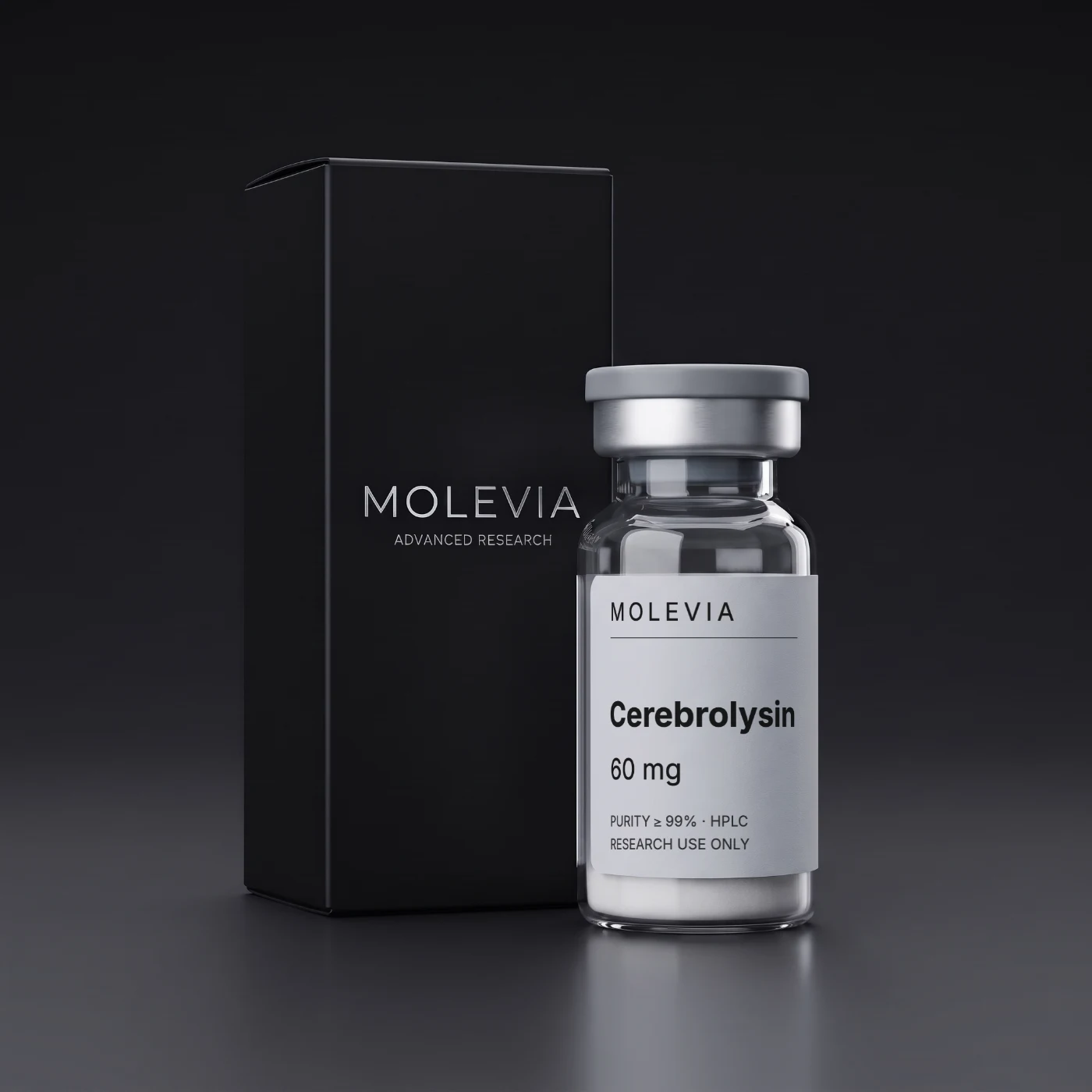
Cerebrolysin: research overview
What is Cerebrolysin
Cerebrolysin is a mixture of low molecular weight peptides and amino acids obtained from porcine brain tissue. It is produced through a hydrolysis process that breaks down the proteins of nerve tissue into shorter fragments. As a result, a single vial contains a broad set of molecules rather than one compound with a single sequence.
This makes Cerebrolysin different from synthetic peptides such as Semax or Selank. Instead of one amino acid sequence, the material is defined by a profile of components, which research teams analyse as a whole. For neuroscience laboratories this is a practical difference, because the result of an experiment refers to the whole preparation.
Mechanism described in research
In vitro studies have reported that Cerebrolysin supports neuronal survival in cell cultures and promotes the growth of neurites. Authors of these papers linked the effects to influence on neurotrophic factors, including BDNF, and to pathways connected with synaptic plasticity.
Animal models have described protection of nerve tissue under conditions of ischaemia and injury, as well as effects on learning processes. The preparation has been the subject of clinical studies reported in the literature, and in selected countries it is registered as a medicine. At MOLEVIA we supply it strictly as a research reagent, and we treat data from the literature as a starting point for your own controlled experiments.
Research areas
- Neuroprotection in models of cerebral ischaemia
- Neuronal survival and neurite growth in in vitro cultures
- Neurotrophic factors, including BDNF
- Synaptic plasticity and learning processes in animal models
- Models of nerve tissue injury
Reagent profile
| Parameter | Value |
|---|---|
| Name | Cerebrolysin |
| Category | Neuropeptides |
| Origin | porcine brain tissue, hydrolysis |
| Form | lyophilized powder |
| Purity | ≥ 99% (HPLC) |
| Confirmation | mass spectrometry (MS) |
| Available size | 60 mg |
Working in the laboratory
Storing the lyophilized powder
- Temperature: store at -20 °C.
- Packaging: keep the vial tightly closed and protected from light.
- Opening: let the vial reach room temperature before opening to limit moisture condensation.
Dissolving and handling the solution
- Water: is the basic solvent in laboratory work. Orders from 50 EUR (40 GBP, 55 USD) that include a peptide vial also receive 10 ml of bacteriostatic water free of charge.
- Acetic acid: used as a solvent when the protocol requires an acidic environment.
- Storing the solution: at 2-8 °C. Avoid repeated freezing and thawing by dividing the solution into working aliquots.
- Record keeping: note the batch number, the date of preparation and the storage conditions.
Batch quality
Every batch undergoes HPLC testing, which confirms purity of ≥ 99%. Mass spectrometry (MS) confirms that the composition matches the product description. You can read more about our quality control on the Quality page.
Order from MOLEVIA
- Same-day dispatch for orders placed by 14:00 on business days
- InPost parcel locker in Poland on the next business day
- DPD across Europe in 2-4 business days
- Free delivery from 80 USD
- Quantity discounts: 2 vials save 5%, 3 vials save 10%, 5 vials save 15%
- Pay online by card, Apple Pay, Google Pay or BLIK (PLN only).
Related products
- Semax, a neuropeptide from the same research category
- Selank, another peptide from the neuropeptide group
- PE-22-28, a reagent for research into the nervous system
Browse all products in the Neuropeptides category. You can convert solution strengths with the concentration calculator.


