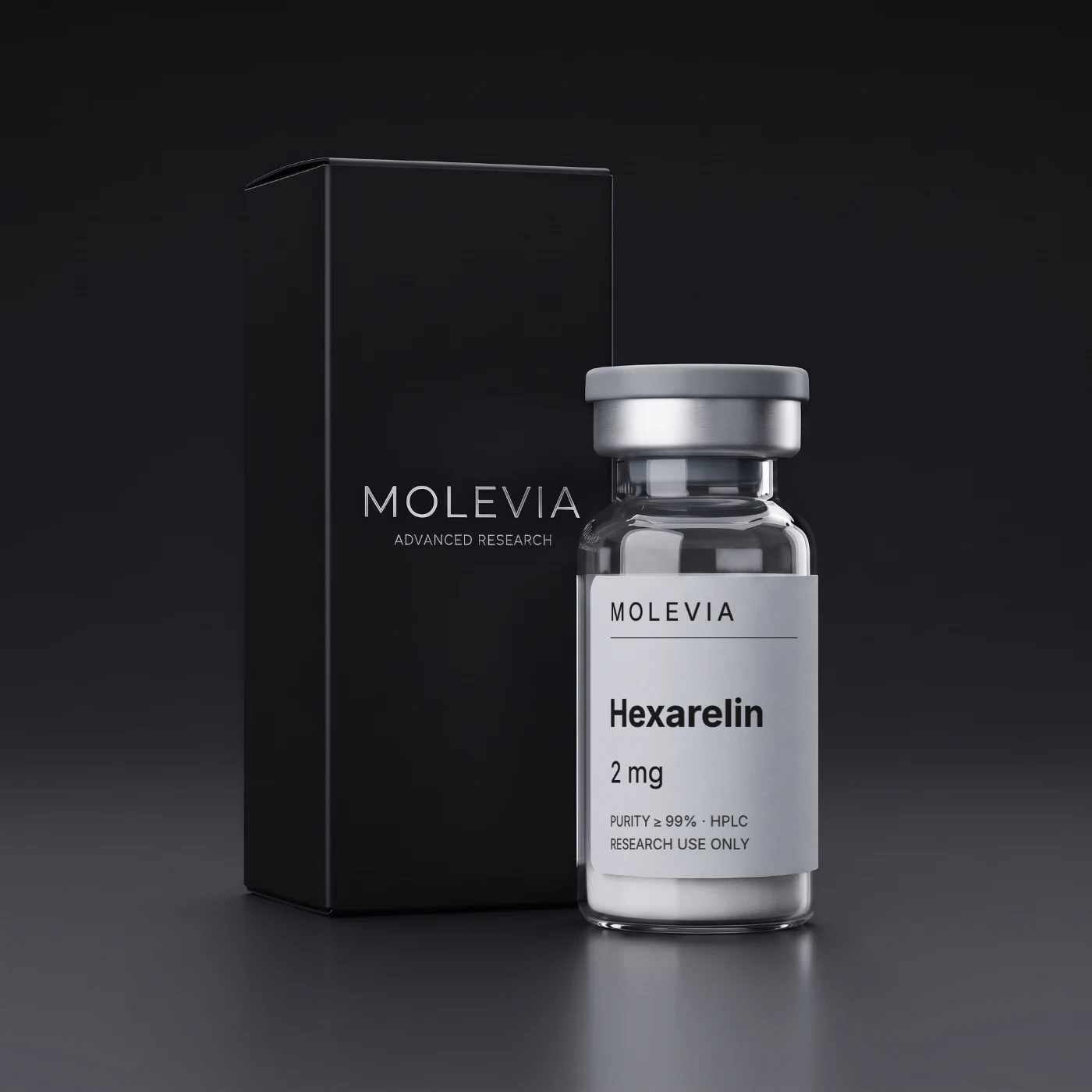
Hexarelin: research overview
What is hexarelin
Hexarelin is a synthetic hexapeptide, a compound built from six amino acid residues. It belongs to the family of growth hormone releasing peptides (GHRPs), alongside compounds such as GHRP-2 and GHRP-6. It is not extracted from tissue. It is produced in a controlled chemical process, so every batch has a predictable composition.
Hexarelin has been studied in clinical trials of growth hormone release, which gives the literature a solid body of data on its properties. For a laboratory, that means a well-described reference point when you plan experiments.
Molecular structure
Hexarelin has the molecular formula C47H58N12O6 and a molecular mass of 887 g/mol. Its chain contains D-amino acids, which are mirror images of the standard L residues, along with a modified tryptophan. These features shape the three-dimensional form of the molecule and how it interacts with its receptor.
Knowing the mass and formula lets you convert the weight of the lyophilized powder into a molar concentration, which is the basis of reproducible measurements.
Mechanism described in research
Hexarelin acts as an agonist of the GHS-R1a receptor, the receptor for growth hormone secretagogues. This receptor is found in the pituitary gland and in peripheral tissues. In vitro studies have described the stimulation of pituitary cells to release growth hormone (GH). Animal models have shown effects on the GH axis, and the literature also describes activity at the CD36 receptor in cardiac models.
Results from one experimental system do not automatically transfer to other models, so a research design should include proper controls, a clearly defined concentration and defined conditions.
Research areas
- Regulation of growth hormone release in in vitro models
- Signalling through the GHS-R1a receptor
- Cardiac biology and the CD36 receptor in heart models
- Neuroendocrinology and the GH/IGF-1 axis
- Comparative studies of growth hormone secretagogues
Product specifications
| Parameter | Value |
|---|---|
| Name | Hexarelin |
| CAS number | 140703-51-1 |
| Molecular formula | C47H58N12O6 |
| Molecular mass | 887 g/mol |
| Form | lyophilized powder |
| Purity | 99% or higher (HPLC) |
| Available sizes | 2 mg, 5 mg |
Working in the laboratory
Storage
Keep the lyophilized vial at -20 °C, away from moisture and light. Before opening, let the vial reach room temperature to limit condensation of moisture onto the powder.
Once dissolved, store the solution at 2-8 °C and use it according to your experimental plan. Avoid repeated freezing and thawing, because repeated temperature changes degrade the sample.
Reconstitution and solvent
Water is the typical solvent in laboratory work. For samples that dissolve poorly, dilute acetic acid can be used to help dissolve the peptide before it is further diluted in water or a buffer. Your research protocol determines the choice of solvent and the volume.
For orders from 50 EUR (40 GBP, 55 USD) that include a peptide vial, we add 10 ml of bacteriostatic water free of charge, so the solvent is ready on your bench.
Batch quality: HPLC and MS
Every batch is analysed by HPLC, which confirms purity of 99% or higher. Mass spectrometry (MS) confirms the molecular mass of 887 g/mol, which matches the expected molecule. Each batch is identified by its batch number, so you can link the data in your own research log to a specific delivery.
Related products
- Ipamorelin, a peptide from the same growth hormone secretagogue family
- GHRP-6, a classic member of the GHRP group
- GHRP-2, an analogue with a similar research profile
Browse the full range in the GH axis category. Read about batch testing on our quality page, and convert solution concentrations with the concentration calculator.


