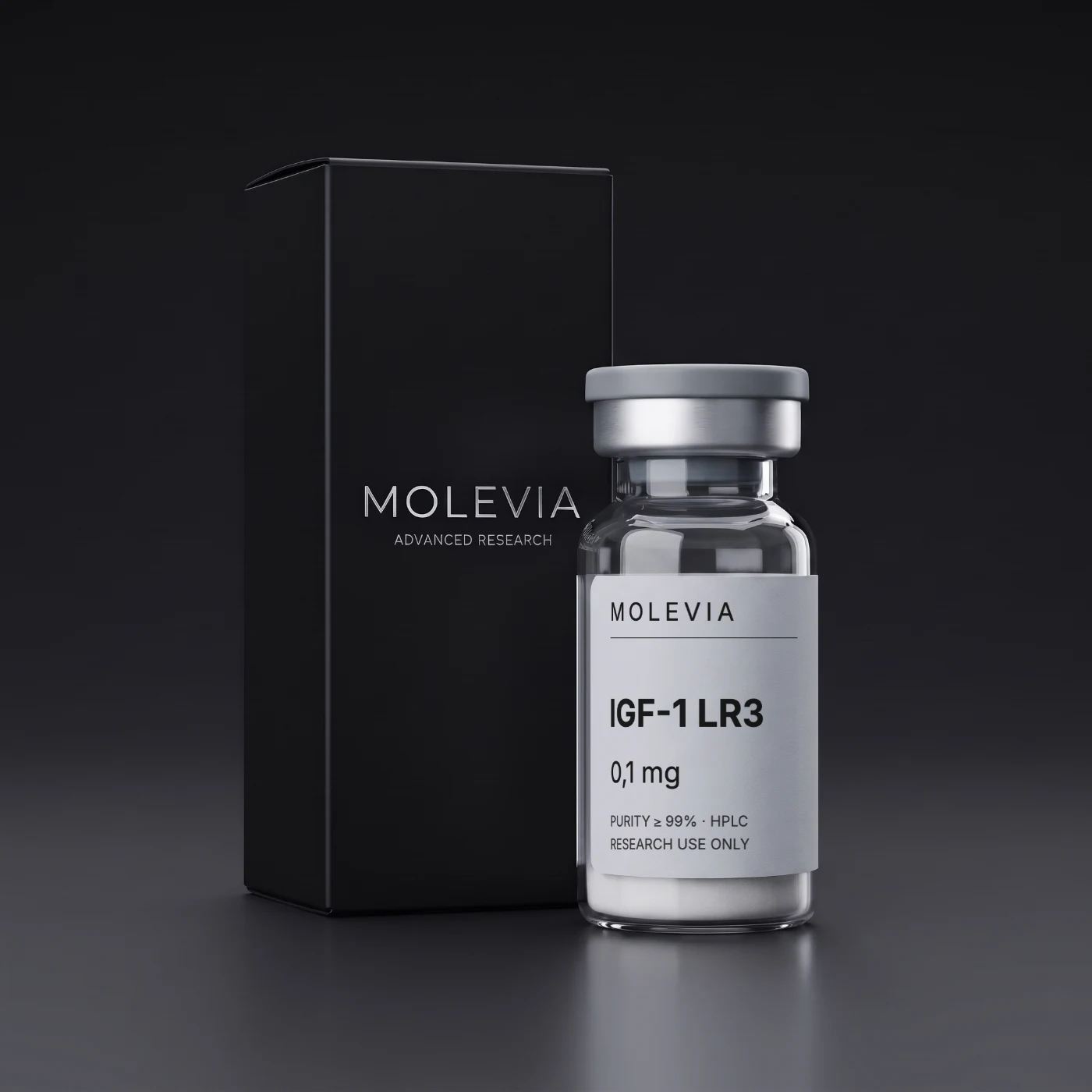
IGF-1 LR3: research overview
What is IGF-1 LR3
IGF-1 LR3 is a synthetic analogue of insulin-like growth factor 1 (IGF-1), a protein that serves as the main mediator of growth hormone action in the body. The molecule is 83 amino acids long and was created by modifying the natural structure of IGF-1.
The LR3 name points to two changes: a long (Long) N-terminal extension of 13 residues and an arginine substitution at position 3 (R3). These modifications set IGF-1 LR3 apart from the parent peptide and shape how it behaves in research systems.
The analogue is widely used in cell culture, where it lets researchers study precisely how growth factors act on cells.
Mechanism described in research
IGF-1 LR3 binds the IGF-1 receptor (IGF-1R), which activates the PI3K/Akt and MAPK/ERK signalling pathways. These pathways regulate cell proliferation, differentiation and survival, which is why they are a core focus of research into tissue growth.
The most important difference from natural IGF-1 concerns IGF-binding proteins (IGFBPs). The analogue binds them more weakly, so a larger share of the molecules stays available to the receptor. In in vitro systems this produces a clear cellular response at a known substance concentration.
Results from one model do not transfer automatically to another, so a research design should include proper controls, defined concentrations and exposure times.
Research areas
- Cell cultures: proliferation and differentiation
- In vitro myogenesis models, where myoblasts differentiate into muscle cells
- Chondrogenesis and chondrocyte cultures
- Cell biology under varying concentrations of growth factors
- Animal models of growth and tissue regeneration
Product specifications
| Parameter | Value |
|---|---|
| Name | IGF-1 LR3 |
| CAS number | 946870-92-4 |
| Chain length | 83 amino acids |
| Form | lyophilized powder |
| Purity | 99% or higher (HPLC) |
| Available sizes | 0.1 mg, 1 mg |
| Category | GH axis |
Working in the laboratory
Storage and reconstitution
Keep the lyophilized vial at -20 °C, away from moisture and light. Before opening, let the vial reach room temperature so that moisture does not condense on the substance.
After reconstitution, store the solution at 2-8 °C and use it within the timeline of your experiment. Avoid repeated freezing and thawing, because temperature cycling degrades the sample over time.
Solvent
Laboratories typically use water or bacteriostatic water. Bacteriostatic water contains a preservative that inhibits microbial growth, which makes it practical when a solution is divided into several portions from one vial. The choice of solvent and volume always follows the research protocol.
Batch quality: HPLC and MS
Every batch is analysed by HPLC, which confirms purity of 99% or higher. Mass spectrometry (MS) confirms the molecular mass. The batch number ties the measured results to a specific delivery.
You can read more about the methods and how we verify them on our quality page.
Ordering and delivery
| Destination | Carrier | Time |
|---|---|---|
| Poland | InPost Parcel Locker | next business day |
| Europe, 29 European countries | DPD | 2-4 business days |
Orders placed by 14:00 on a business day ship the same day. Delivery is free from 75 EUR, 65 GBP or 80 USD.
| Quantity per order | Discount |
|---|---|
| 2 pcs | 5% |
| 3 pcs | 10% |
| 5 pcs | 15% |
The quantity discount is applied automatically in the cart. Orders of 50 EUR (40 GBP, 55 USD) or more that include a peptide vial receive 10 ml of bacteriostatic water free of charge.
See also
- Ipamorelin: a secretagogue from the same research axis
- Sermorelin: a GHRH analogue used in GH axis research
- Tesamorelin: a GHRH analogue used in GH axis research
- GH axis category: other products in this group
- Concentration calculator: convert vial weight into solution concentration


