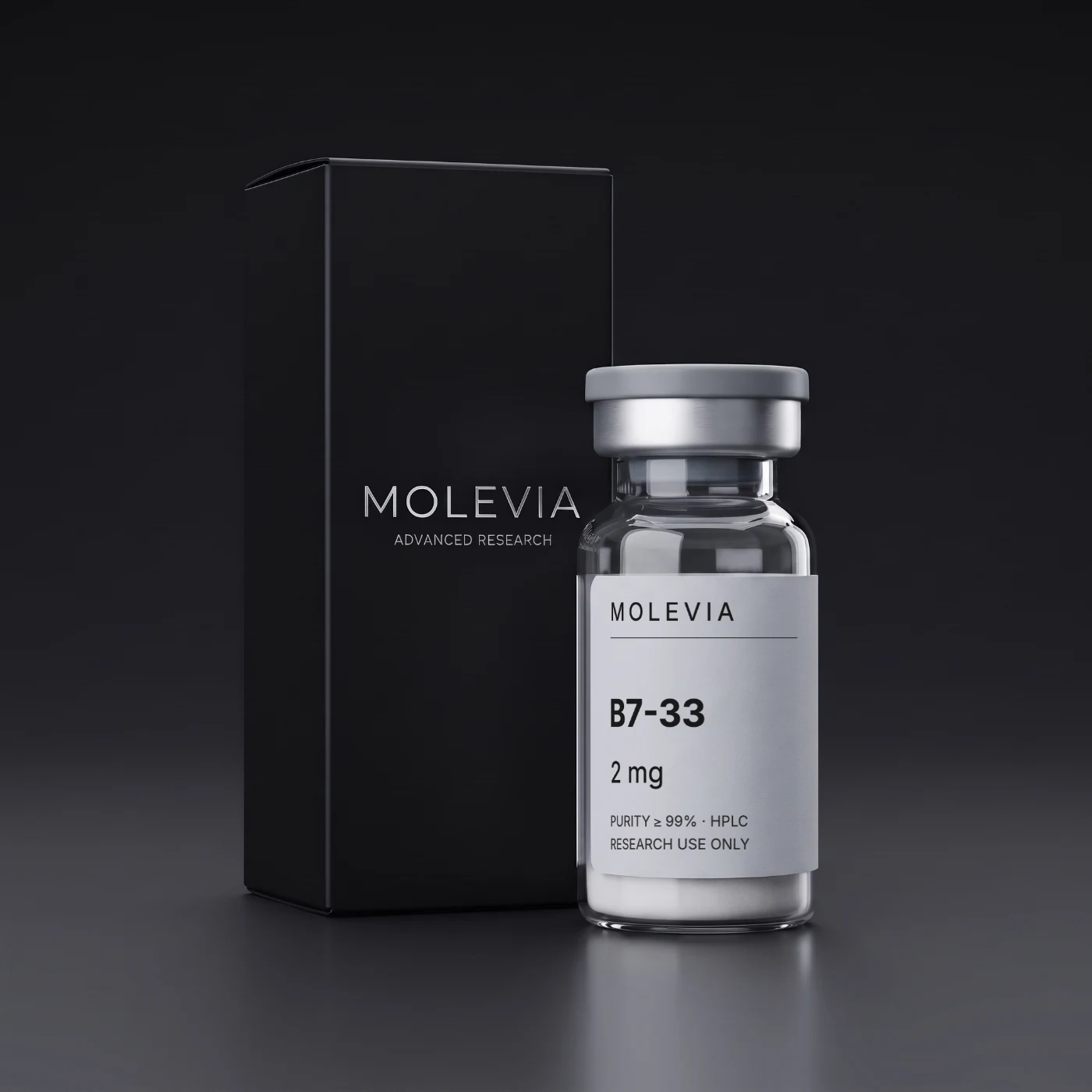
B7-33: research overview
B7-33 is a single-chain relaxin-2 analogue, a research reagent available at MOLEVIA in 2 mg and 10 mg vials. Every lyophilised batch has HPLC purity of 99% or higher, mass confirmed by MS, so you know exactly what you are working with from the first vial.
What is B7-33
B7-33 is a synthetic peptide designed from relaxin-2 (H2 relaxin), a peptide hormone from the insulin-like family. The molecule is a single-chain version of relaxin-2, which simplifies its structure and focuses it on one well-described target: the RXFP1 receptor.
That focus makes B7-33 a convenient tool for studies of relaxin signalling in controlled systems. Every batch is the same molecule at the same purity, which makes experiments easier to repeat and results from different runs easier to compare.
Mechanism described in research
Relaxin-2 acts through the RXFP1 receptor, which belongs to the family of G protein-coupled receptors. B7-33 binds this receptor selectively. In vitro studies have described RXFP1 activation as triggering cAMP-dependent pathways and signalling linked to nitric oxide.
In fibrosis models, researchers have examined how this signalling affects fibroblast activity and the deposition of extracellular matrix, in other words the remodelling of connective tissue. This is an area where B7-33 remains a subject of preclinical research.
Natural relaxin-2 and its recombinant form, serelaxin, have been studied in clinical trials, and the literature describes them in the context of acute heart failure. B7-33 itself is not a registered medicine and is intended solely for laboratory research.
Research areas
- RXFP1 receptor signalling in cell models
- tissue fibrosis models in vitro and in animal models
- fibroblast activity and extracellular matrix remodelling
- effects on blood vessels and nitric oxide-dependent pathways
- comparisons with relaxin-2 and serelaxin in controlled systems
Product specifications
| Parameter | Value |
|---|---|
| Name | B7-33 |
| Compound class | single-chain relaxin-2 analogue (H2 relaxin) |
| Research target | RXFP1 receptor |
| Category | tissue research |
| Form | lyophilised powder |
| Purity | ≥ 99% (HPLC) |
| Mass confirmation | MS |
| Available sizes | 2 mg, 10 mg |
| Intended use | research reagent for laboratory use (RUO) |
Working in the laboratory
Storage and reconstitution
- Lyophilised powder: store at -20 °C, tightly sealed and protected from light.
- After reconstitution: keep the solution at 2-8 °C.
- Freezing: avoid repeated freezing and thawing, and divide the solution into smaller portions.
- Before opening: let the vial reach room temperature to limit moisture condensation.
The role of the solvent
Sterile bacteriostatic water is the solvent most often used for reconstitution. It is inert for most protocols, and using the same solvent each time keeps prepared solutions consistent between experiments. Acetic acid is sometimes used as a secondary solvent, depending on the requirements of a specific study. Always follow your laboratory protocol, and check the expiry date and labelling on the vial.
You will find the full range of accessories in the laboratory supplies category.
Batch quality
- HPLC: confirms purity of 99% or higher by showing the share of the main peak after the sample components are separated.
- MS: confirms that the molecular mass matches the expected value for the compound.
Every batch of B7-33 has its own number, so your records always refer to the exact reagent you used. Read more about our quality standards at MOLEVIA.
Related products
- BPC-157: a tissue research peptide, studied in regeneration models.
- TB-500: a second peptide from the same group, often paired in parallel studies.
- ARA-290: a peptide studied in tissue protection models.
Browse every reagent in this group in the tissue research category, and recalculate the concentration of your reconstituted solution in the concentration calculator.


