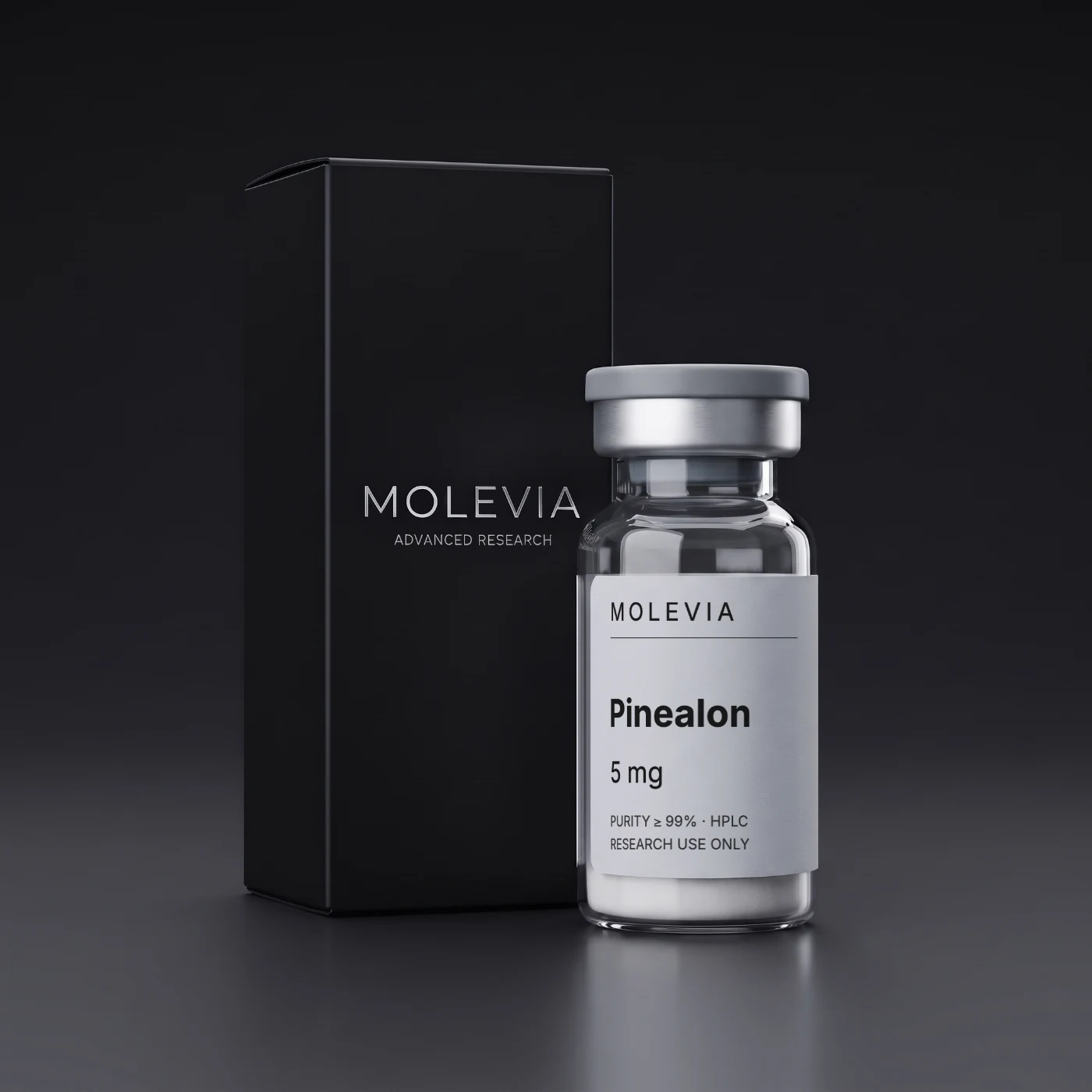
Pinealon: research overview
What is Pinealon
Pinealon is a tripeptide, a short chain of three amino acid residues linked by peptide bonds. Its sequence, Glu-Asp-Arg, combines glutamic acid, aspartic acid and arginine. It belongs to the group of short peptides associated with Khavinson, known as bioregulators, which have been studied for years in the context of nerve cell function.
The compound is chemically synthesized, so its sequence, mass and structure are precisely defined and every batch can be verified analytically. Pinealon is supplied as a reagent for scientific research.
Mechanism described in research
In vitro studies on nerve cell cultures have described the effect of Pinealon on neuron survival under oxidative stress. Animal models have reported changes in the function of the central nervous system.
One working hypothesis proposes that short peptides of this type may interact with selected DNA regions and influence gene expression. This hypothesis needs further study, so each project should rely on its own negative and positive controls.
Research areas
- Neuroprotection in in vitro models and protection of cells against oxidative stress
- Neuronal function in models of ageing and hypoxia
- Gene expression and regulation of cellular activity in molecular research
- Comparisons of short bioregulatory peptides in structure-activity studies
Specification
| Parameter | Value |
|---|---|
| Name | Pinealon |
| Sequence | Glu-Asp-Arg |
| Molecular formula | C15H26N6O8 |
| Molecular mass | 418.4 g/mol |
| Form | lyophilizate |
| Purity | ≥ 99% (HPLC) |
| Available vial sizes | 5 mg, 10 mg, 20 mg |
Laboratory handling
Storage of the lyophilizate
Store unopened vials at -20 °C, tightly closed, away from moisture and light. Before opening, let the vial reach room temperature so that water vapour does not condense on the substance. A dry, sealed lyophilizate keeps its stability far longer than any solution.
Solvents
| Solvent | Role in the laboratory |
|---|---|
| Water (bacteriostatic) | Primary solvent for reconstitution. Add slowly along the wall of the vial, without vigorous shaking. |
| Acetic acid (dilute) | Auxiliary solvent for batches that dissolve poorly in water alone. Peptides containing basic arginine often dissolve better in a slightly acidic medium. |
Working solutions
Store the reconstituted solution at 2-8 °C and use it within the timeframe set by your protocol. Avoid repeated freezing and thawing, so split the solution into working aliquots right after reconstitution. You can convert concentrations in our concentration calculator.
Batch quality
- Purity of 99% or higher confirmed by HPLC
- Molecular mass confirmed by MS analysis
- Results that let you reproduce the verification conditions in your own lab
You can find more on our testing in the quality section.
Related products
- Thymalin as a second bioregulator from the same category, useful for side-by-side comparisons
- Vilon for parallel studies of short peptides
- Cortagen for comparisons across bioregulator research
Browse the full range in the bioregulators category.


