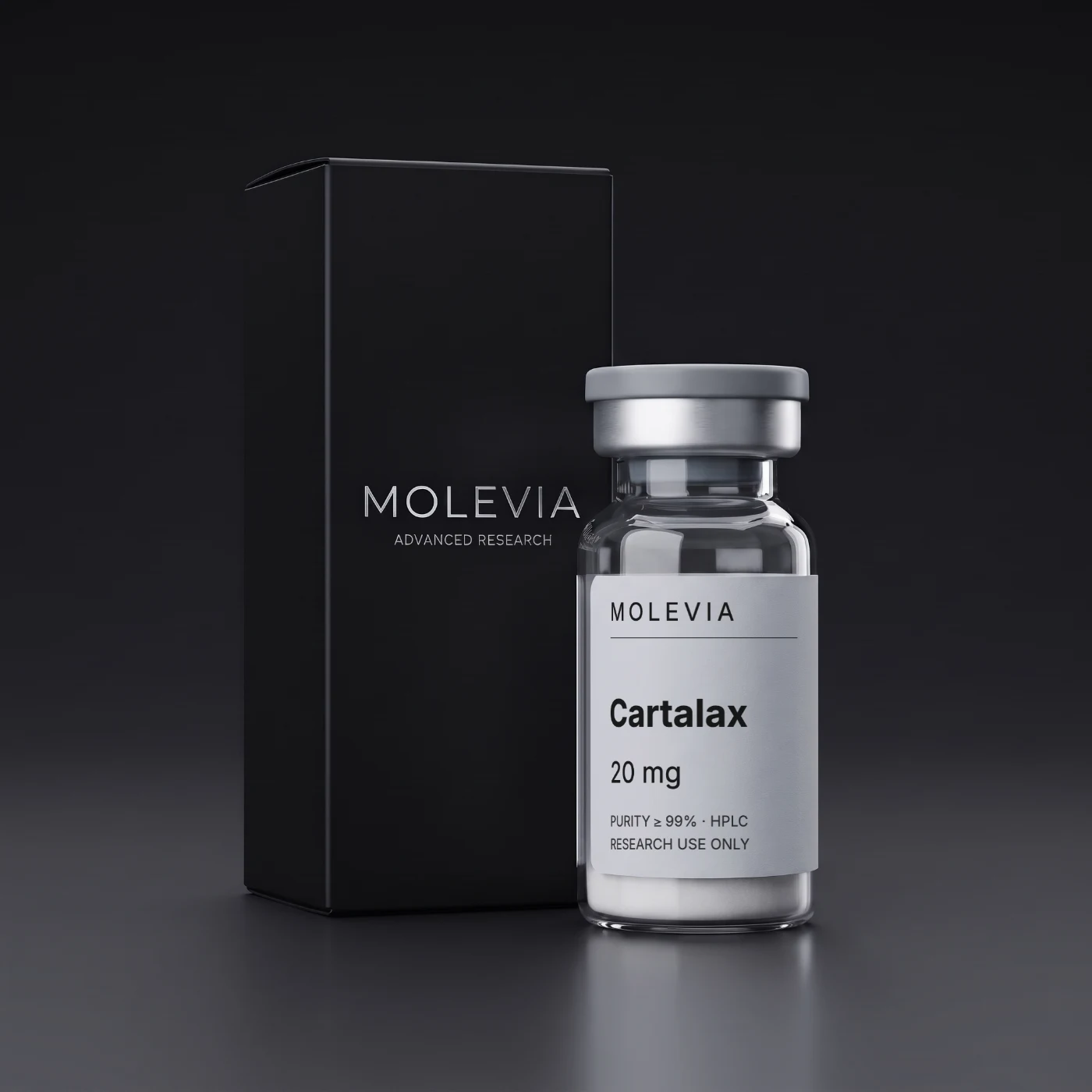
Cartalax: research overview
What Cartalax is
Cartalax is a short peptide from the bioregulator group, a family of molecules described in the literature as factors that regulate the function of cells in a specific tissue. Short peptides are simpler to synthesise than long proteins, and their purity and mass can be checked precisely with HPLC and MS.
Cartalax is intended for research use only and sits in the bioregulators category of our shop.
Mechanism described in research
Tissue bioregulators are described as short peptides that may influence the activity of cells in one particular tissue. In the case of Cartalax, researchers focus on cartilage tissue and on the chondrocytes associated with it.
The literature on this group describes in vitro studies, meaning cell cultures, as well as studies in animal models. The exact pathway of action is the subject of further work, which is why Cartalax serves laboratories that test their own hypotheses in a controlled system.
Research areas
- Chondrocyte cultures and cartilage tissue models in vitro
- Comparisons of tissue bioregulator activity in cell panels
- Studies of processes taking place in cartilage tissue in models
- Analysis of the relationship between peptide concentration and cell response
Product specification
| Parameter | Value |
|---|---|
| Name | Cartalax |
| Category | Bioregulators |
| Form | Lyophilized powder |
| Purity | ≥ 99% (HPLC) |
| Molecular mass | Confirmed by MS |
| Available sizes | 20 mg |
Working in the laboratory
Lyophilized powder
Store the lyophilized powder at -20 °C in a tightly closed vial, away from light. Under these conditions it remains stable until you reconstitute it.
Solution after reconstitution
- Storage temperature: 2-8 °C
- Avoid repeated freezing and thawing
- Gently swirl the vial before withdrawing a sample so the solution is uniform
The role of the solvent
- Bacteriostatic water: contains an agent that limits bacterial growth, which makes it easier to work with a solution used more than once. Orders from 50 EUR (40 GBP, 55 USD) that include a peptide vial come with 10 ml of bacteriostatic water free of charge.
- Acetic acid: in dilution it helps dissolve peptides that dissolve less readily in water.
The choice of solvent always depends on your research protocol.
Quality of every batch
- HPLC: purity measurement, with a result of at least 99%
- MS: confirmation of molecular mass
We describe the standard in detail on our quality page.
Related products
- Thymalin: another bioregulator from the same category
- Pinealon: a tripeptide from the same bioregulator category
- Vilon: a dipeptide from the same research family
See the full list in the bioregulators category. Check our quality standard for every batch and calculate your solution concentration in the concentration calculator.


