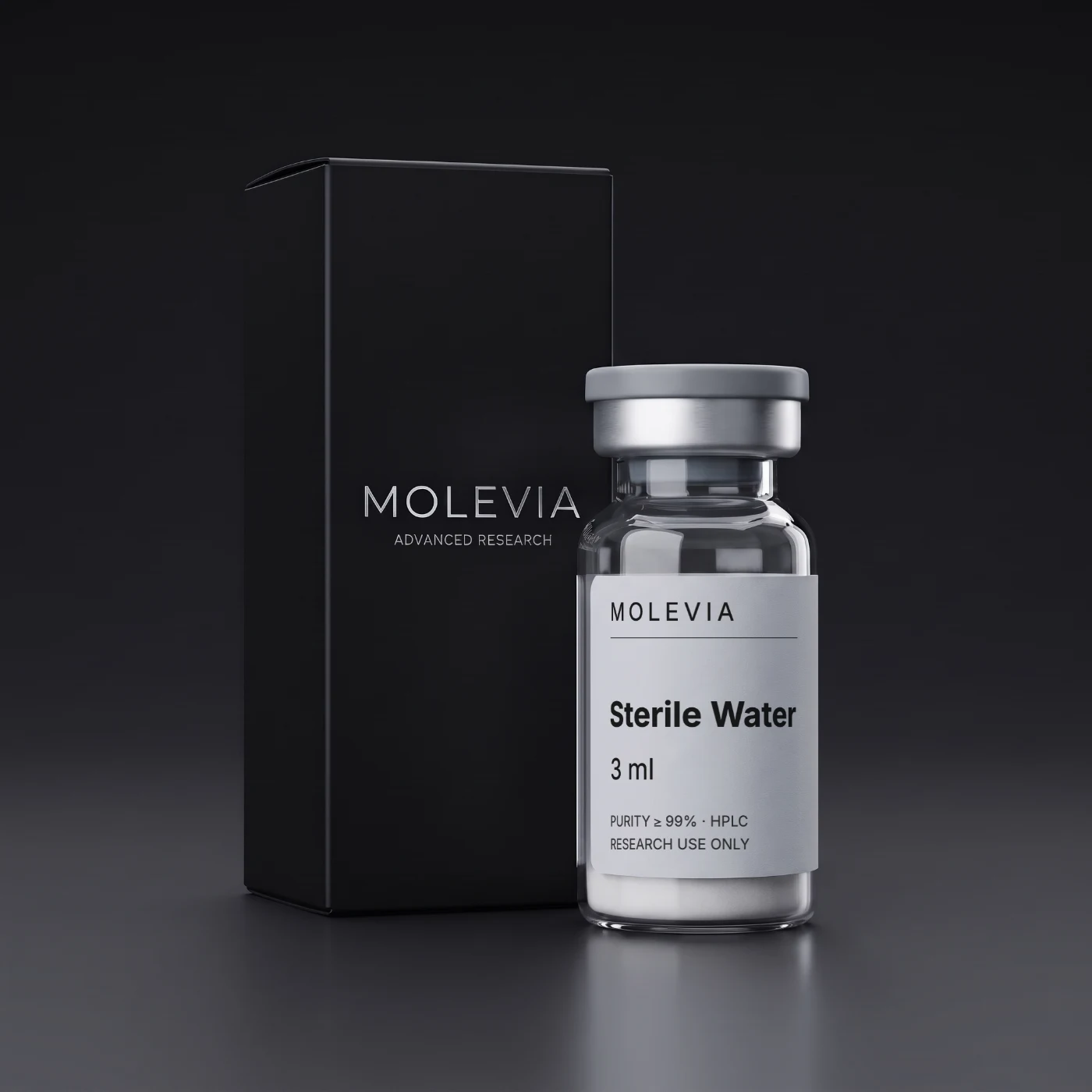
Sterile Water: research overview
Sterile water is an auxiliary reagent used in the laboratory as a solvent for reconstituting lyophilized materials. It contains no preservative, so it is intended for a one-time preparation of a solution for a given experiment. We offer it in 3 ml and 10 ml vials.
What Sterile Water Is
Sterile water is purified water that has been sterilized and contains no chemical additives. Its composition is simple, and its value in research comes from being an inert solvent. The lack of a preservative distinguishes it from bacteriostatic water, which contains benzyl alcohol to limit microbial growth in the solution.
The water molecule is polar. Hydrogen and oxygen atoms form a structure with an uneven charge distribution, which lets water dissolve polar and ionic compounds well. This property is why it is a common starting point when preparing solutions from lyophilized materials.
Mechanism Described in Research
Sterile water does not act on biological systems like an active substance. In research it serves as a carrier in which the studied compound is dissolved. Its value lies in the fact that it adds no extra components to the solution, so the outcome of an experiment depends on the substance itself.
The stability of the finished solution depends on how the lyophilized material and the solution are stored, not on the water. For that reason, attention to tight sealing, temperature, and the number of freeze-thaw cycles matters most at the solution stage.
This product is a reagent for scientific research.
Areas of Research
- reconstitution of lyophilized peptides before analysis
- preparation of working solutions of known composition
- dilution of samples in analytical procedures
- blank controls in experiments that require a clean solvent with no additives
Product Specifications
| Parameter | Value |
|---|---|
| Name | Sterile Water |
| Category | Lab supplies |
| Form | solution, sterile liquid without preservative |
| Available sizes | 3 ml, 10 ml |
| CAS number | 7732-18-5 |
| Formula | H2O |
| Molar mass | 18.02 g/mol |
Working in the Laboratory
Reconstitution and Storage
Reconstitution means dissolving the lyophilized material in a suitable volume of solvent. Sterile water contains no preservative, so prepare the solution for immediate needs rather than for stock.
- Lyophilized material: store at -20 °C, tightly sealed and protected from light.
- Solution after reconstitution: store at 2-8 °C.
- Freezing: avoid repeated freezing and thawing, and divide the solution into smaller portions.
- Sterile water: store sealed at room temperature, away from light.
You can calculate the solvent volume and the resulting concentration in our concentration calculator.
Sterile Water as a Solvent
The choice of solvent depends on the sequence and on the result of dissolution. Sterile water is the starting point for most lyophilized materials. When a lyophilized material dissolves poorly in neutral water, the protocol may call for diluted acetic acid. The 0.6% acetic acid solution is itself prepared in sterile water, so this water remains the base in that case as well.
Choosing the Size
The 3 ml vial suits single reconstitutions. The 10 ml vial is useful when you prepare several working solutions within one series. Choose the size based on the volume your protocol requires.
Batch Quality
For peptides and compounds in our range, purity is at least 99% (HPLC), and we confirm mass by mass spectrometry (MS). You can read about our control principles on the quality page.
Related Products
- Bacteriostatic Water: water with benzyl alcohol as a preservative, for solutions that will be opened many times.
- Acetic Acid 0.6%: acetic acid solution in sterile water for peptides with poor solubility in neutral water.
Browse the full range in the lab supplies category.

